Absence and permanence
The exhibition Temporada, which Manuela Marques is presenting at Appleton Square, is made up of two corpuses of her work. The first takes as a starting point the use of video to create a performative and inter-relational approach in the space. The second corpus, consisting of printed photographs, reveals a web of close connections between painting and cinema.
This brief statement does not aim to establish a hierarchy within the artistʼs work. Firstly, because the media that she uses – photography and video – are designed to seek out diverse relations with the spectator, and secondly, because she takes a remote possibility of objectivizing the real to its limit. Or rather, she triggers a continuous questioning of the conditions of representation. Taking cinema as one of the essential reference points in her working process, the artist constructs each of the images in this exhibition around apparently banal situations and occurrences. It is in the framings that we are confronted with a feeling of unease that comes very close to an ambiguity that deterritorializes any trace or sign of a possible narrative. What is represented is found on a hybrid boundary that approximates to abstraction and asks the spectator to share the impossibility of describing or documenting the event that the image suggests. In all of the photographs in this exhibition there is a melancholic luminosity, like a poetics of absence that takes us an infinite distance away from the action or character while simultaneously keeping us in front of the latter. This (impossible) distancing to which we are subject is intimately linked to a temporal suspension determined by the non-existent narrative information, the lack of context, the incompleteness that treats the real as a field of possibilities of representation to which it is only possible to respond through fictional construction.
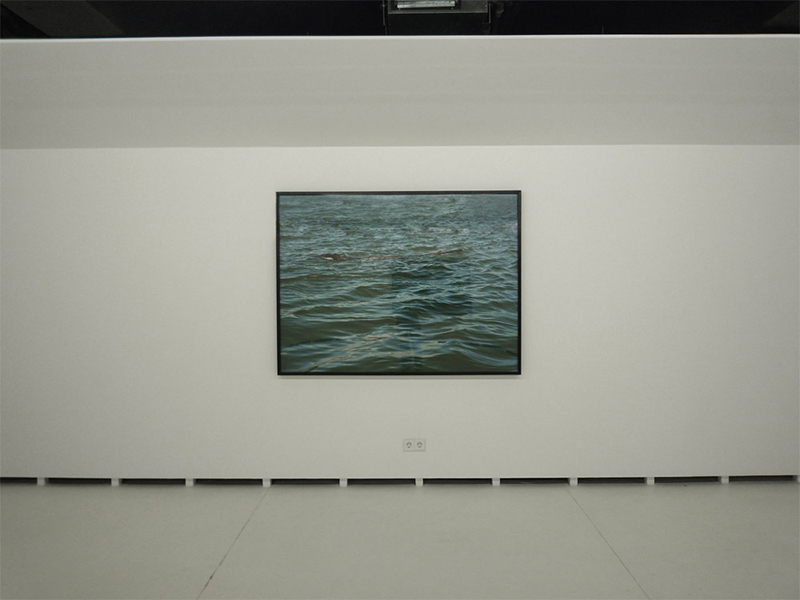
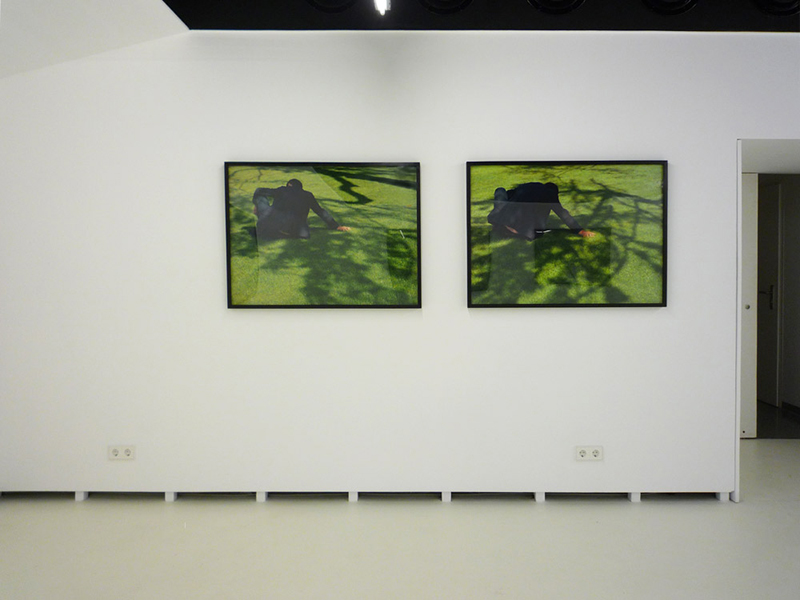
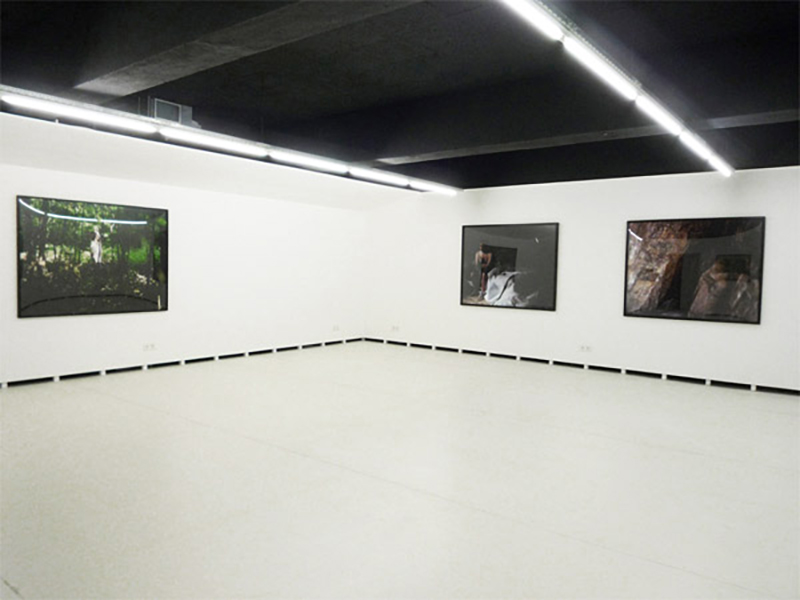
However, this question of territory – as an initial instance of the place and the moment – inscribes in itself a primordial, ontological inaccessibility that is present in a particular figure or element of landscape. As if the nature of these images were about to break up in the impossibility that we feel in establishing a dialogue between what is represented and its meaning. The photographs evoke painting as a referent of the composition, summoning the portrait as a stylistic genre in which the main figure in the image stands out because of its central position in the plane or because of the incidence of the light that leads the gaze to the punctum of the image. One example of this is the naked man sitting on the bed with his eyes closed. Another human figure is photographed in two similar positions, sitting with its back to us against a luminous lawn. A tree branch resists the surface of the water in a river or the sea by the coast. In a forest, an isolated figure emerges. Its silhouette is indeterminate. Almost androgynous.
In fact, in all of the images there is a concentrated gaze on an object, and the portrait as a referent of painting is immediately transformed into something transitory and closer to cinema, revealing a tension between the image and the spectator. Between what is inside the field of the image and everything else, which, being inaccessible is found on the edge of the observer’s imagination and his/her ability to resist the unnameable or unrepresentable. Here, the spectator is the counter-field of the image, the other of the scene in which intimacy and desire are inscribed. As if we were subject to a mediative action in which we are part of the event and we interactively welcome a certain degree of absurdity and alienation in the images that are part of us.
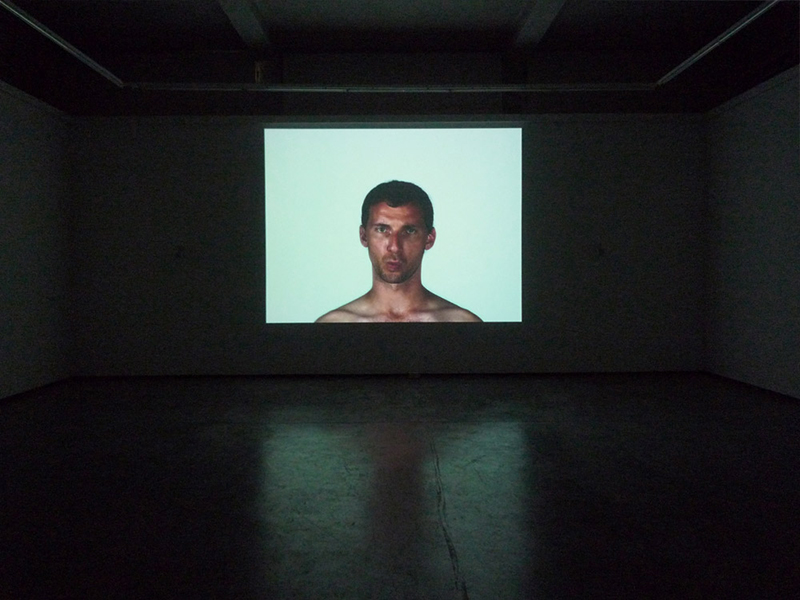
Possessing a similar structure of thought, in which the status of the image and temporality are questioned, the video installation Grândola activates memory and recognition, re-contextualising the relationship with the space and the work in real time. Once again, we find ourselves confronted with an absence of narrative: we can merely reconnect signs that allow us to re-counter a political event, the April Revolution of 1974 and one of its most significant symbols, the song Grândola Vila Morena by José Afonso. In a video installation mounted in a white space, with a minimum of visual distractions, the portrait is used again: a man with a naked torso whistles the melody of the song of April. Here, the presence and the circulation of the spectators in the space transform absence, given that, without them, Manuel Marques’s work would be determined only by the suggestion of the exhibition space. It is as if it did not exist and were in suspension. The idea of interactivity is thereby closely linked to permanence and the work of the body. This relationship is similar to that which we experience before the photographic images, constructing, through our presence and the time that we are prepared to devote to them, possible relations with the signs that the artist very subtly reveals.
Besides being a metaphor for a period of time that occupies us and prepares us for something, the title Temporada is a warning to our ability and availability to construct a potential experience.
João Silvério
April 2011



 /
/  /
/ 