


João Onofre
Curator: Ana Cristina Cachola
Guitarra Portuguesa
Carlos Paredes’ first album of his own compositions, released in 1967, was called Guitarra Portuguesa – an obviously tautological phrase, in which the title seems to simply repeat musical content that consists of 11 pieces played on a Portuguese guitar. From a simplistic perspective, tautology always takes the form of gratuitous repetition, corrupted pleonasm or differential incapacity. Nonetheless, and acknowledging repetition as a strength of language, tautology can also be the affirmation of a structural absolute: this is this or this sounds like this. It is this complexity of the tautological – from the logical tautology to the philosophical tautology – that runs through the work of João Onofre.
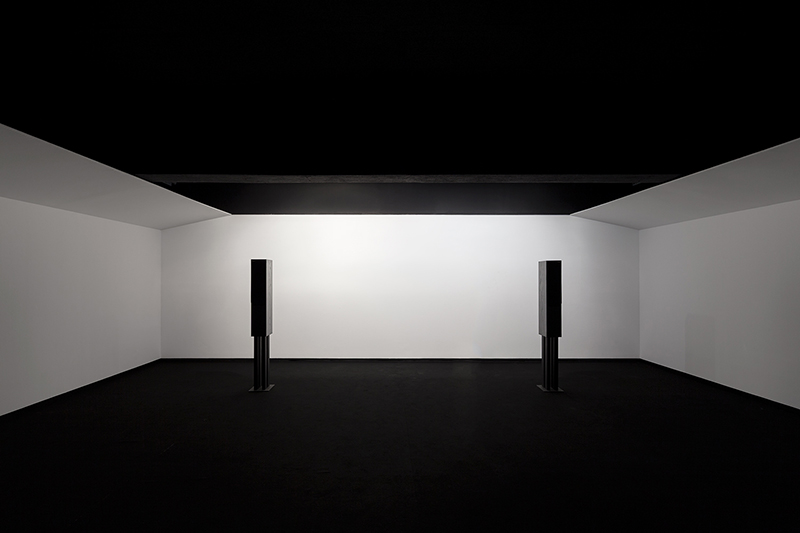
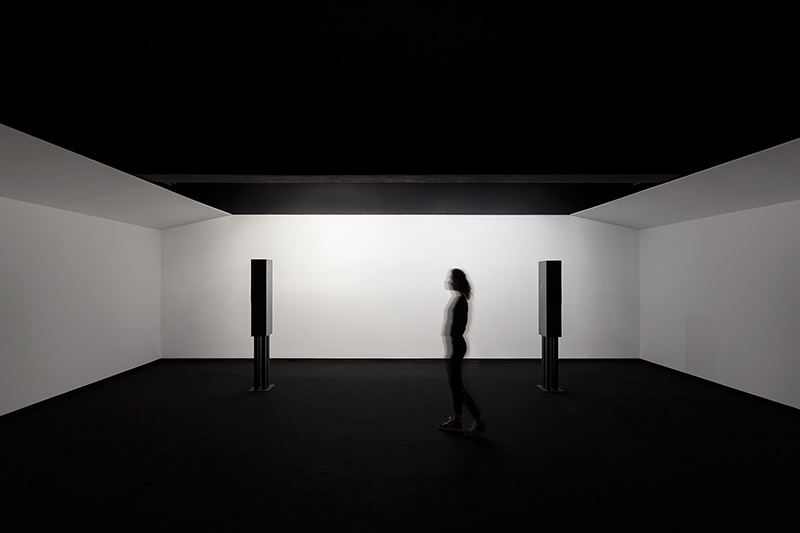
From the outset, the scope of Onofre’s investigation has encompassed reflection on utterances (including sound, visual, linguistic and cultural utterances) that overlap constitutively and, sometimes, unnecessarily, and the work Untitled (2016) is set within this critical terrain. Over the 14 minutes and 12 seconds it lasts, we hear all of Carlos Paredes’ respiratory activity on the five studio albums of his own compositions, namely: Guitarra Portuguesa (1967), Movimento Perpétuo [Perpetual Movement] (1971), Espelho de Sons [Sound Mirror] (1987), Asas sobre o Mundo [Wings Above the World] (1989) and Canção para Titi – Inéditos de 1993 [Song for Titi – New Works from 1993] (2000). Onofre’s (de)composition arranges Paredes’ breathing at the time of recording in chronological sequence, in a continuation of the artist’s ongoing investigation into the elasticity of sensible and sensory structures.
Movimento Perpétuo
In the narrative of the Bible, the onus of creation is placed on the respiratory act. With his own exhalation, God gave the ‘breath of life’ to Adam, a gesture that initiated the entire cycle of human existence. In this and other narratives breathing thus becomes the sonic correlation of life, the perpetual movement that accompanies (one’s) being human. Yet we know that the perpetual doesn’t correspond to eternal longevity, but to a finite temporality, with a beginning and an end, a movement that starts and finishes. The perpetual is a temporal delimitation of an action or a state, a state in action indeed – an image in movement. As such, it evokes a performance open to sensible inscription.
João Onofre has examined the performative possibilities of bodies, focusing – primarily through video – on their limits and seeking out their elementary arrangements. The emphasis on Carlos Paredes’ breathing, the performance that allows, controls and constrains all the performative capacity of a living body, brings us towards what, in performance, is synthesis.
The search for the minimal ontology of sound was already present in Tacet (2014), which referenced John Cage’s 4’ 33”. In this work, Onofre’s video shows a pianist who interprets Cage’s piece – 4’ 33’’ of silence – on a burning piano. If, on one hand, 4’ 33’’, presented for the first time in 1951, affirmed the impossibility of silence, or sound as life, since the musical interpretation of silence is incapable of generating a total absence of sound (sounds from the audience or of the interpreter’s breathing will persist), on the other hand, the destruction of the (unnecessary) instrument that produces the sound, in Tacet, retains an idea of beginning and end, life and death (of a paradigm for sensible sonority).
Espelho de Sons
In 2004, Jim Drobnick proclaimed the ‘sonic turn’. This proclamation may have come at the end of a succession of turns that the second half of the twentieth century brought to the mechanisms of cultural study, but it made it possible to find in sound an analytical territory, a medium for aesthetic engagement and a conceptual and theoretical model for thinking about the world. A new lexicon has imposed itself within various disciplinary fields, where acoustics, sonorities, voices, sounds and silences are now discussed at great length. It is within artistic production, however, that the sonic turn has been most acutely felt, with the emergence of creative methods of compartmentalising sound and terms such as sound art.
Many of the arguments advanced in this new critical arena pointed to these new tendencies and nomenclatures as fallacious and extemporary. Sound has occupied a central place in artistic discourse since the emergence of the various modernisms, expanding its sphere of action with the technological changes that normalised videographic mediation within the art system. All of João Onofre’s video work operates in this way, illuminating what cannot be seen, within the framework of visuality. Not only is there a recurrent reference to themes and figures from the world of music – as also exemplified by Untitled (2016) – but sound has always emerged on the same level as the image, participating in the signification of the work and playing an active role in establishing a spatial dimension and temporal dynamic of the movement-image.
Visuality is consensually accepted as a synaesthetic cultural dimension that rejects sensorial compartmentalisation and, these days, articulates the importance of what is not seen in a context in which we are saturated with images. The fact that image and sound are interdependent and that they mutually project each other doesn’t mean that each doesn’t have their own problems. Untitled (2016) is a sound work, despite the surrounding installation paraphernalia, making it possible to examine issues of the ontology of sound as the physiological process of hearing, which demands a genuine incorporation of stimuli, or the affects that determine the way that hearing takes place.
Carlos Paredes’ breathing, enabling and accompanying the chords of the Portuguese guitar, challenges the notion of image and sound as static or rigid. Various layers can be observed in this pre-existing superimposition, which João Onofre reveals and organises while always seeking out the elementary structures of each performative gesture. The two sound layers come together with the projections of images, affects and affections that the viewer brings to the gallery. At the same time, it is impossible for Paredes’ breathing, when heard, to remain the only breathing in the room, making each individual aware of his or her own actions, and also of the way that sounds affects the body and the body forcibly affects sound.
Asas sobre o Mundo
In Phenomenology of Perception, Merleau-Ponty demonstrates the need to return to the basic structures of human experience from a subjective perspective, emptied of positivist distancing, as the only possible way of knowing the form and content of human experience. This knowledge presupposes a corporeal relation, in which (technological) mediation should be reduced to the minimum possible. Sound is one of the least referential dimensions that contribute to artistic production, or to producing meanings of the world, since it never creates a correspondence between what it describes and its description as a sensible registering. Despite its indexical predisposition, which indicates the real, it doesn’t suffer from the semiotic overload of visual or verbal language; it belongs in the realm of experience and distances itself from the compulsive need for communication.
There is, therefore, a need to establish a relationship between body and world in movement with a view to affective knowledge. The universality of the act of breathing generates empathy, understood here in a basic biological sense in which self-awareness takes place in a way that relates to others and to the world. Breathing thus synthesises the notion of sound as life. At the same time, it forces the body into movement, a minimal action that reflects total performativity or at least its possibility.
The possibilities of technology, allowing sound and image to be fixed in many different ways, created a hierarchy of performative tendencies, establishing an exclusive order of sensible registers, in determined parameters of quality. This system is doubly corrupted in Untitled (2016). Firstly, what is revealed is the registering of the respiratory act and – indeed – all of its banality. Secondly it is breathing that governs João Onofre’s (de)composition, stripping the musical chords of their performative primacy. In this way the importance of the universal act – the original performance – is emphasised.
The apparent oppositions between the visible and the invisible, the transcendent and the immanent, life and death, are evoked, in this work, in a field of expanded possibilities, anchored in biological states that are of and for (artistic) creation. All this takes place over a line of suture that, by superimposing, unifies semiotics and the phenomenology of perception.
Canção para Titi
The last of Carlos Paredes’ albums featuring his own compositions is called Canção para Titi – Os Inéditos de 1993, that being the year it was recorded, when the musician was already affected by the neurological disease that would force him to give up the guitar, though it was not released until 2000. A song presupposes the existence of a musical composition for the human voice and, consequently, the existence of a text. By not including any sung composition, the form of the title refers to a discursive intention diluted in an abstract formulation. The same can be said of Untitled (2016). The group of superimposed sounds, the dissonant composition that results from Onofre’s intention, the revealed breathing, do not merely generate a formalist exercise of analytic innocuousness, but a place where poetics and conceptual sensibility converge. By bringing technology to act on life, synthesised in Paredes’ respiratory act, João Onofre expands it into a clearly violent exercise that, like Paredes’ song, is real, even when it is not true.
Ana Cristina Cachola
November 2016
credits © photodocumenta

HCI / Colecção Maria e Armando Cabral /  /
/  /
/ 