Several times throughout his career, João Penalva has used objets trouvés to give body to work that constructs stories of everyday and anonymous people. These are presented as fictional characters, surprised in moments of tension or in banal circumstances, and whose narrative details we have to complete ourselves by taking into account the objective – and possibly deliberate – emptiness of the events with which we are confronted. These opportunities seem to seek to synthesise time from real life within the artifice of the exhibition time. We are immediately reminded, though not exhaustively, of The Asian Books and, among these, of Taipei Story (2007) and Hello? Are you there? (2009) especially, but also of the installation Character and player (1998) and, with particular significance in this context, Men Asleep (2012).
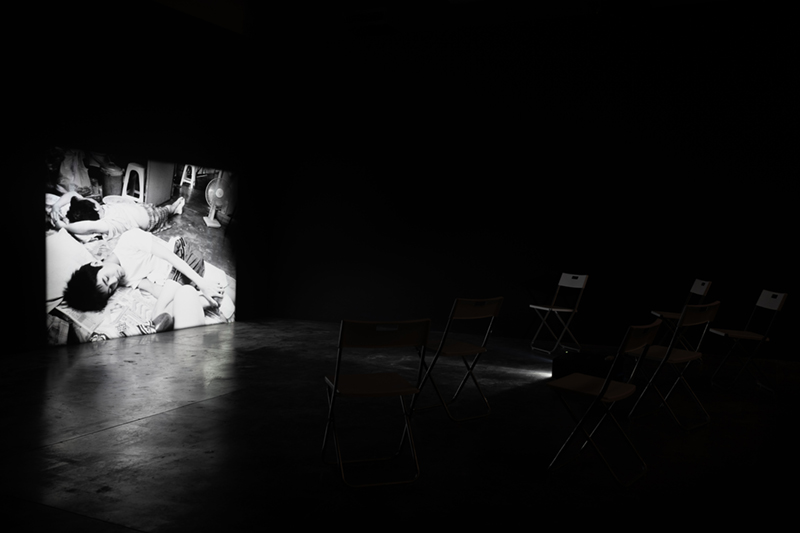
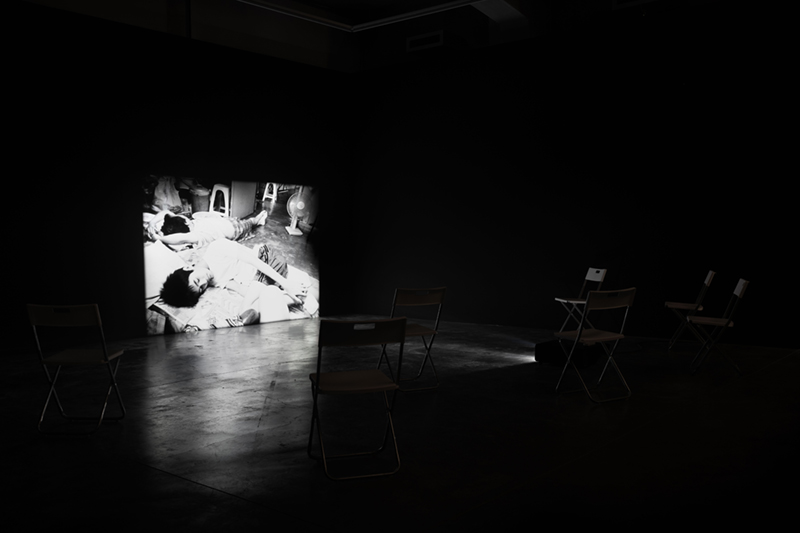
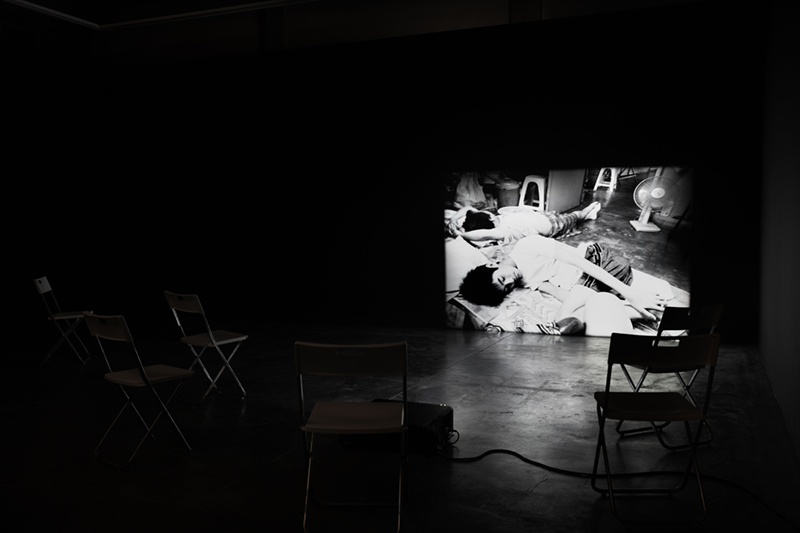
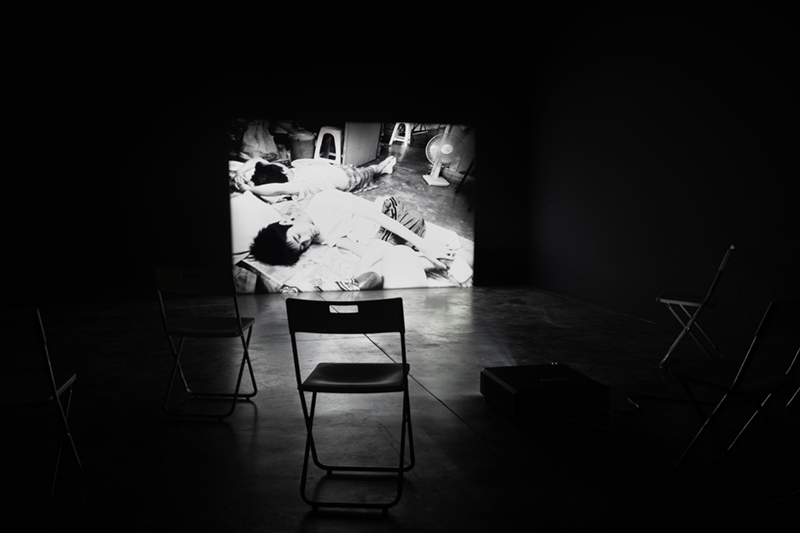
This is the first time that João Penalva has used an objet trouvé for the production of a film. The black and white photograph ‘Cousins – two boys sleeping’ transports us to a domestic setting, though it could also be that of a workplace that also serves as a residence. In the image, we see two young Asian boys in shorts who have fallen asleep on the floor. This is obviously a daytime scene, as there is sunlight in the room. The scene includes a bin, a fan and cheap plastic stools scattered disorderly around the room. One of the boys has an injured foot. From the bottom corner of the image, the leg of a third person in the foreground stands out in the image in an irritating way. It is a photograph that leaves much room for interpretation.
What might we add to this so richly detailed visual description? That the original image was taken in 2010 with the poor quality of that time’s mobile phones and later improved? That the same thing happened with the audio recording, which was later worked on in the studio, crossing recorded conversations with street and nature sounds? Is it important to know that this scene took place during a period of festivities, when a Chinese family gathered at their grandmother’s house in Mantin, a rural village in the district of Negeri Sembilan, Malaysia, for the celebrations of the Chinese New Year? And what would it mean to know that the grandmother is talking to a friend, in Cantonese, and that the two boys lying on the floor are cousins?
Are they really asleep? Are the heat and humidity suffocating? And won’t the conversations around them, mixed with the noises of the street, disturb them? What is left for the spectators? To remain silent in front of the image, cautious in their condition of (in)voluntary voyeurs? Or to tiptoe away, moved by the increasing modesty that has been growing in them as time goes by and their intrusion into the family scene becomes increasingly uncomfortable?
What, then, can the public expect? For the cousins to wake up? For their grandmother to come in and call them? For the photographer Jun Kit Boh to lie next to them? What private unshared stories do the spectators construct in their contemplation of a domestic scene transformed into spectacle through the manipulation of the scale of the images?
Enlarged to this scale they shift in status from a private object in a personal collection to communal property, which, just like a theatre set, demands a group audience to come alive.
João Penalva invites spectators to a game that oscillates between mediated voyeurism and enchanting contemplation, perhaps of a self-reflexive nature. This exercise had already been tested in Men Asleep (2012), which placed viewers before the unprotected fragility of those who sleep, of those who do not know they are being observed, and who, for that very reason, cannot prevent that very observation and the intrusive disturbance of their intimacy. This theme was also present in Sumiko (2009) and As if she could see him (2011), although in those works, by decision of the artist, the modesty of the characters ostensibly prevents the voyeurism of the public, a gesture that is taken to the point of paroxysm in the installation Door (2018), with João Penalva inviting people to peep through a hole in a door, as if it were a peep show.
Although in another context, and regarding another work, I wrote about João Penalva and his creative process: Penalva constantly makes demands of the skills of the viewer. All the information is available, whether hidden or not, but discovery depends on the possibilities of each of the viewers and, inevitably, on their cultural heritage.
As spectators we once again find ourselves before a seductive challenge proposed by the artist. If we accept his invitation, we can (re)discover how we see and hear that which surrounds us and, in this way, better understand our context, but also revisit the stories and ghosts that define us and that we always carry within us.
João Penalva’s Cousins was first presented in 2020 at the 25th Rohkunstbau, an exhibition taking place at Schloss Lieberose in the State of Brandenburg in the Federal Republic of Germany.
Lisbon, 28 May 2023
Carlos Vargas



 /
/  /
/ 