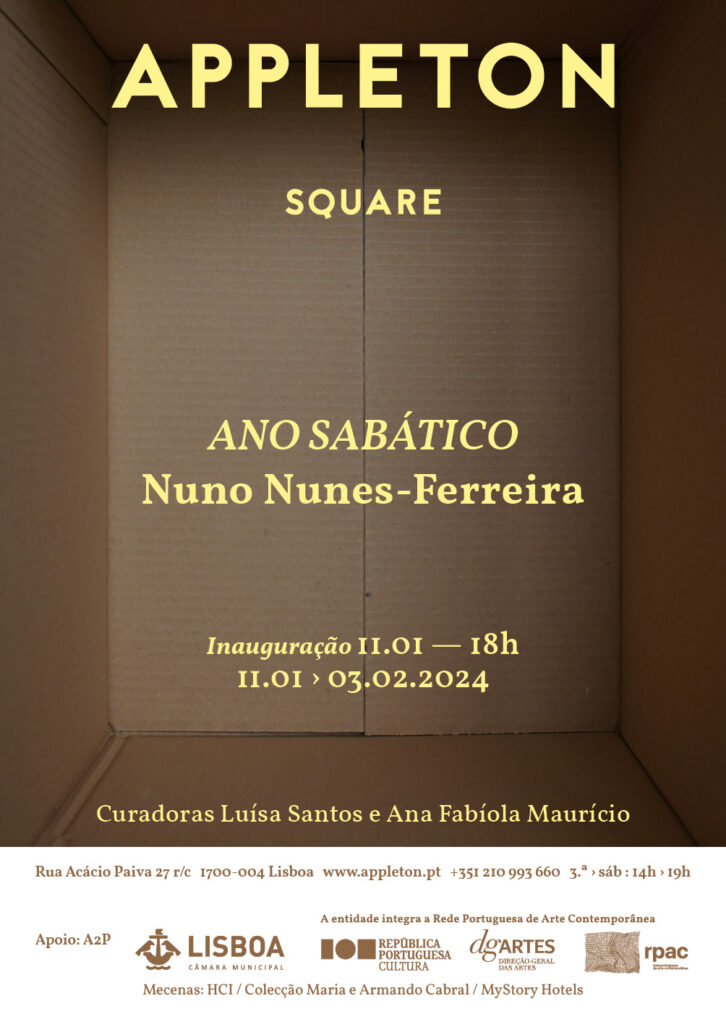
We commonly associate a sabbatical year with an approximate period of time in which one interrupts their professional or academic activity in order to pursue another activity. If we investigate the etymology of the word ‘sabbatical,’ we are led to the Hebrew term Shemitah, which translates literally as ‘liberation.’ This liberation can be seen as a release from the constraints of the constant demand for public presentation of work which results from the artist’s continuous and permanent processes of (self-)formation and (self-)construction, or as a liberation from an accumulation of (in)visibilities of the artist’s work. The exhibition ANO SABÁTICO (2023) concerns the year 2023, during which Nuno Nunes-Ferreira (1976, Lisbon) dedicated himself to personal projects without presenting new work in public exhibitions. In other words, a year of work that remained invisible and which, now that the production period is over, can be made visible, free from the enclosure of his studio walls. However, this process of making visible, this ‘liberation’ – like all forms of freedom – comes at a price.
365 days, 365 works of art
Let us start with the year, the period of production for ANO SABÁTICO. Nuno Nunes-Ferreira’s practice could be described as durational, insofar as his projects always involve long periods of research and accumulation of material that he observes, categorises, catalogues, interprets, and transforms. Let us recall, for example, the project Dois Anos e Meio (2016-2019), presented at Balcony Gallery in 2019, which, in fact, is not yet finished, with the work Chegar aos Cem (2016-2019) only recently having been completed due to a need to find a newspaper article corresponding to an 81st birthday in order to ‘reach a hundred.’ In ANO SABÁTICO, Nunes-Ferreira worked non-stop for a year (contrary to the usual understanding of a sabbatical) and, in a performative process of daily repetition, produced one work of art a day.
For each of 28 to 31 days, depending on the month (from January to December 2023), between 28 and 31 works of art were put together month after month, box after box, until the twelfth and final box. At the end of each month, each box was closed and sealed, and the rules dictated. By closing the box on the last day of each month, the artist determined, with the performance of his monthly sabbatical, that inside that box were a number of works of art corresponding to the number of days in the month in which they were produced, simultaneously announcing that they can only be considered works of art for as long as the box remains closed; the opening, and consequent viewing of the works of art, will immediately remove them from this categorisation, and the objects will now have an identity as ex-works of art.
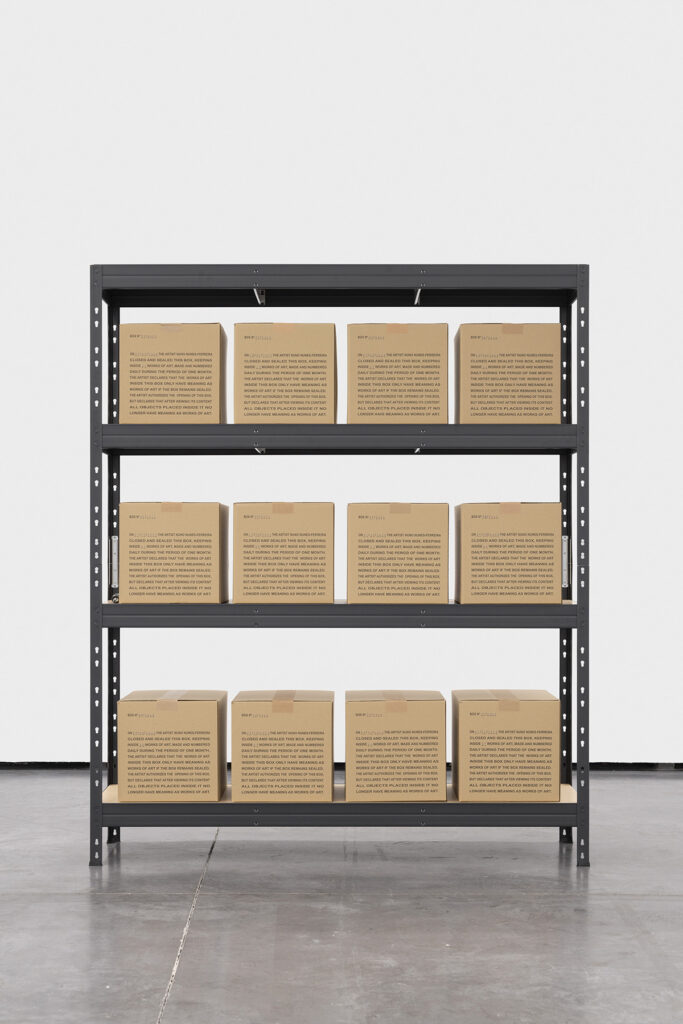
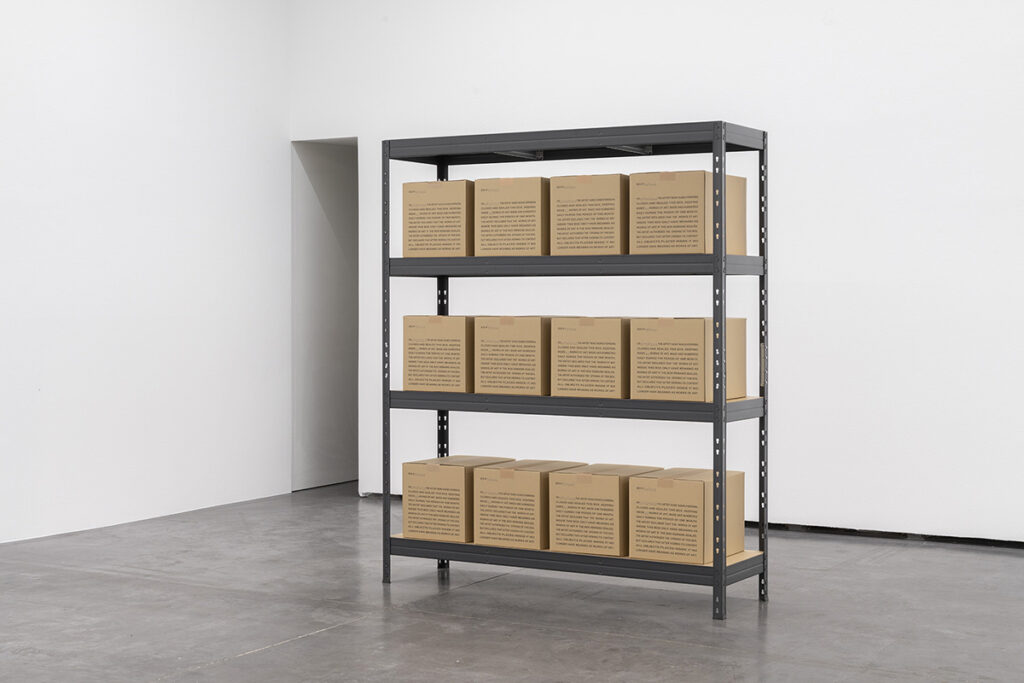
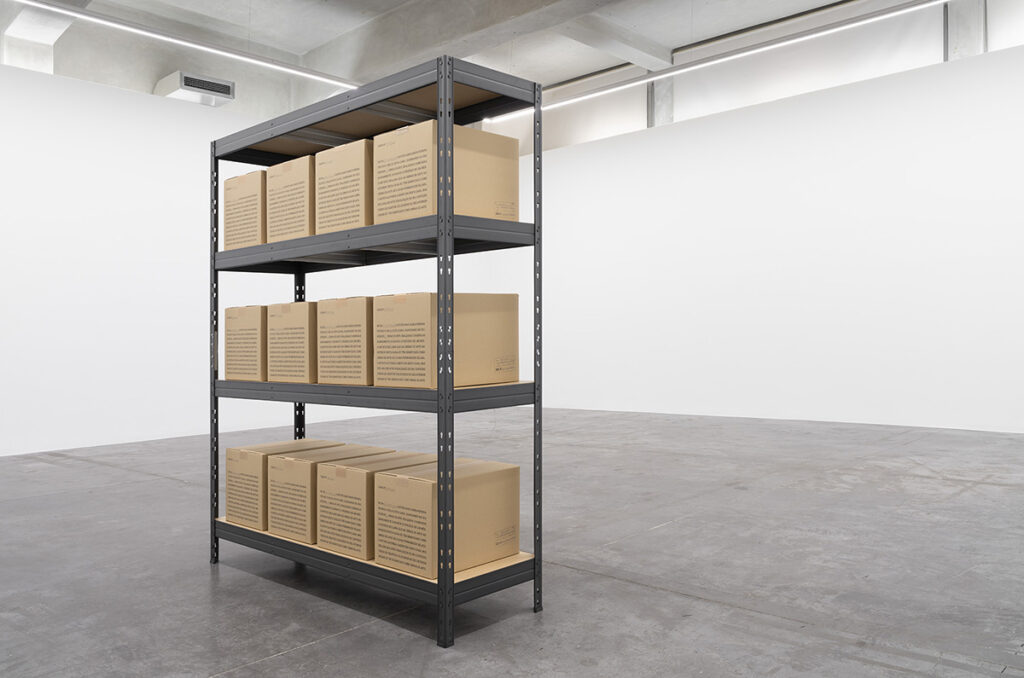
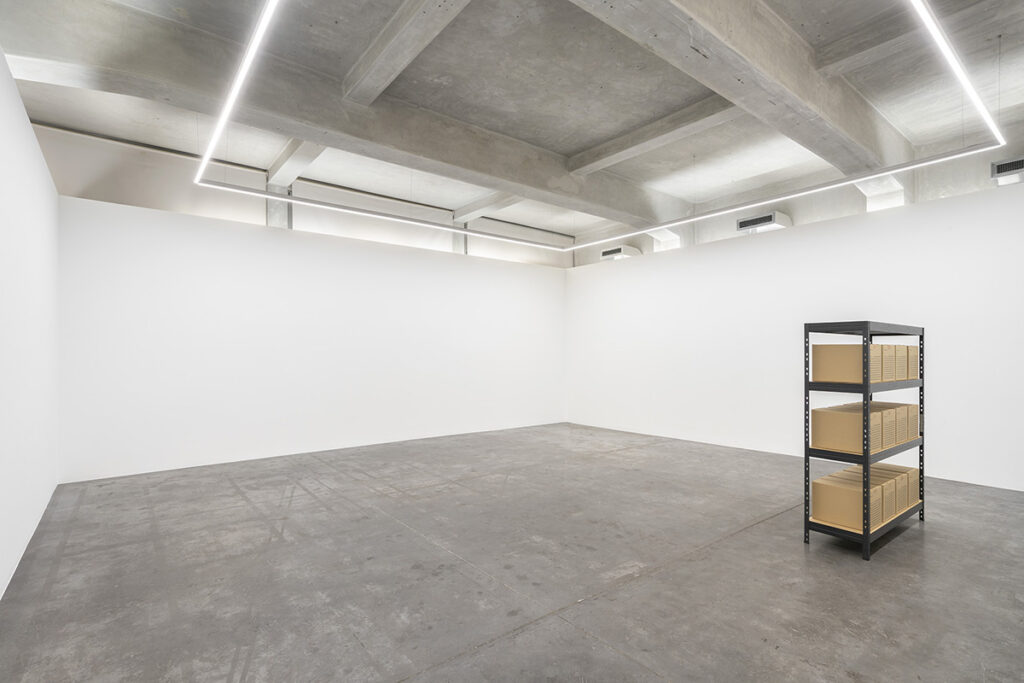
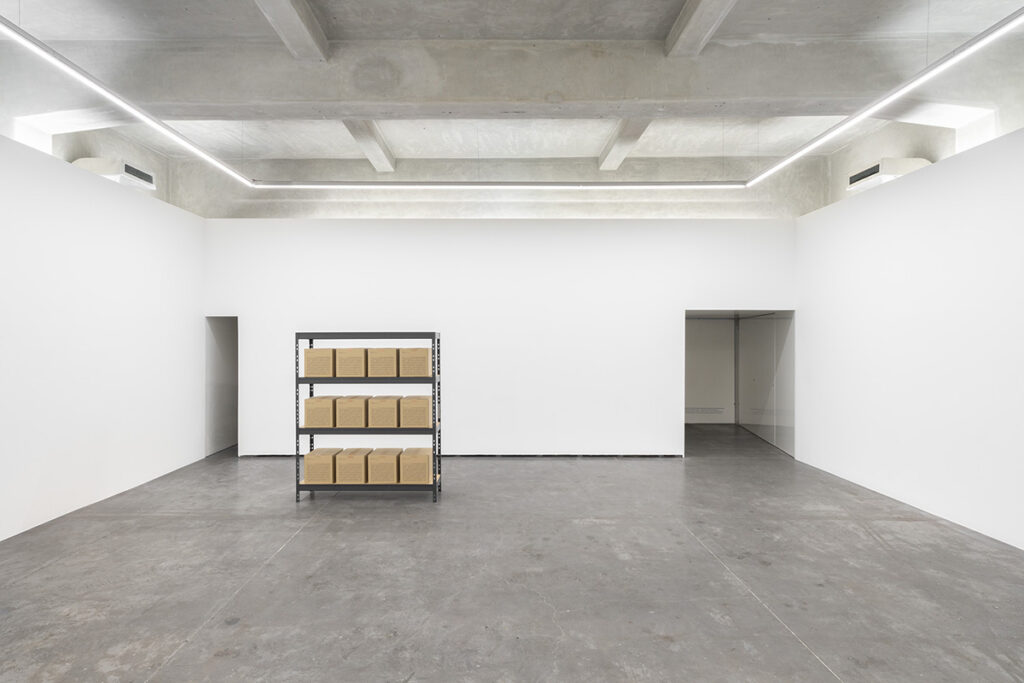
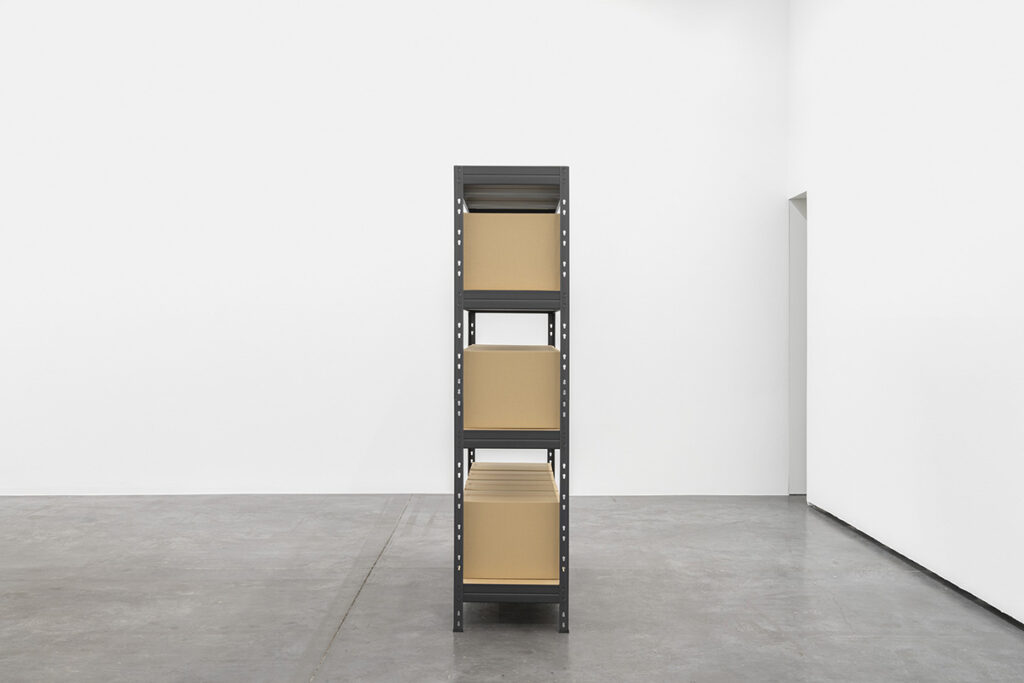
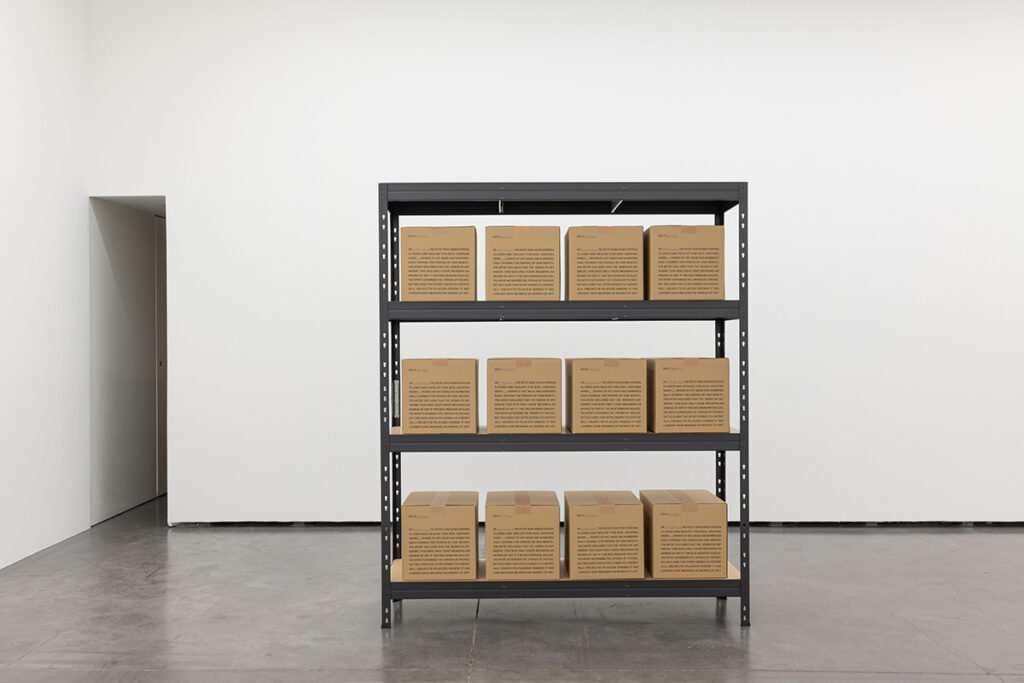
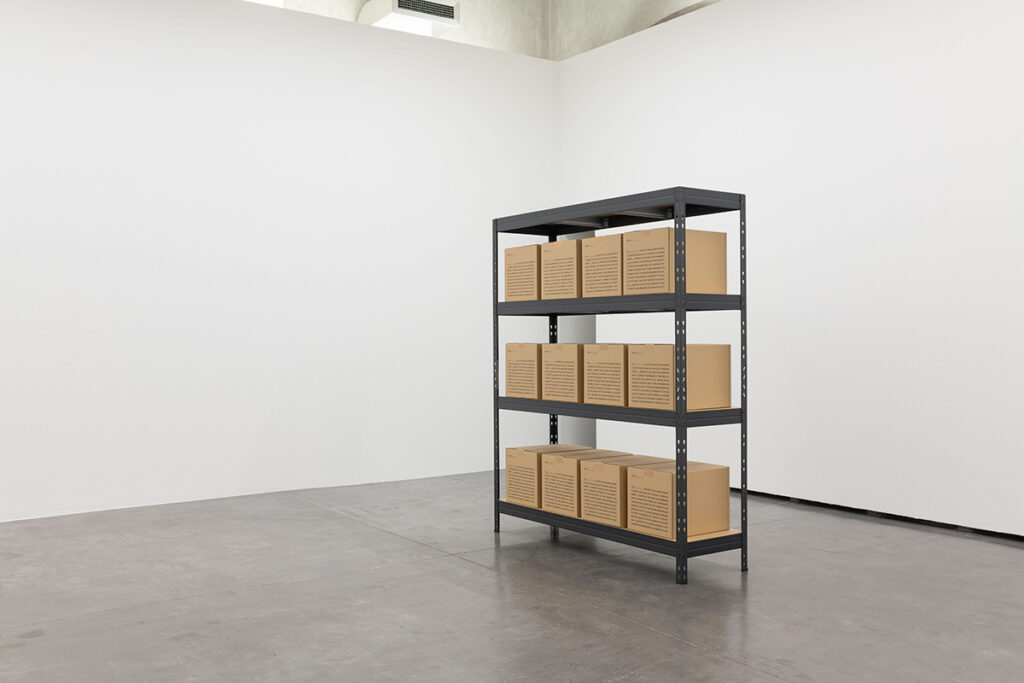
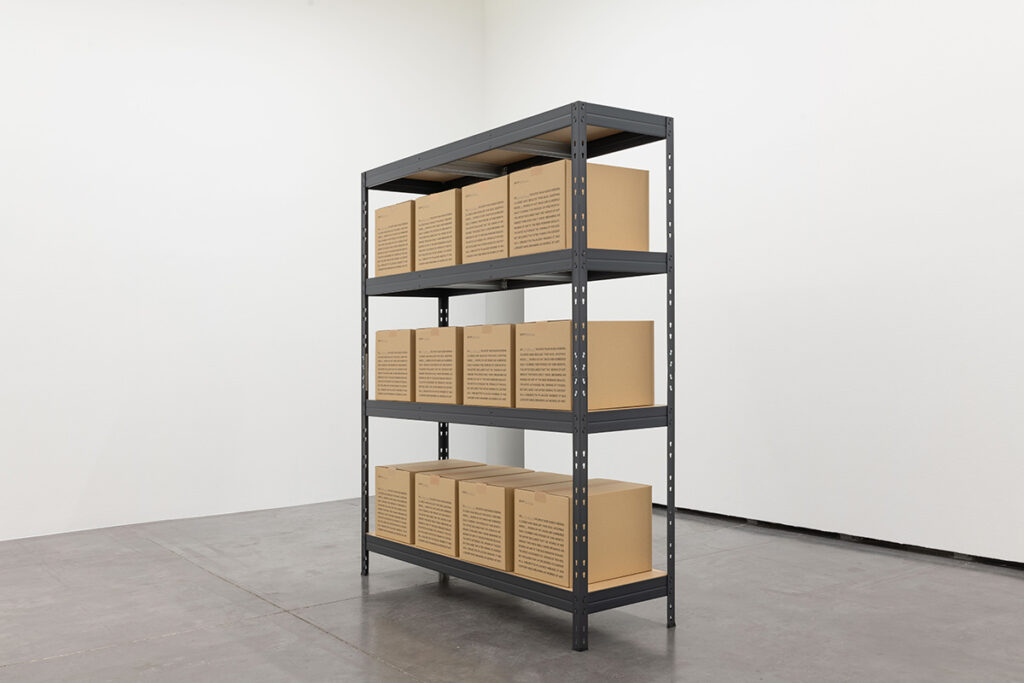
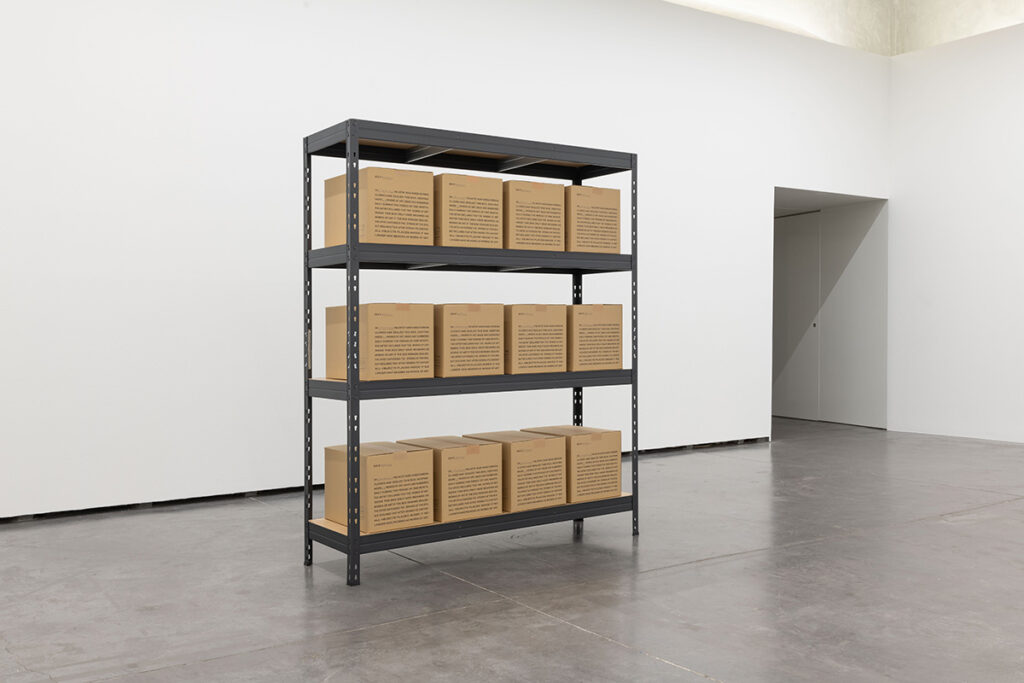
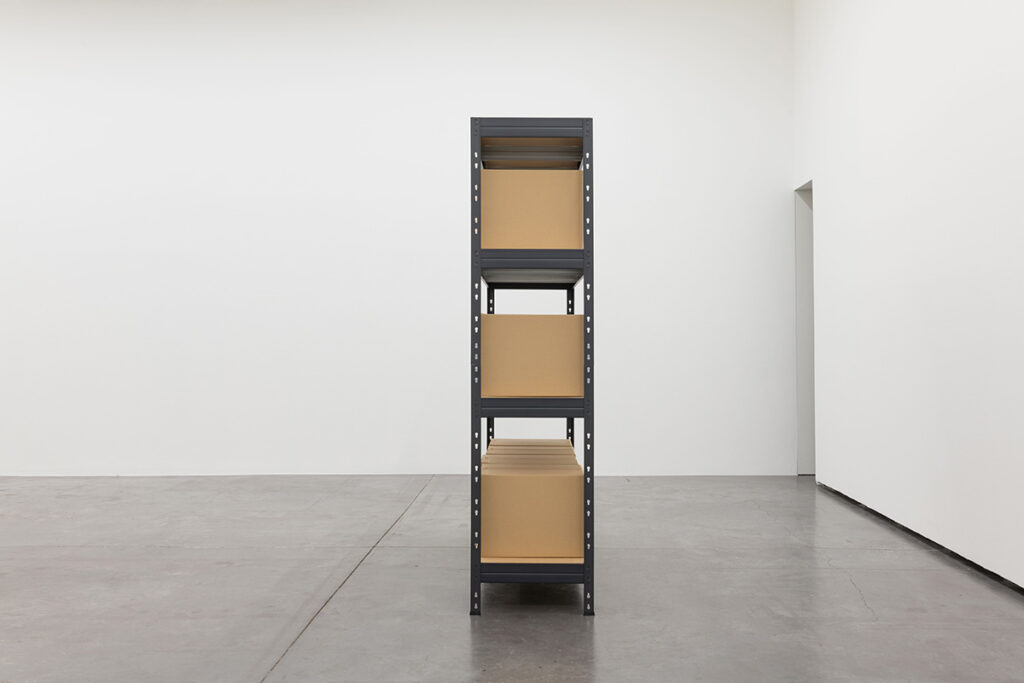
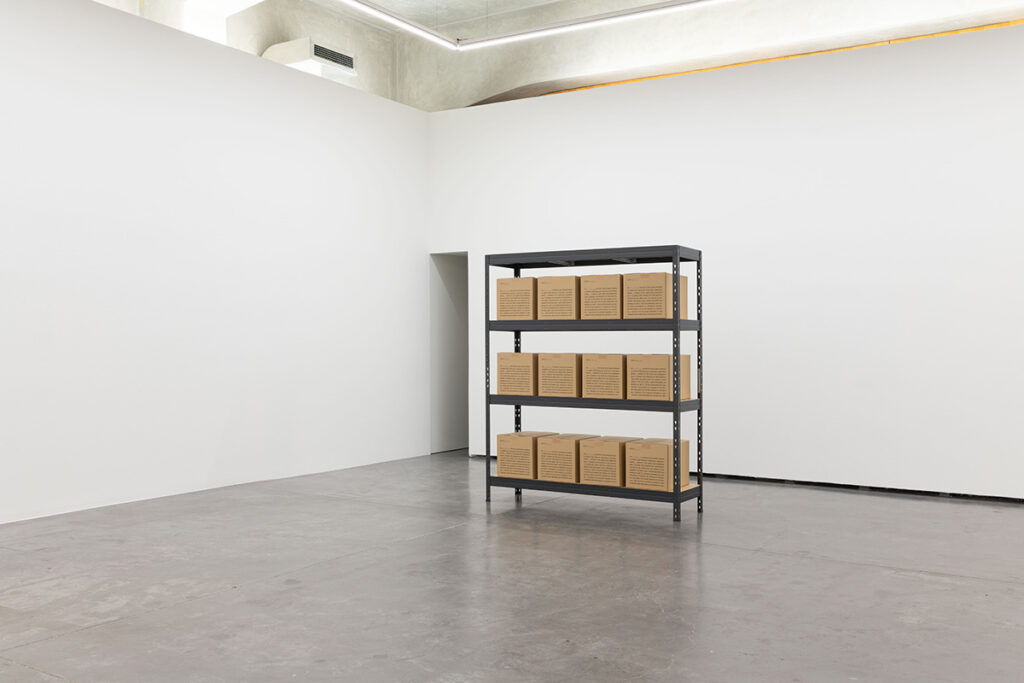
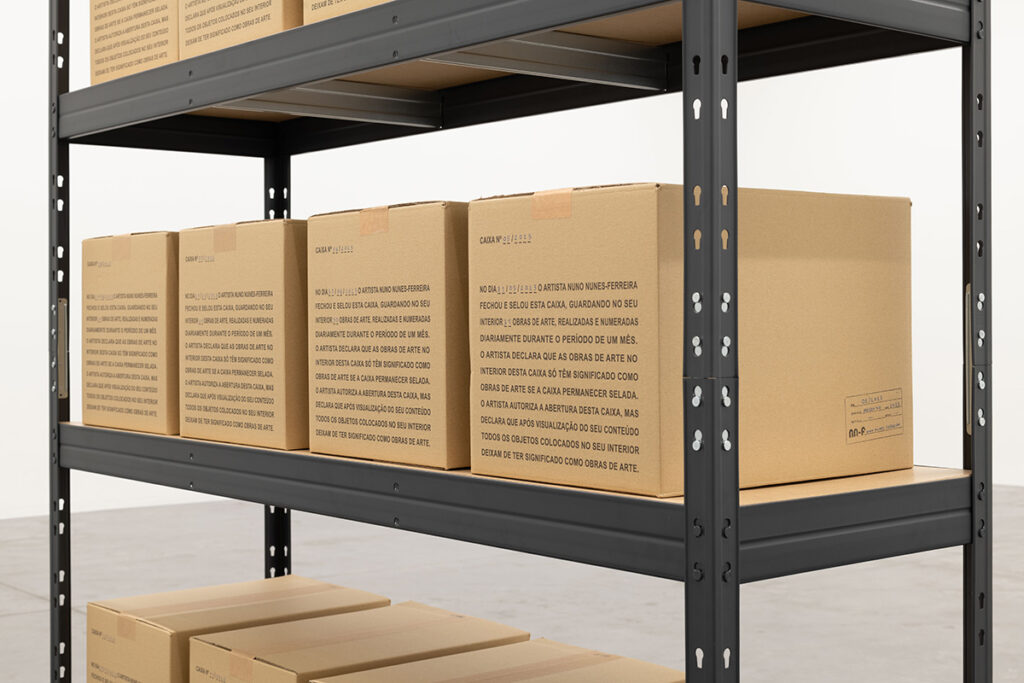
The 365 days of 2023 and the 365 works of art that Nuno Nunes-Ferreira diligently produced on a daily basis during that year are thus literally boxed up. The boxes (and the shelves that organise, arrange and display them) are the only elements to which we have direct access for enjoyment/viewing. At the same time, they are the elements of containment and form for the work ANO SABÁTICO, as well as the delimiting elements that prevent us from actually viewing and enjoying the works of art that the artist created day by day, every day, during the year 2023.
The price of making visible, liberation
Schrödinger’s cat is a mental experiment in quantum mechanics conducted by Austrian physicist Erwin Schrödinger in 1935 which studies the paradox of the apparently illogical superposition of two or multiple states. In the experiment, a hypothetical cat inside a box may be either alive or dead because there is a poison that can kill the animal inside the same box. The theory holds that as long as the box remains closed, the cat is neither alive nor dead, but rather in a state that is both living and dead. The moment the box is opened, this overlap ceases to exist and we can observe the cat in a single condition – alive or dead – and the observer is the one who ultimately determines, through their choice to open the container or keep it closed, the cat’s final outcome of life or death. It is observation (which is necessarily empirical) and not thought (which is necessarily conceptual) that brings a conclusion to the experience, but in so doing deprives the experience of all its potential as an element of cognition that will permit greater and deeper reflection on, and potentially knowledge of, this universe.
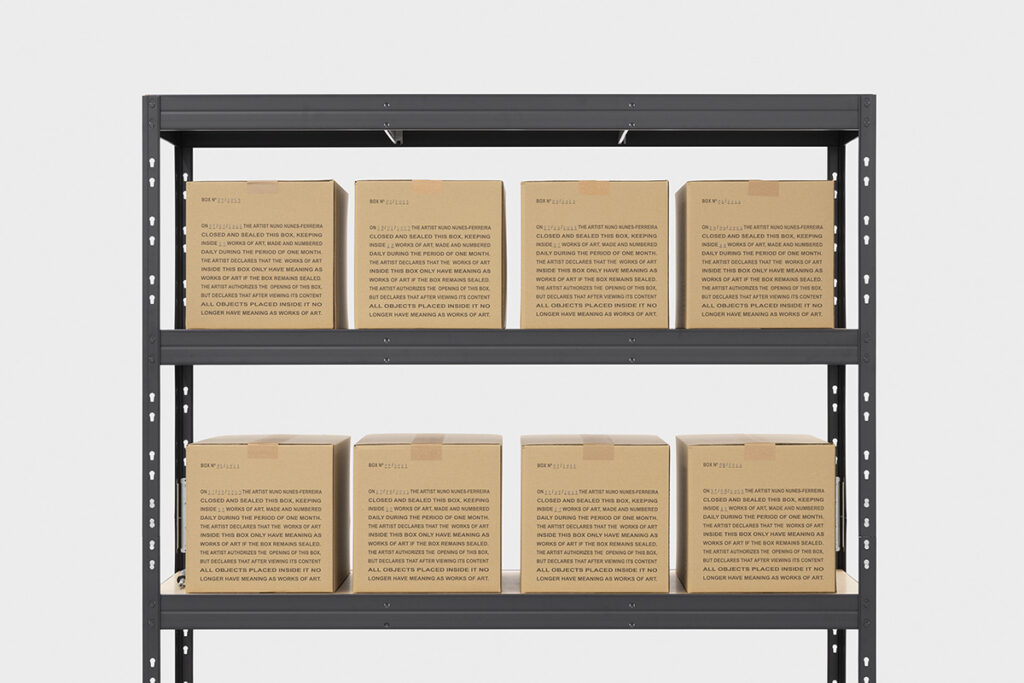
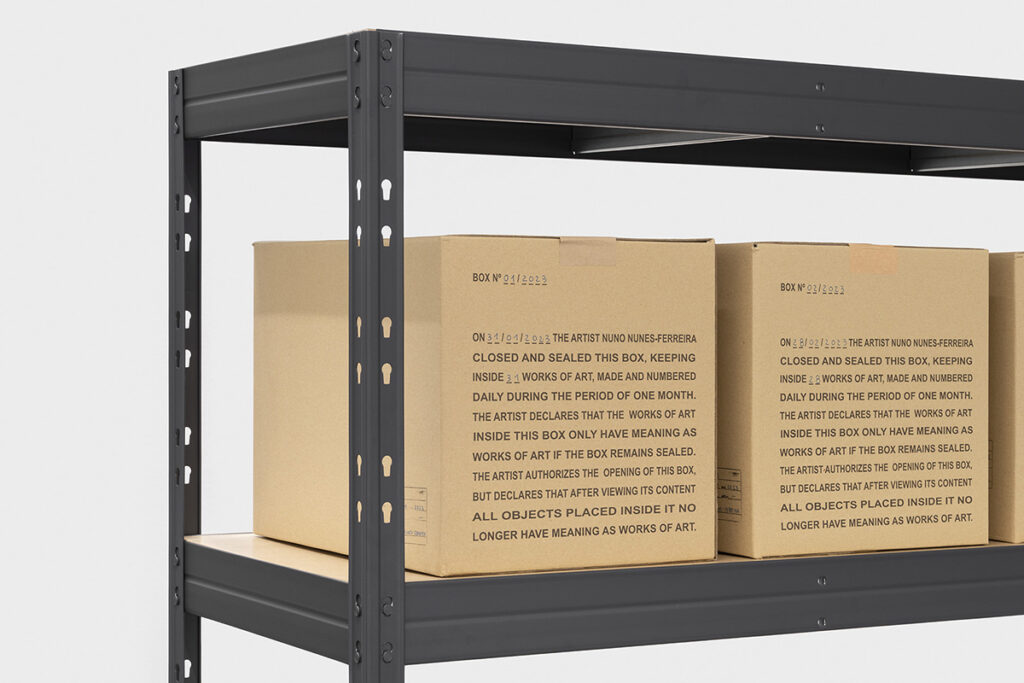
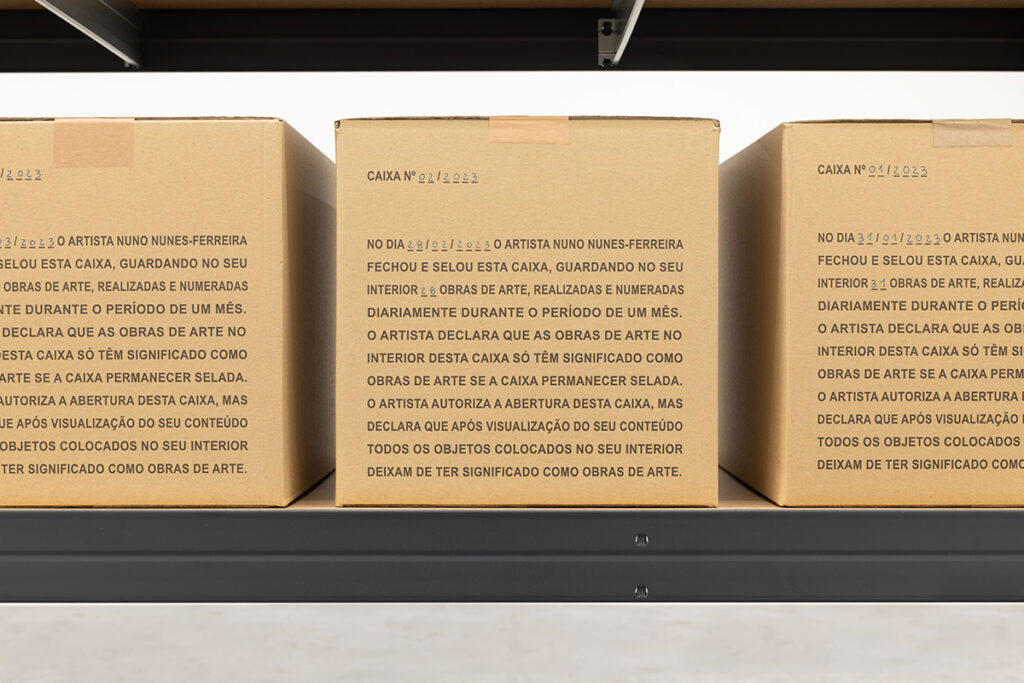
The encounter with Nuno Nunes-Ferreira’s ANO SABÁTICO (2023) is reminiscent of this experience. We are faced with a set of twelve closed boxes, all exactly the same size, duly numbered, with a description of their contents on the outside, and with instructions, always the same with the exception of the day, month, and respective number of artworks, which always corresponds to the number of days in the month, such as:
“ON 30 / 11 / 2023 THE ARTIST NUNO NUNES-FERREIRA CLOSED AND SEALED THIS BOX, KEEPING INSIDE 30 WORKS OF ART, MADE AND NUMBERED DAILY DURING THE PERIOD OF ONE MONTH. THE ARTIST DECLARES THAT THE WORKS OF ART INSIDE THIS BOX ONLY HAVE MEANING AS WORKS OF ART IF THE BOX REMAINS SEALED. THE ARTIST AUTHORIZES THE OPENING OF THIS BOX, BUT DECLARES THAT AFTER VIEWING ITS CONTENT ALL OBJECTS PLACED INSIDE IT NO LONGER HAVE MEANING AS WORKS OF ART.”
While the boxes are closed, we know (we believe) that there are between 28 and 31 works of art in there, depending on the months to which they correspond. However, we cannot see them. In other words, we don’t have access to their images and forms, to what makes them alive as works of art. If we choose not to open the boxes, the works of art remain conceptually alive as such; they retain their identity, but there is no possibility of their ‘practical’ enjoyment. If we choose to open the boxes – after all, the artist authorises it – we gain access to their contents. However, what were once works of art are no longer such once viewed. When we open the boxes and enjoy the works sensorially and empirically, we kill their identity.
But as with a rare bottle of good wine, enjoyment exists on different levels. The enjoyment is in knowing that you own something that has value because it has been sealed since the moment it was produced, intact and unknown; but the enjoyment is also in the planning, in the opening of something to mark a special moment, experienced with family and friends, where the seal is finally broken and a direct relationship is established with the works of art produced by the artist so they can ultimately be enjoyed, known and recognised. But just as it happens with wine, which when tasted ceases to exist as such, so it is with the work of art, which when ‘drunk’ becomes an ex-work of art. The experience of having lived and enjoyed works of art that, when closed in their box, lived only on conceptuality, brings added value to the experience that will potentially be all the more rewarding the greater the conceptual slant attributed to the works.
On the conceptualisation of art and the empiricism of life
If, when we enter an exhibition space, the work on display announces that viewing it is the act that deprives the work of that categorisation, how do we relate to that work? Invisibility and the lack of access to the artwork can, in this case, be seen as acts of generosity by the artist, who allows his works to be potentially enjoyed on several different levels (and at different times), even just in the exhibition space: the idea about the mystery of the artwork that takes place and remains in the artist’s studio; the conjecture about the works enclosed inside the boxes and why those in particular are there (which we don’t know) and not others (which we imagine); the formal appreciation of 12 catalogued cardboard boxes arranged on metal and wooden shelving, which with their physical existence and their written indications, bring to the fore the fundamental and necessary conceptual existence of all art, insofar as all art invokes notions that are essential to us: time, space, memory, imagination.
Luísa Santos and Ana Fabíola Maurício
December 2023



 /
/  /
/ 