Before Time, MACE
What place exactly are we talking about when we talk about the place of the imagination today? A place that happens exclusively at the level of the spirit, of the mind? A place of fantasy and illusion, a refuge from reality? An original, free place, without limits or defined boundaries that motivate the gesture of the creator or the alienation of the dreamer? What exactly are we talking about when we invoke this nostalgic place by condition, where imagination reigns and overcomes the normative conception of reality? Could this place be more similar or even closer to our primal world, those other places that knew no time during the concentration of play, games and adventures, created and explored in this disarticulation, or rather, in this prevalence of challenges created over the cadence of time, reigned over and regulated by the discipline of reality?
Once confronted with the ruthlessness of reality that imposes itself, drives and embodies the matter of our days, it is certain that this place of magic, spontaneity and fascination is temporarily abandoned, often scorned, to make way for the institution of rules that dictate the context and place we occupy in the world. These days, moments of fantasy and wonderment have inevitably become momentary, rare and tremendously scarce. The world we live in demands extraordinary attention and dedication to contextualising verifiable facts, making necessary enquiries into dubious information, justifying acquired data, reformulating platitudes, objectifying a certain truth on which we spend our time and to which we dedicate the opportunities we have.
In fact, apparently, we are already a long way from the awe that Walter Benjamin wrote about, felt by those who listened to a story in a carefree manner, without feeling the need to check its plausibility (or adequacy, one might add). We are a long way from looking at works of art in all their formal breadth and convening a critical debate at a collective level without looking for the possibility of ethical justifications, without demanding similarities and identities, seeking to reformulate their existence in an unusual way. Today, the place of imagination is inevitably filled by the imposition of an acquiescent, damaged, exhausted reality. Perhaps that is why, when we think about this place of the imagination, there is a significant sense of nostalgia and a feeling of distant enchantment, now attributed only to children, poets and dreamers. But perhaps that is precisely why it is so important to look at works of art that show us the unexpected possibility of opening up this place of illusion, fantasy, humour and play, adventure and discovery.
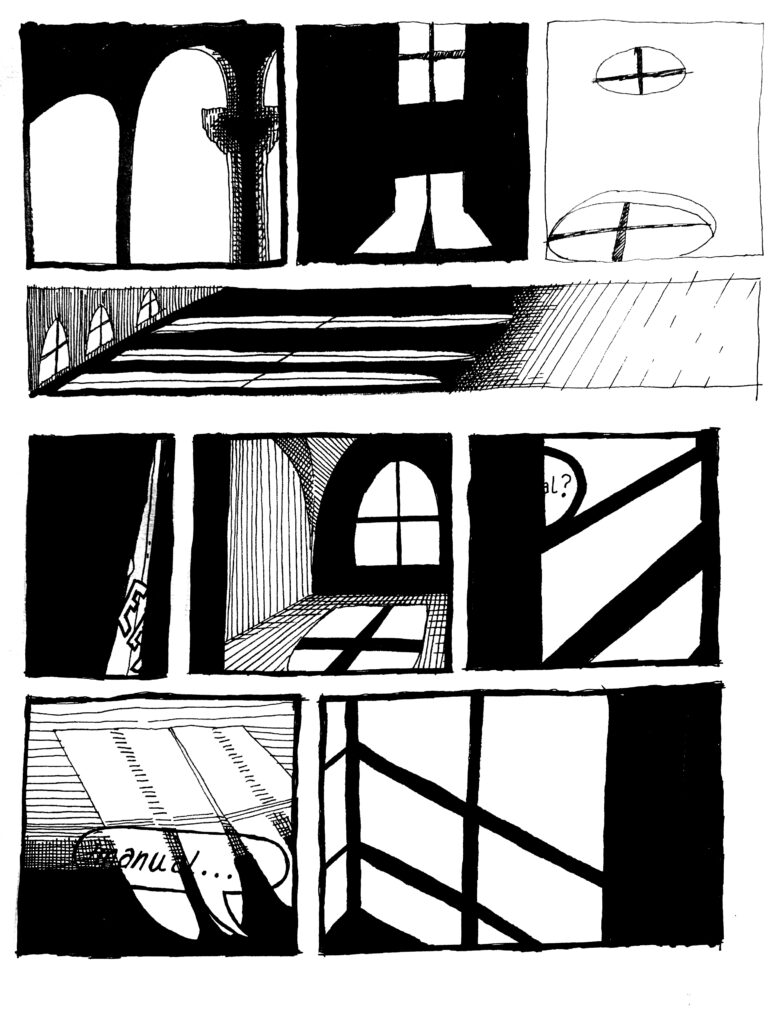
May the reformulation of this place take place in a long dark corridor, in which we are allowed to glimpse points of light in mirror-windows to other places at the imagination level. They are reflections of light in mirrors. Over them, the carefully applied paint draws geometric shapes that reproduce light inlets in different forms of refraction and rebounding. The corridor is then punctuated by beams of light in windows that appear there. Different images of a common experience are represented here: the reflection of a bedroom window in the early morning; the long, jagged silhouette of a window frame that runs across the carpet of a living room during a mild day; the sunlight on the stone arches that maintain the freshness of a cloister in the middle of the day; the clarity that enters through the shattered glass of attic windows; the luminosity of an early afternoon that enchains the curious gaze of someone peering through the boards of the window of a closed house. Our world is represented here, along with our past experiences, so naturally manifested through these representations that provoke a sensation of unexpected surprise, given the familiarity with that which our imagination calls into being. Without an exhaustive search for concepts or explanations, this is the kaleidoscopic and metamorphic world to which we so deeply wish to return, which opens up and invites us in. We are then faced with the possibility of rediscovering this small and intimate imaginary world of ours that we have experienced and that reconciles with the universal real, without forgetting or withdrawing it, but rather welcoming it. And when art comes closer to life, perhaps we get closer to the longed-for conquest of a truth that unites us, that truth that we so discreetly but perseveringly seek to achieve.
Filipa Correia de Sousa 2025


 /
/  /
/ 