To the angry woman
‘I’m angry,
very angry,
so angry that it’s become my normal state.’[1]
Over the past decades, Carla Filipe has led us deep into her growing archive of objects, documents and images. The traces of the past that permeate her work are not immaculately preserved or exhibited with any particular ceremony—instead, they are digested, dismantled and continually contested. For the artist, the archive is a battleground and a place of experimentation, uncertain and malleable. ‘There is always, in the way I approach the archive, a gesture of rupture and provocation,’[2] she states. In this exhibition, that gesture is blunt and decisive.
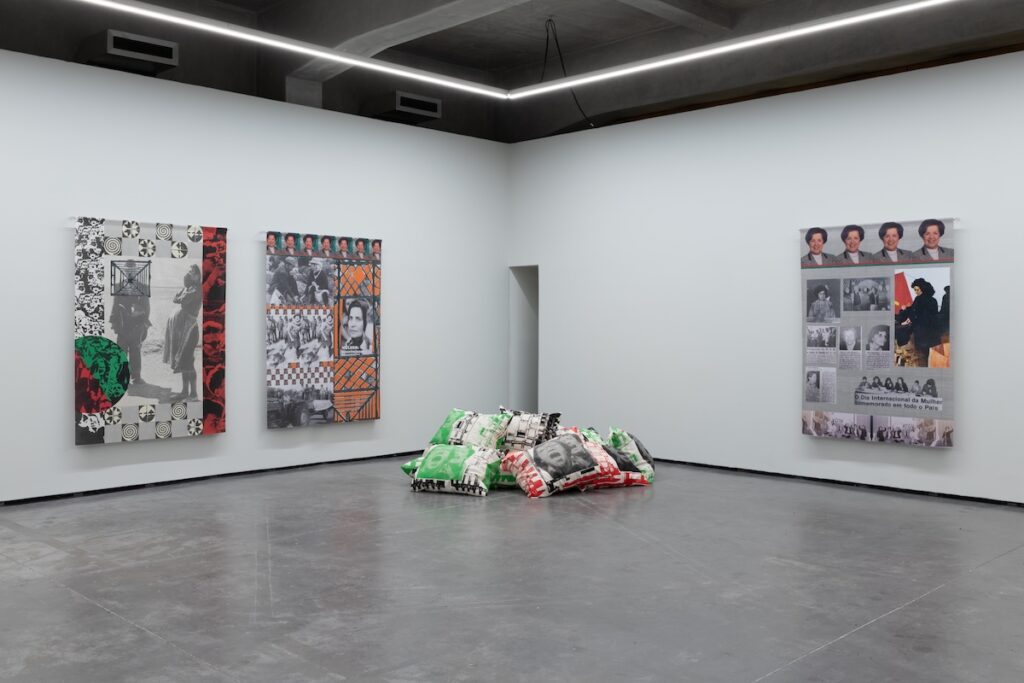
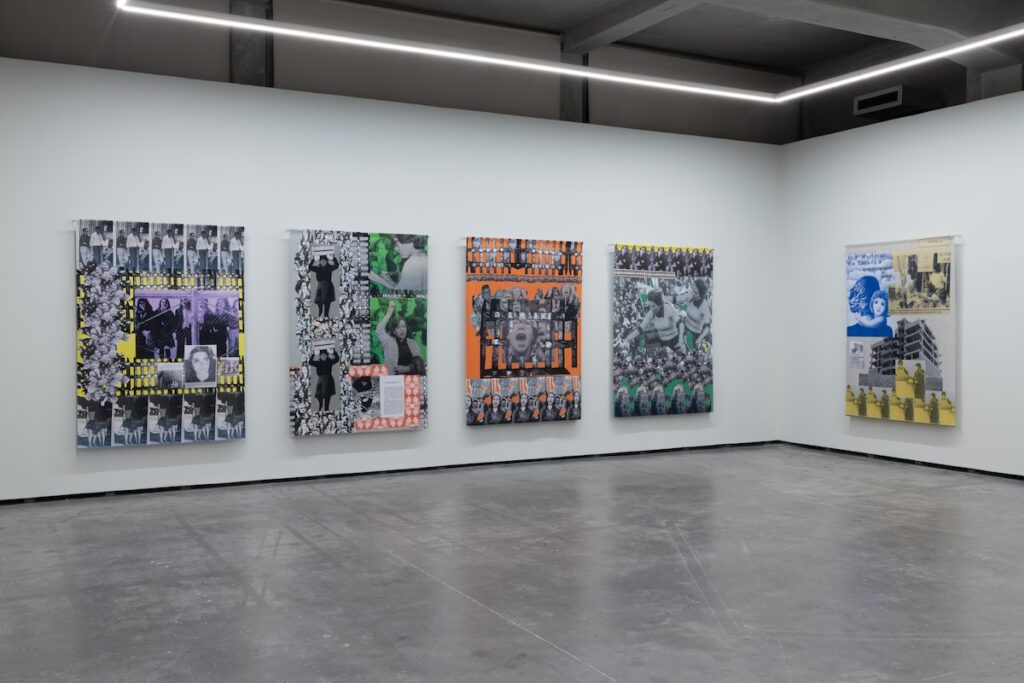
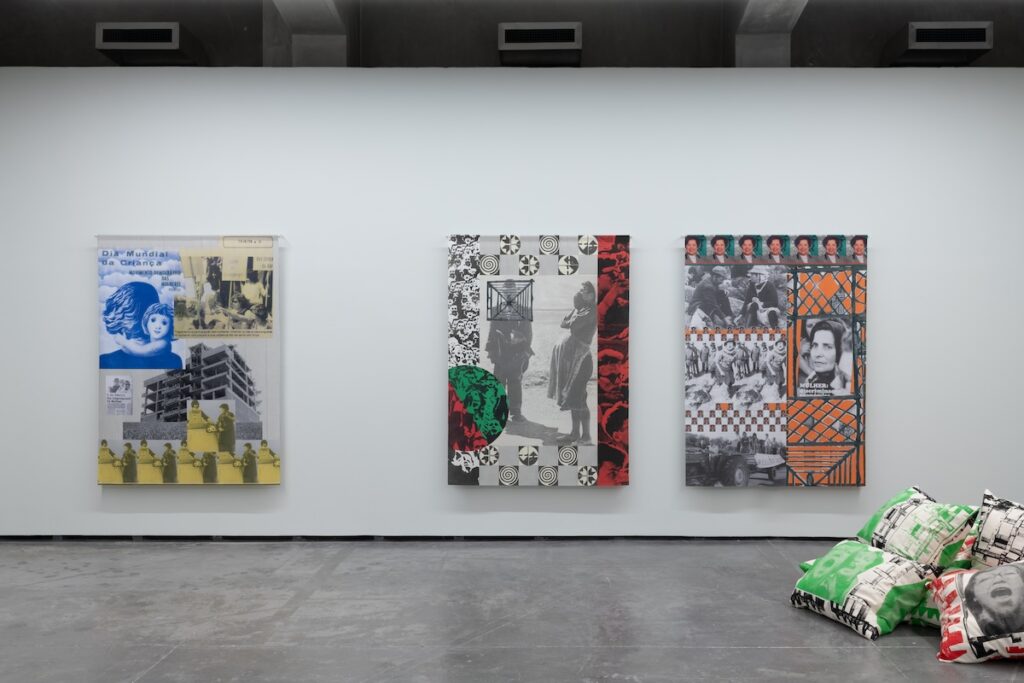
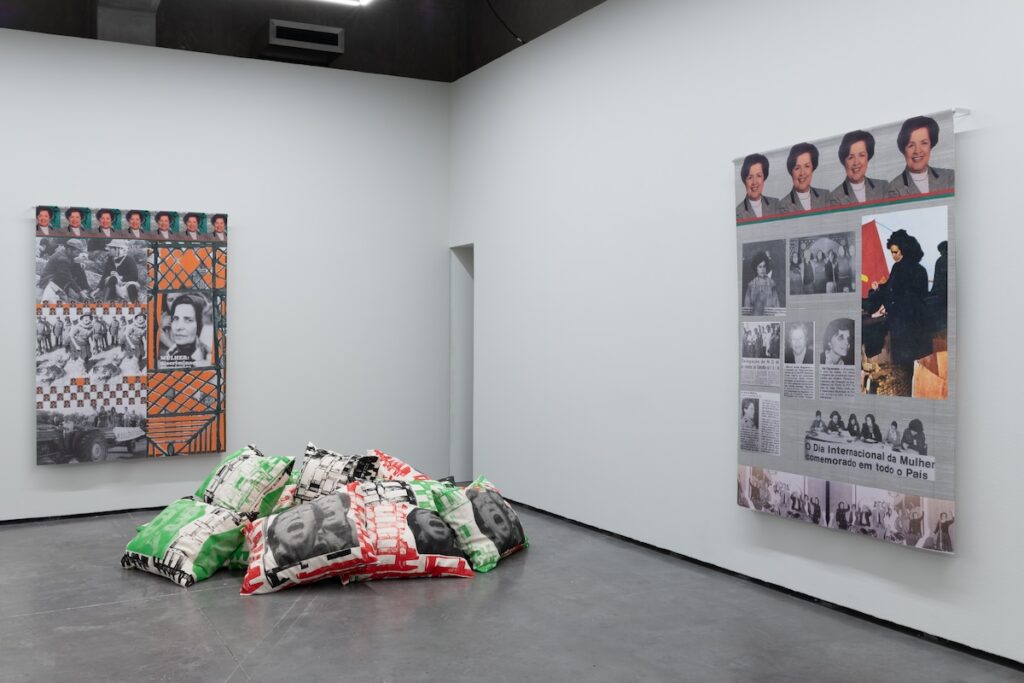
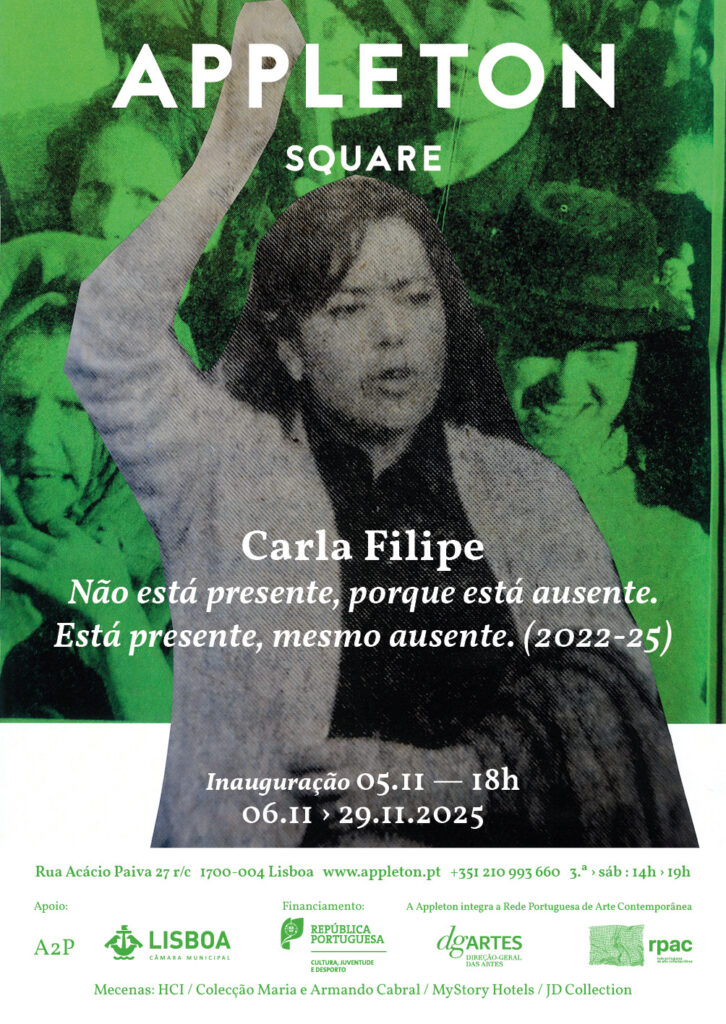
In Não está presente, porque está ausente. Está presente, mesmo ausente [She is not present, because she is absent. She is present, and yet absent], Carla Filipe takes us back to the period following the Revolution of 25 April 1974 and its unfulfilled promises, combining works from 2022[3] with new works [4] made especially for this exhibition. Here, the image prevails over the text and materiality of the historical documents appropriated by the artist. The layers she cuts out, pastes and overlaps – newspaper cuttings, portraits of anonymous and illustrious people, political stickers, convent grilles and geometric grids – merge in an uneven and chaotic but continuous whole. By detaching these figures from their context, the artist evokes the visuality of political posters of the period (and their constructivist roots), when images were the most effective means of mobilisation in a country afflicted by high rates of illiteracy. Despite their multiplicity, all these images share a common denominator: the woman—her flagrant absence or glaring presence.
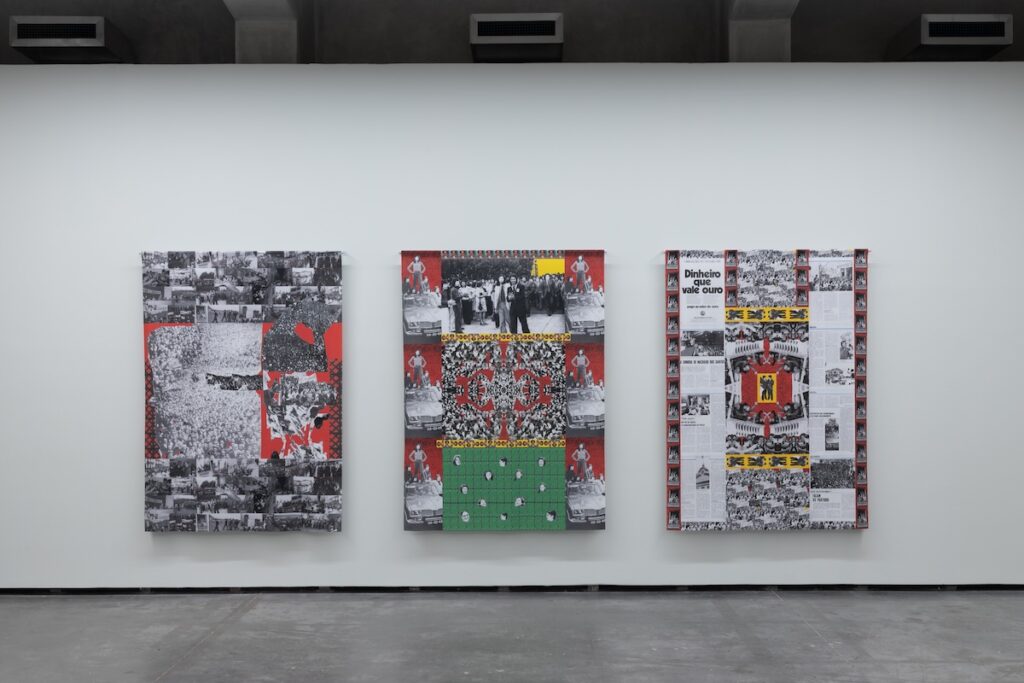
The 2022 series, created during the artist’s residency at Arquipélago – Contemporary Art Centre, on the island of São Miguel, stems from her realisation of an absence: consulting period archives on the mainland and in the Azores, the artist was struck by a persistent ‘patriarchal testimony of the Revolution’ and the lack of representation of women in the realm of politics and protest. In this group of printed fabrics, Carla Filipe mines the archive with a gesture of symbolic reparation: she multiplies the few female faces she finds, superimposing them over male figures, whether anonymous or iconic, like Otelo Saraiva de Carvalho and Ramalho Eanes, granting women the political prominence that was denied to them. The faces of these unknown women are repeated countless times, mirrored on the rostrums and replicated in the crowd, producing hybrid bodies that refuse to submit to the normative hegemony of the patriarchy.
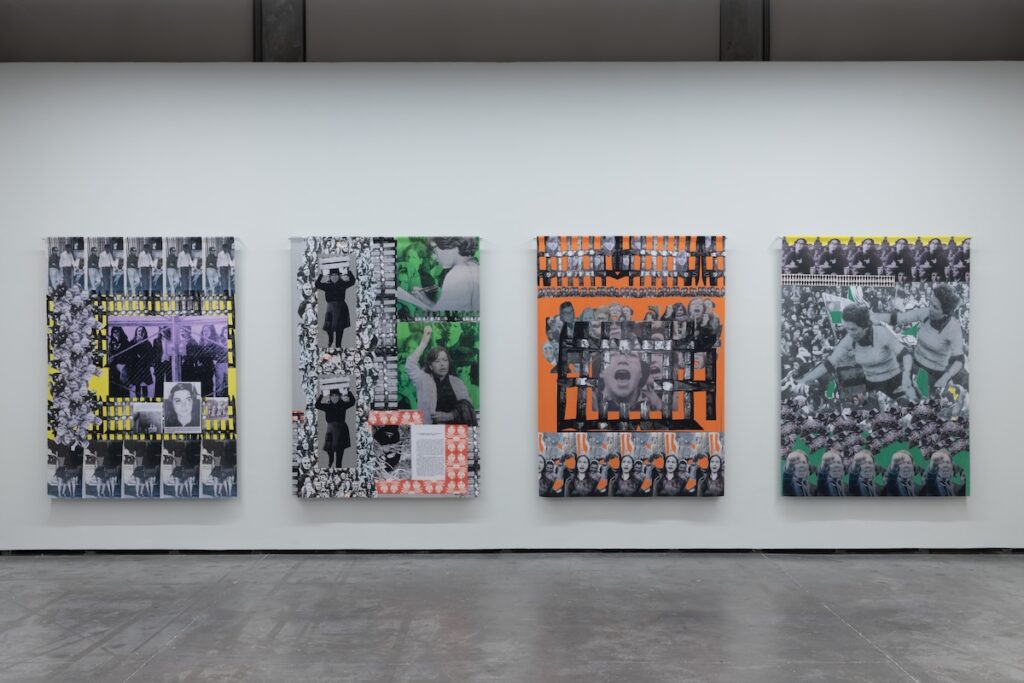
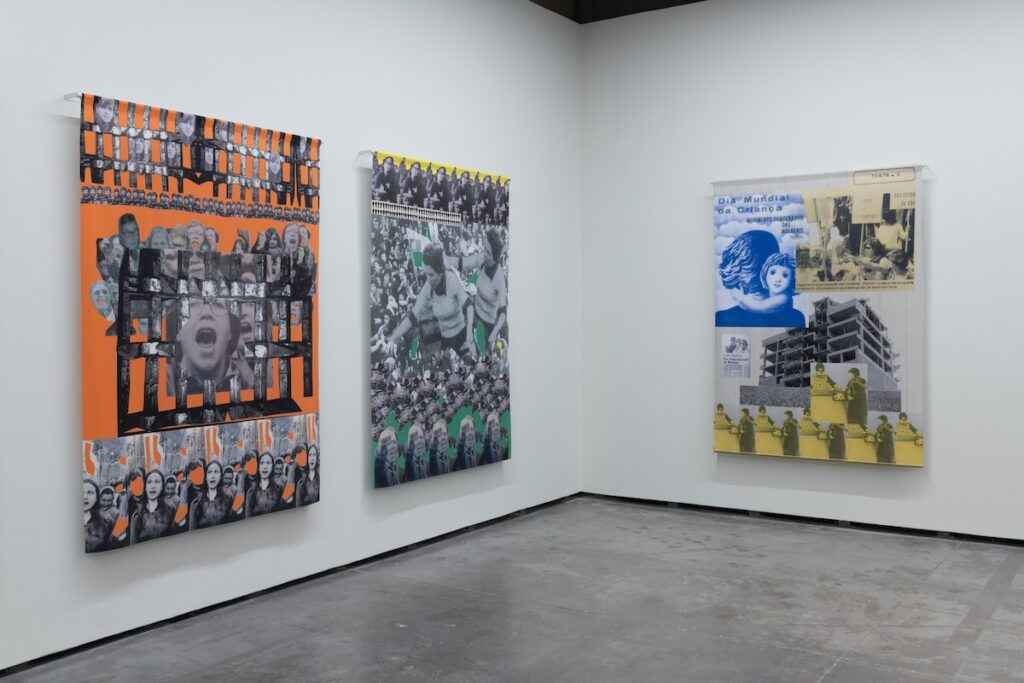
Conversely, in the new works the woman becomes an insistent presence. In her recent research, Carla Filipe has been delving into periodicals from the same years, where she finds, page after page, the images of women she was so eagerly seeking. Their visibility, however, turns out to be illusory, because they are given no voice or authority. Leafing through partisan newspapers such as Avante!, the artist reflects on the political exploitation of the female image, disseminated as an act of propaganda aimed at a sector of the population that had only just gained the right to vote: ‘The outraged working woman would be easily incited,’ she observes. ‘She was necessary, but hardly protected.’ While in some of these textiles—banners or standards, raised as protest posters—the text disappears completely, in others incisive messages stand out, such as: ‘If women have a right to the guillotine, don’t they also have a right to the rostrum…?’[5]
Rising up among the many shouting faces, are the hands of these multiple women: the hand that writes, that demands, that nurtures, that holds heavy loads over the head or tight to the chest. These are concrete, everyday gestures that condense centuries of invisible work. The artist highlights not just the political woman—in the figure of Maria de Lourdes Pintassilgo, the exception that proves the rule—but also the ‘woman-child’ or the woman aged by poverty; and, above all, the rural woman, without right to education and trained from an early age for hard work and obedience. As Carla Filipe mentions in the artist publication accompanying this exhibition, their stories do not seem to fit within the dominant historiography, instead lingering on the margins of accounts of agrarian reform, focused on the (male) worker’s struggle, and of gender studies, centred on the educated urban woman.[6] This binocular publication expands the reading of the exhibition in time, stretching from the historical origins of the patriarchy to the sanctioned violence that still blights our daily lives.
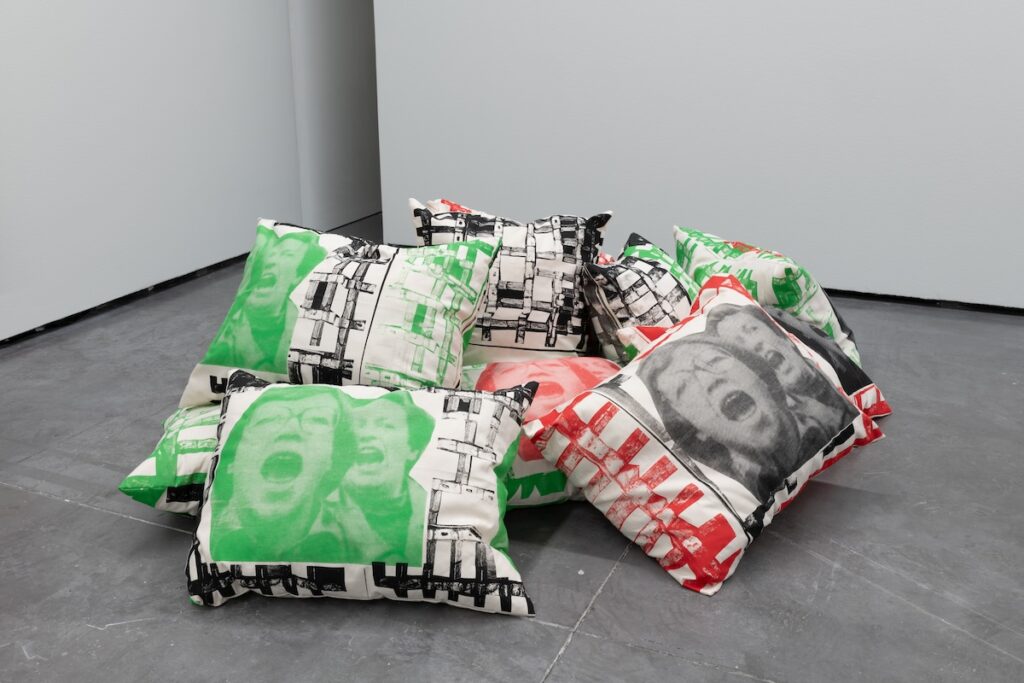
In its plurality, the exhibition pays homage to the angry woman, the one who screams and breaks the grilles of the convent. Because ‘no one likes angry women, they like conformist, intellectualised women, but not angry ones.’ Because these women shout, and their cry is a political act, urgent and conscious. Because in the face of this sea of evidence – the absences, the manipulations, the regressions – how could we not be angry?
Joana Valsassina
[1] Excerpt from the poem Confissões de uma Baptizada (III) [Confessions of a Baptised Woman (III)] by Carla Filipe, published in the catalogue of the exhibition of the same name, curated by João Mourão and presented at Arquipélago – Contemporary Art Centre, in Ribeira Grande, São Miguel, Azores, from September 2022 to April 2023. The works from 2022 presented here were conceived in the context of this exhibition and the artist’s residency at that institution.
[2] Unless stated otherwise, all quotes are from the artist, taken from unpublished notes.
[3] As esposas e mulheres (mulher anónima) de um corpo político ausente sob uma artificialidade de um corpo presente [The wives and women (anonymous woman) of an absent political body under the artificiality of a present body], 5 prints on fabric, 2022.
[4] Está presente, mesmo ausente (She is present, and yet absent), 6 prints on fabric, and Zangadas (Angry Women), 13 cushions, both from 2025.
[5] Beatrice D’Arthuys, As Mulheres Portuguesas e o 25 de Abril, Porto: Edições Afrontamento, 1976, p. 31.
[6] In relation to this historiographic reflection, the artist references the research developed by Ana Sofia Ferreira, particularly the article ‘Revolução nos campos do Sul: A participação das mulheres na reforma agrária em Portugal, 1974–1976’ (Revolution in the southern fields: Women’s participation in agrarian reform in Portugal, 1974–1976), História Agrária, no. 96 (August 2025), pp. 105-132.


 /
/  /
/ 