A Revolution is a Spinning Force is a collective exhibition exercise that puts together the artists Céline Condorelli, Jacopo Miliani and Mariana Silva in a joint reflection on the double meaning of the term Revolution, which can define both a social, political or cultural turning point as well as a movement of rotation of a body.
A Revolution is a Spinning Force comes out of a yearlong exchange of ideas, materials and impressions between the artists and the curator. The resultant works, new pieces that were produced during this process of dialogue, will be presented in the two gallery spaces of Appleton Square.
Condorelli/Miliani/Silva strongly ground their practice in a permanent activity of research, which becomes the founding element for their visual inquiry on sources and transmutations of gestures, forms and objects. Likewise they extend such activity to a revision of the physical and cultural structures that constitute the exhibition space: how it relates to time and to its perception, and how displays condition the forms in which space is traversed, used, lived and perceived.
Céline Condorelli
We just came to say No, 2013
Two-channel video installation, 55’, sound, colour
Jacopo Miliani
Studio for an alphabet, 2013
Photographic test
Dire e detti, 2013
Slide projection
Mariana Silva
Habit du Citoyen, 2013
3-D model rendered for video, 10’’, colour
Ex-Tiara of Saitaphernes, 2013
3-D model rendered for video, colour
La Gorguera or the Prolonged Repetition of the Guillotine, 2013
3-D model rendered for video, colour
Céline Condorelli is the author and editor of Support Structures published by Sternberg Press (2009), and one of the founding directors of Eastside Projects, Birmingham.
She is currently Professor at NABA (Nuova Accademia di Belle Arti) Milan.
Recent exhibitions include ‘Puppet Show’, Eastside Projects, Birmingham; ‘Additionals’, Pavilion, Leeds; ‘The Parliament’, Archive of Disobedience, Castello di Rivoli, Rivoli (2013); ‘Social Fabric’, Iniva, London and Lund Konsthall, Sweden; ‘Surrounded by the Uninhabitable’, SALT Istanbul (2012); ‘There is nothing left’, Alexandria Contemporary Arts Forum, Egypt and Oslo Kunstforening (2011-12); Manifesta 8, Murcia (2010); ‘Revision, part 1 and 2’ (Artists Space, New York, 2009, and Cell Projects, London, 2010).
Céline Condorelli (Paris, 1974) lives in London.
Jacopo Miliani has presented his projects in various exhibition spaces, including: Studio Dabbeni, Lugano; Frutta, Rome; Montehermoso, Victoria; Museo MADRE, Naples; Villa Romana, Florence; Nomas Foundation, Rome; Careof, Milan, Barbican, London; Istituto Svizzero of Rome, Rome; Castello Sforzesco, Milan; Museo de las Ciencias, Valencia; CAB Centre d’Art Bastille, Grenoble; Form Content, London; Círculo de Bellas Artes, Madrid; Serpentine Gallery, London; Galeria Vermelho, São Paolo an Komplot, Brussels. In 2009 he did the residence program at Platform Garanti, Istanbul. He is currently resident of MACRO, Rome.
Along with other artists, curators and scientists, he is a member of the collective OuUnPo (Ouvres d’Univers Potentiel).
Jacopo Miliani (Florence, 1979) lives in Milan.
Mariana Silva’s solo shows include ‘Environments’ (w/ Pedro Neves Marques), e-flux, New York, 2013; ‘P/p’, Mews Project Space, London, 2013, and ‘The organization of forms’, Kunsthalle Lissabon, Lisbon, 2011. Silva has participated in several group exhibitions, namely, ‘To the Arts, Citizens!’, Serralves Museum, Oporto, 2011; ‘For Love, not Money’, 15th Tallinn Print Triennial, 2011; ‘Perpetual Interview’, Cristina Guerra Contemporary Art, Lisbon, 2010; ‘Into the Unknown’, Ludlow 38, New York, 2010; ‘República ou o Teatro do Povo’, Arte Contempo, Lisbon, 2009; and ‘BesRevelação’, Serralves Museum, Oporto, 2008. She was a resident at Zentrum Paul Klee Sommerakademie, Bern, Switzerland, 2010, and at ISCP, New York, 2009–10.
Mariana Silva (Lisbon, 1983) lives in New York.
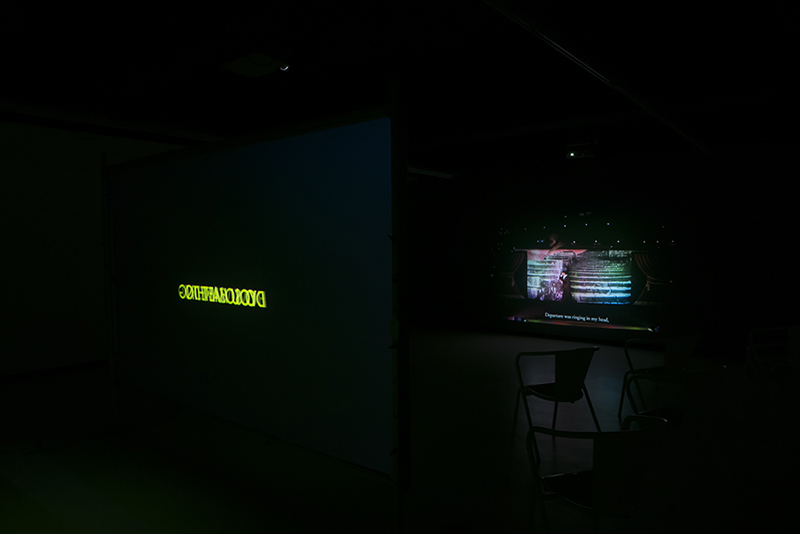
Céline Condorelli presents We just came to say No, an installation based on an homonymous performance, presented in Modica, Sicily, in August 2012.
The plot results from the adaptation of Elio Vittorini’s anti-fascist novel Conversations in Sicily (1938) and is performed – and watched by – a group of puppets. Reacting to the seeming passivity of the players on stage – and by the impossibility to revolt against the established – the unruly puppets in the audience call for a rebellion.
We just came to say No tests the possibilities of adapting a live event into a video installation, at the same time as it considers the potential revolutionary role of the scenic space.
Jacopo Miliani presents Dire e detti, a sequence of photographs and Studio for an alphabet, a series of slides that display a possible embodiment of speech and in which movement becomes the generator of forms, and is translated into an appropriating gesture that upgrades the past.
The slideshow presents a physical representation of the Western alphabetical characters. The letters are arranged to compose a sentence by the Carmelo Bene, When we believe we are the ones saying, we are being told (Quando crediamo di essere noi a dire, siamo detti), in which the Italian writer-actor-director reproposes the Lacanian assumption that the uttering subject is subjected to its own declarations.
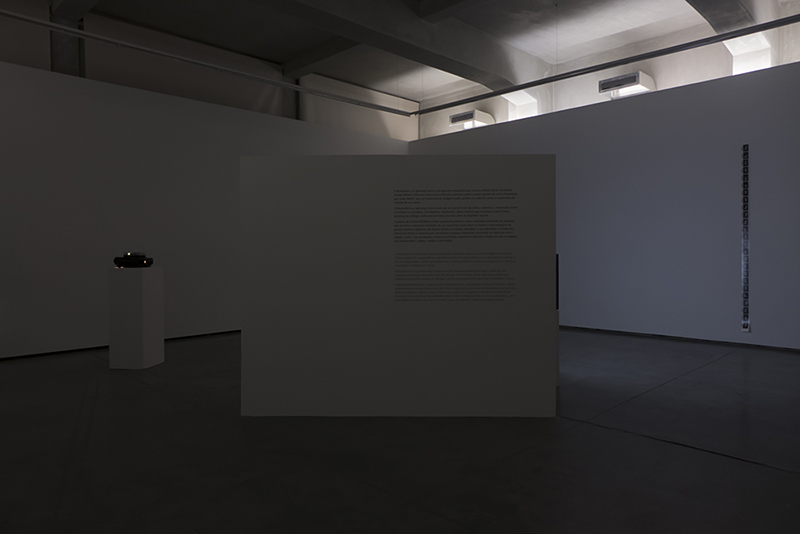
Mariana Silva’s three videos propose an extension of the space of Appleton Square. They encompass three absent objects, which were reconstructed with 3D animation, thus becoming part of a secondary museological language that bears latent the representative violence of the gesture of representation.
Ruffs: 16th century collars of the Spanish aristocracy, considered by the Brazilian architect Flávio de Carvalho as a herald of the invention of the guillotine, supported by a modernist device used by Peggy Guggenheim in Art of the 20th Century.
Tiara of Saitaferne: supposedly a Greek crown of the 3rd century BC, purchased by the Louvre and later declared a fake, thus being reclassified as 19th century jewellery.
Habit du Citoyen: anonymous poster, possibly from the 1970s, alluding to the “citizen suit” designed by Jacques Louis David during the French Revolution.



 /
/  /
/ 