A. Every time I reflect on the categorisation of a work of art, or try to classify it, it immediately becomes a reductive act. Reducing its intent or potential. I don’t want to dictate or control its narrative, I just offer the necessary conditions for it to exist in a shared environment. There will be times when something connects us with art, in the face of its presence, and others when art conveys something, a message or emotion. I am referring to something in the field of intuition, the emotional, or even the spiritual.
B. I understand what you say, and I identify with that a lot. Art, and all of its production, seems to exist precisely in that limbo; potent and tensional. Between what we recognise in it as a symbolic dimension, codified language, or subjective projection, and all the Real, tumultuous, unshakeable, almost chaotic, that it brings with it and that always exceeds us in the relationships that we can develop with objects. Somehow, this experience that you are referring to seems to be the point where our language fails. Where the effort of description always falls short of the object’s reality.
A. I would say that language both fails and shows its own limitations. It is as if it reveals a space on the margins, a fissure, approaching the unrecognisable. When I look at each of the works in this exhibition, I feel that I am placed somewhere that has familiar elements, but that offers me something new. They add something to my visual, auditory or imaginative vocabulary. They have the ability to explore my senses and pull me beyond. Am I heading towards the occult? Towards what is not visible but whose presence is felt?
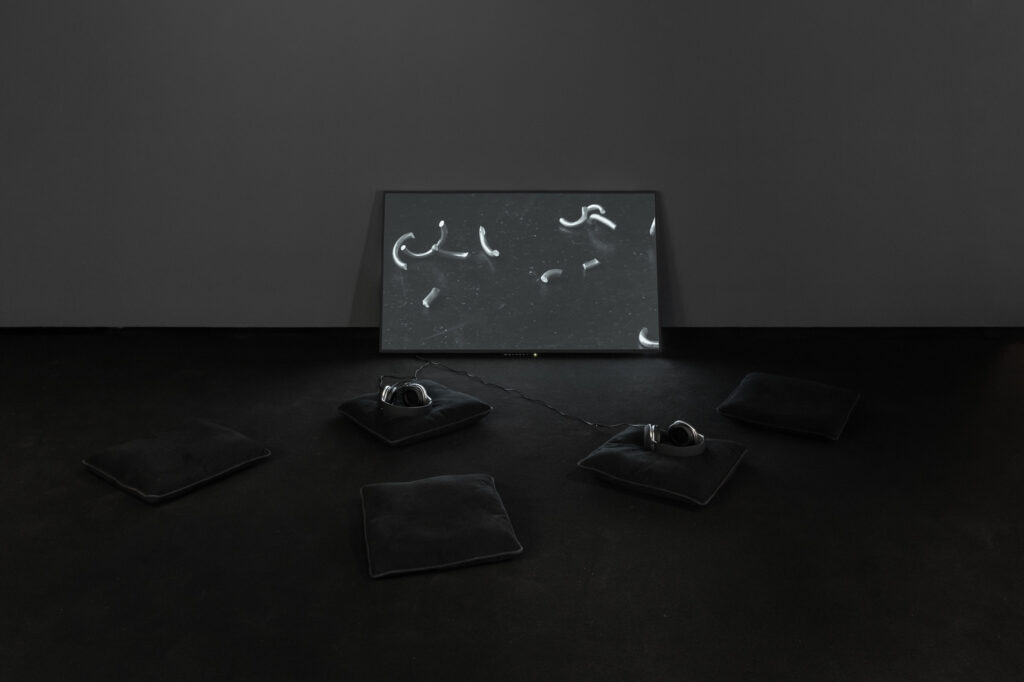
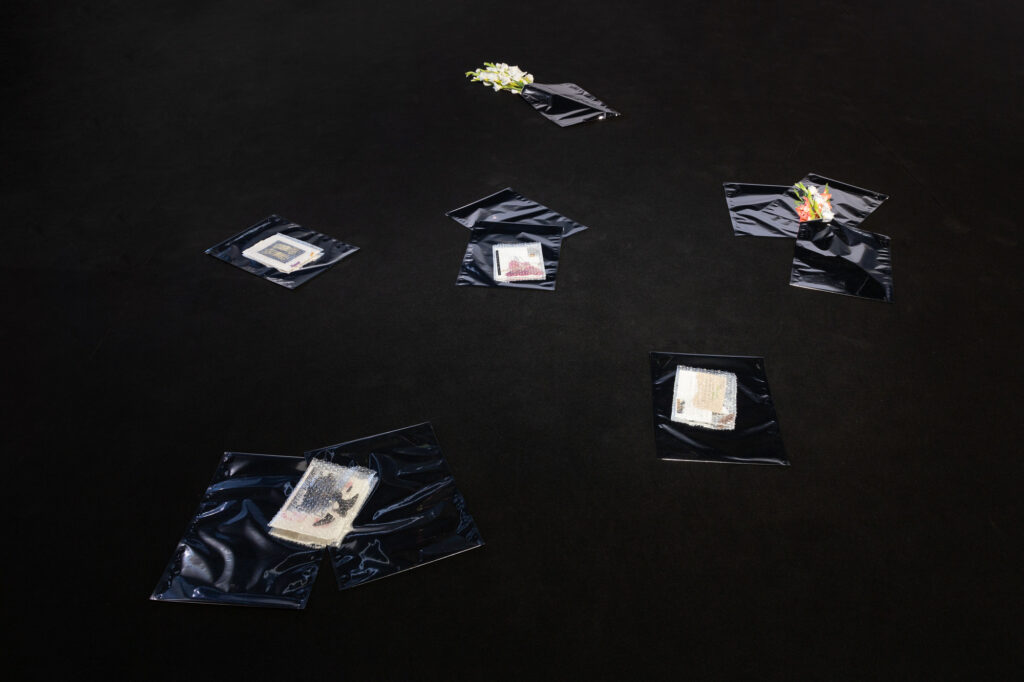
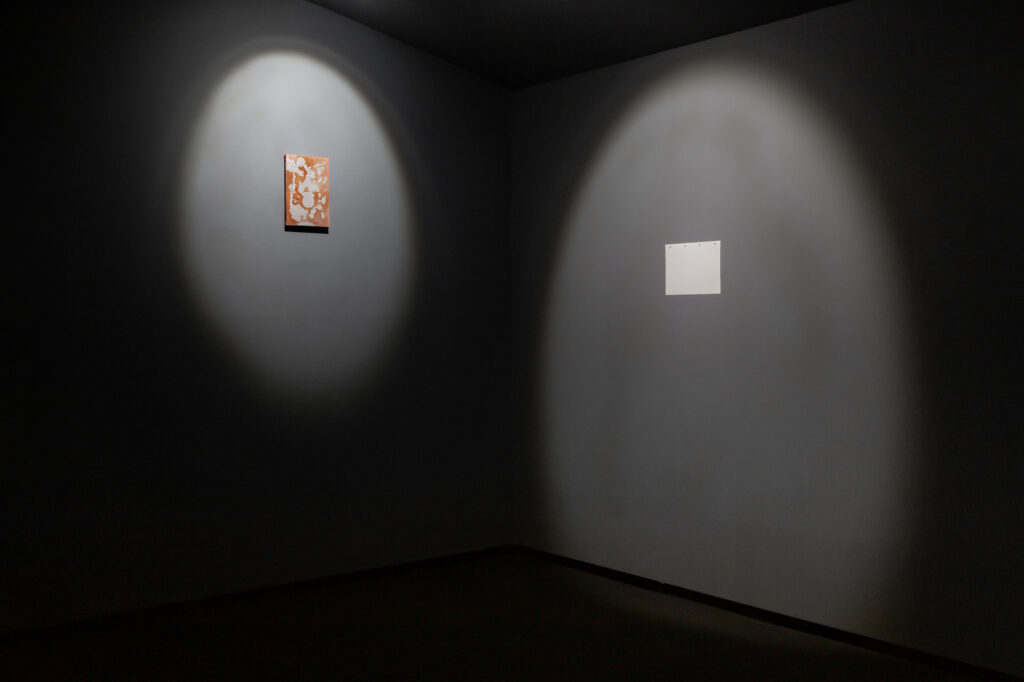
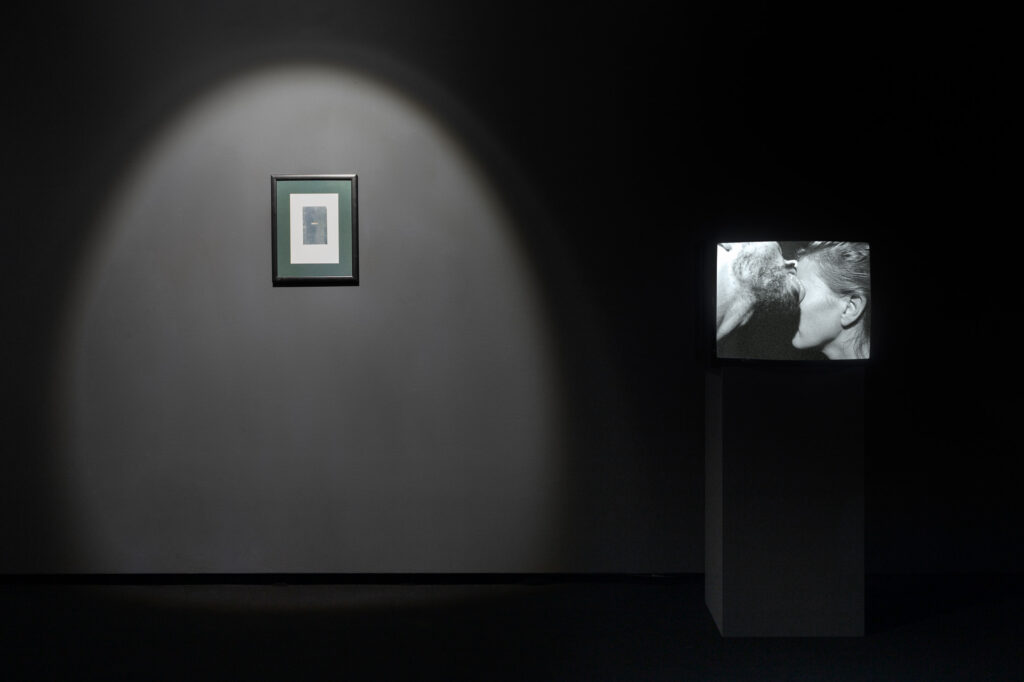
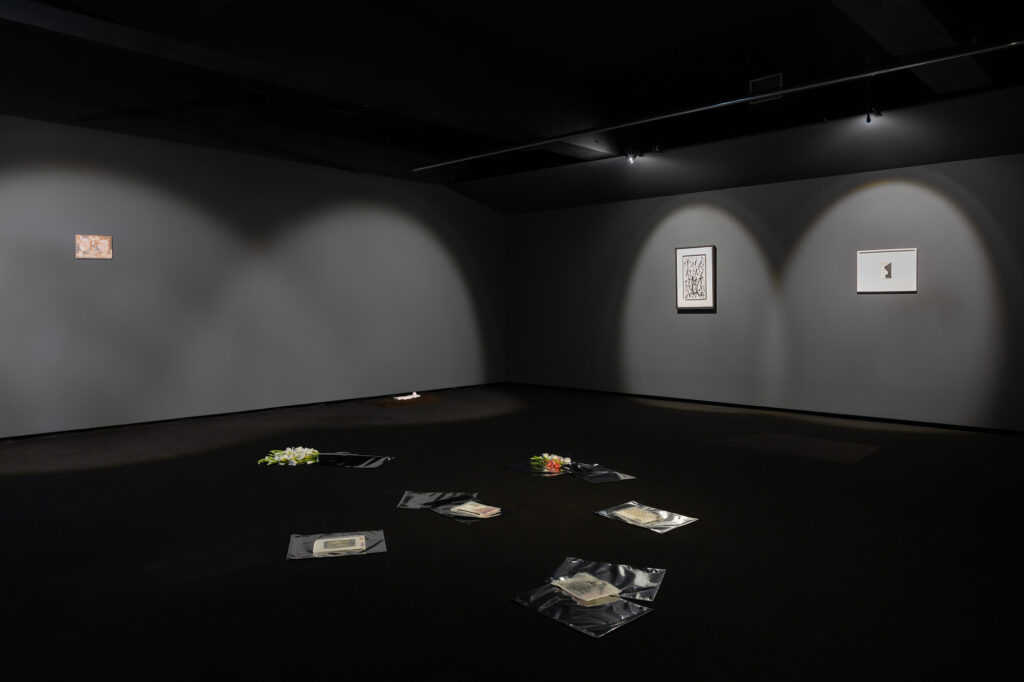
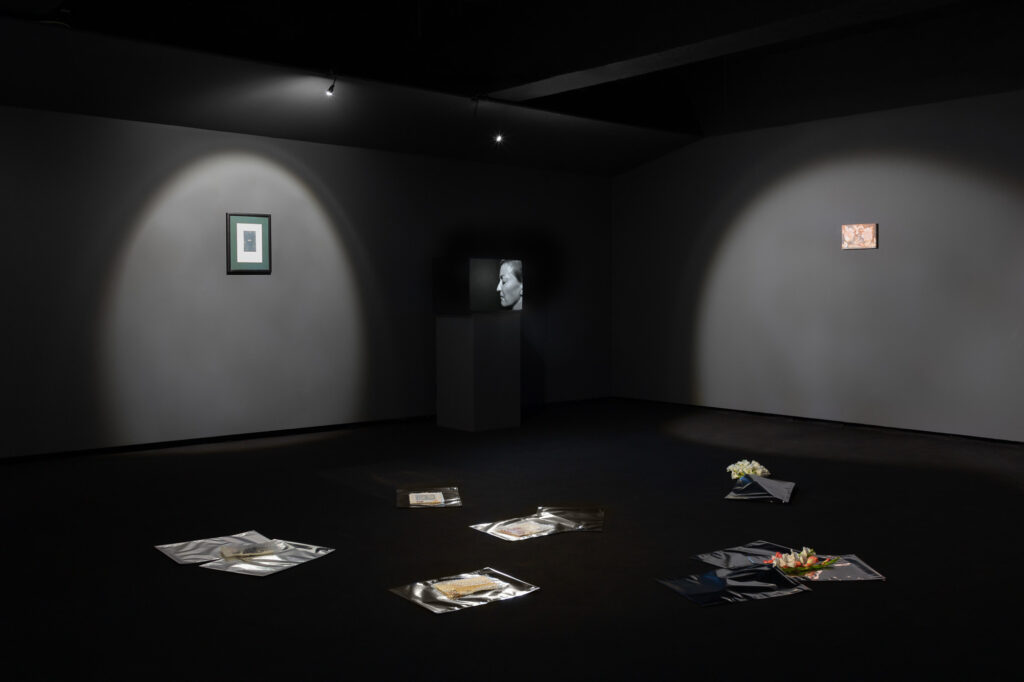
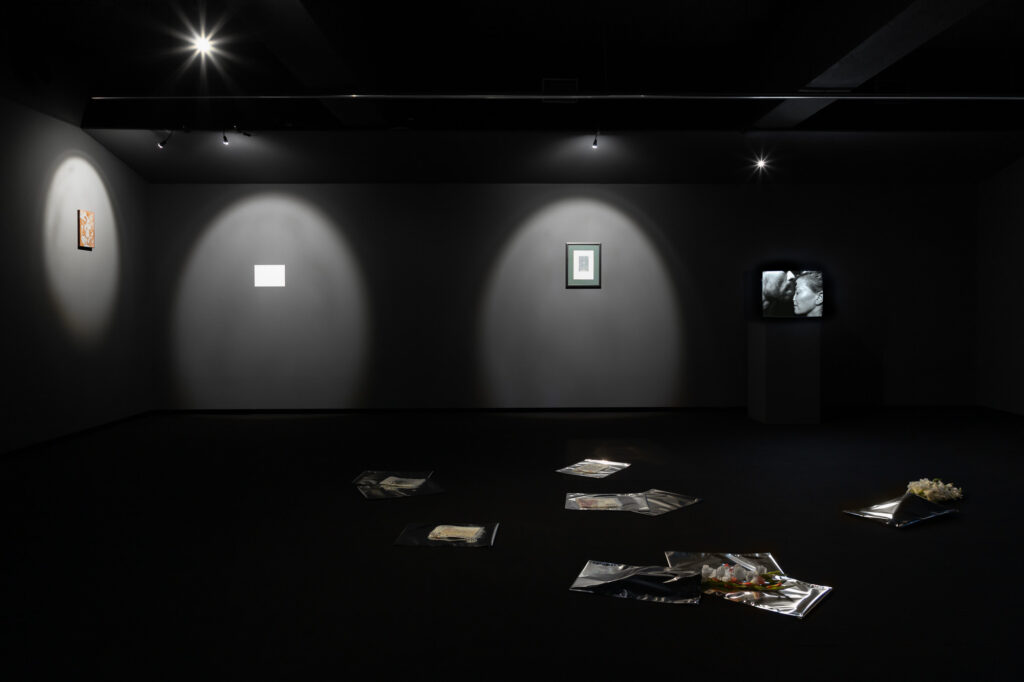
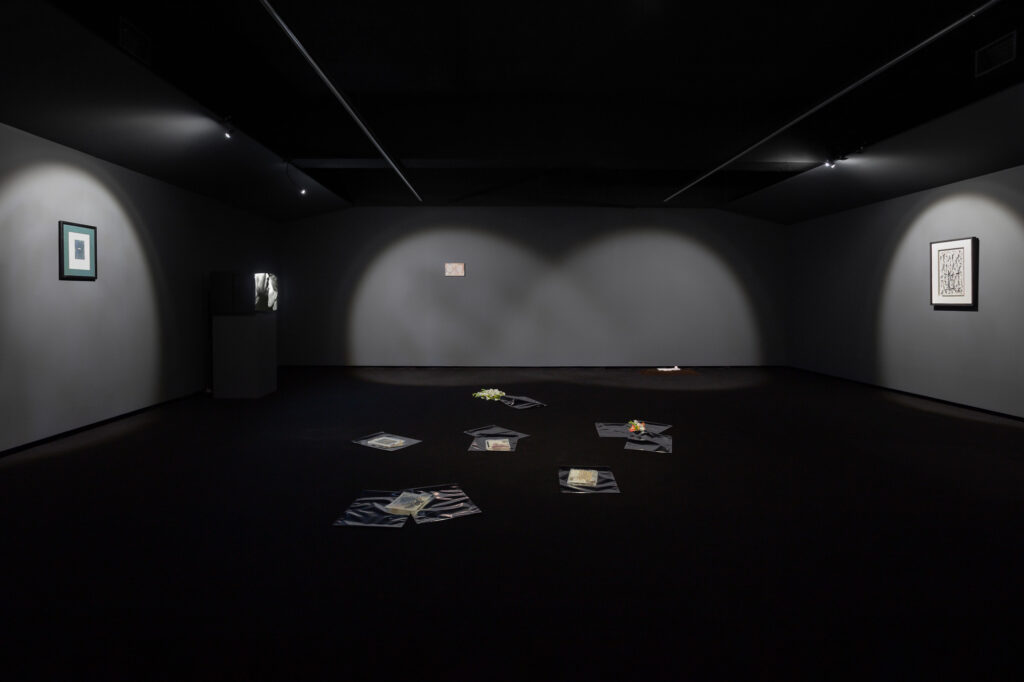
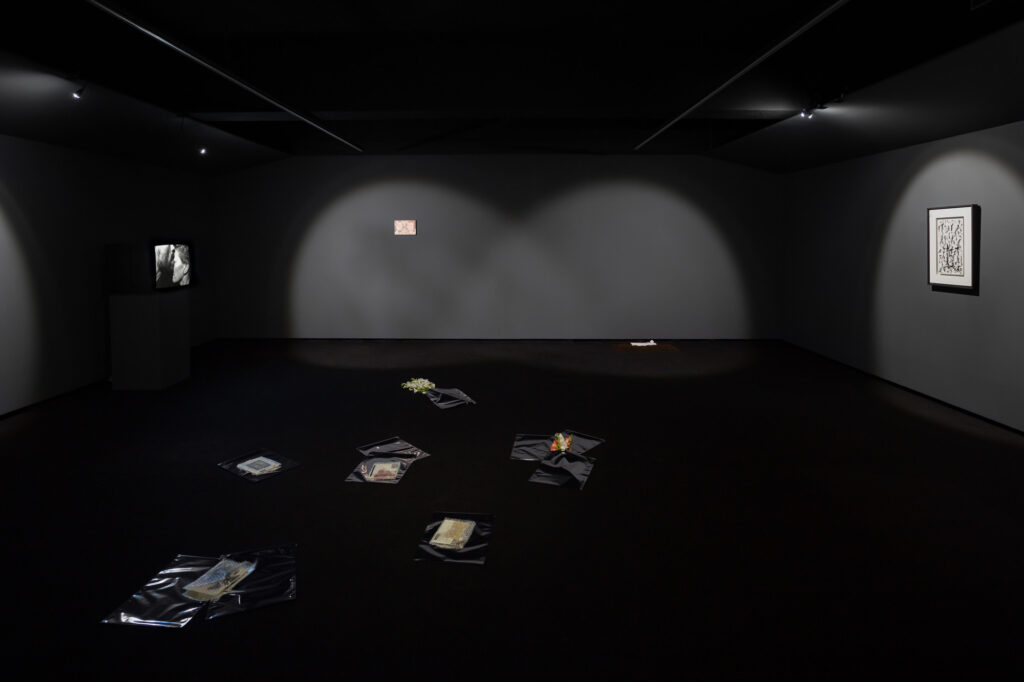
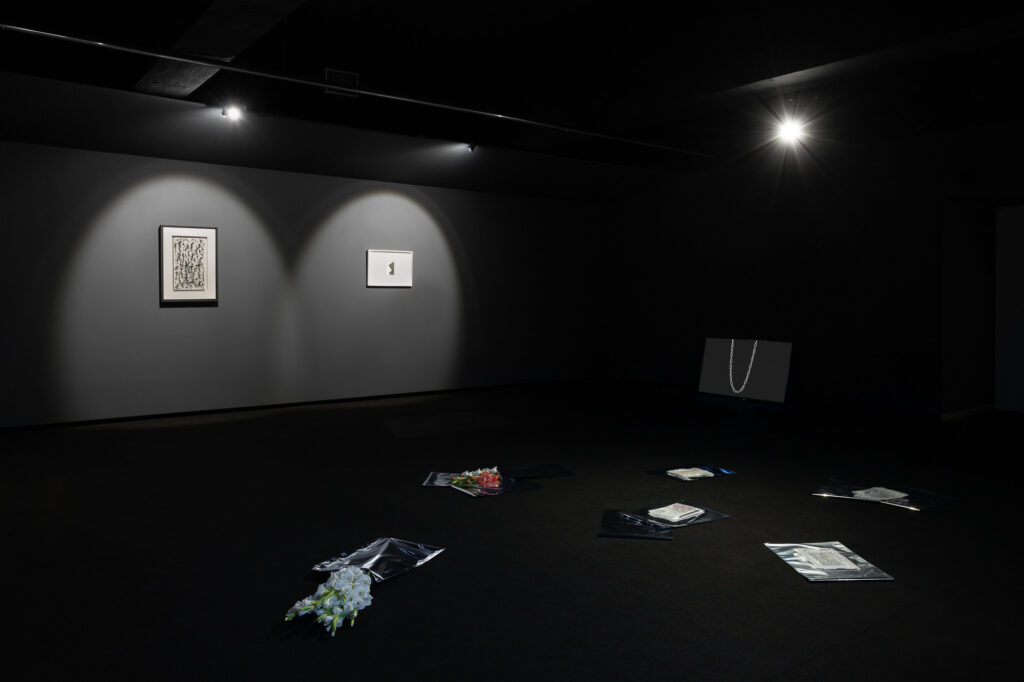
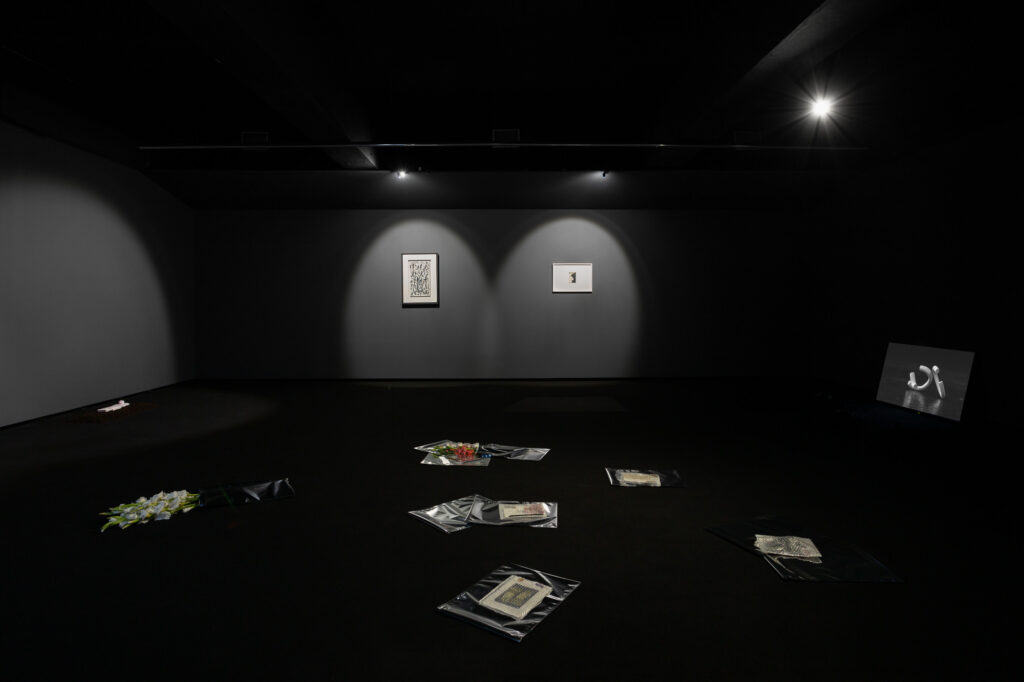
B. Yes. Language is a human invention. A filter of protection and control between us and things. An instrument for mobilising reality through thought. So I agree with you, it’s limited. There is always something that remains uncovered, or that cannot be completely covered. Perhaps the occult you speak of is precisely what is completely unhidden, and therefore entirely free. I would say that in this exhibition we end up placing ourselves neither beyond nor below language. As if this could be an immobile point in space, a centre of hegemonic convergence or a fixed identity image which we reject. I feel that we are in a parallel, perpendicular, tangential place, in what is an attempt to confirm differences in a powerful plane of multiplicity. Human and non-human languages coexist in this exhibition space, among objects, materials, virtualities, images and expressions of different natures. Which points to heteroclite directions, always elusive, always indomitable.
A. All this attracts new possibilities, not only in the way we think about works of art but, in this case, also in how we as humans can relate to anything that is outside of the prescribed. Arguably, the limitations that are imposed on the way we relate and communicate do not allow for other forms of expression to take place. I often think of the agency that each of us has in questioning what is conceived as reality or as irrefutable truth. Here, in this space, we manage for a moment to suspend certain beliefs and believe that there is something more. We have opened up a potential new web of associations, one that we hope will generate many others.
Barbara Kapusta lives and works in Vienna. Her works are articulations of situated bodies, partial perspectives and queer agency as they question the imperial gesture of universality and binary structuring. Recent and upcoming exhibitions include The Palace of Concrete Poetry, Writers’ House, Tbilisi, (2022); Let your () do the talking, NAK Aachen (2022); Futures, Kunsthalle Bratislava (2022); Lo(l) – Embodied Language, Kunsthaus Hamburg (2022); Dissolving Matter & Value, Lothringer 13, Munich (2021); Enjoy, museum moderner kunst stiftung ludwig wien, Vienna (2021); Europa Antike Zukunft, Halle für Kunst Steiermark, Graz (2021); The Leaking Bodies Series, Gianni Manhattan Vienna (2020); Dangerous Bodies, Kunstraum London (2019), Hysterical Mining, Kunsthalle Wien (2019), Empathic Creatures at Ashley Berlin (2018).
Ian Law, born 1984. Lives and works in London, UK. Exhibitions include Kingdom of the III: Second chapter of TECHNO HUMANITIES (2021-2023), Museion, Bolzano (2022), Drips the room, Piper Keys, London (2020), Robert Overby / Ian Law, RODEO, London (2018).
Gonçalo Birra lives and works in London. Their practice investigates the ways in which our particular attachments to objects, be them words, ideas, people, or things, remain vulnerable to the disruptive and disorganising persistence of the unknowable, irreparable, and the forgotten.
Loreto Martínez Troncoso currently lives in Marseille. For the last twenty years, she has been unfolding an artistic practice focused on performance, developed from very diverse approaches and disciplinary spaces, but always connected by language, whether through the oral word or the written word, from which she creates different situations, realities and performances. Previous exhibitions and individual actions include Les Laboratoires d’Aubervilliers (Paris), Center Georges Pompidou (Paris), Arteleku (San Sebastian), Fundação de Serralves (Oporto), MARCO (Vigo), Center d’Art – La Ferme du Buisson (Noisiel, France), PM8 Gallery (Vigo) and Church of San Domingos de Bonaval (Santiago of Compostela); or the group exhibitions Urbanitas (MARCO, Vigo, 2006), Art and Research 07 (Montehermoso Cultural Center, Vitoria), The medium is the museum (MARCO, Vigo / Koldo Mitxelena, San Sebastián, 2008), The Scream (MUSAC, 2011), Creation Scholarships art abroad Gas Natural Fenosa (MAC, A Coruña, 2015).
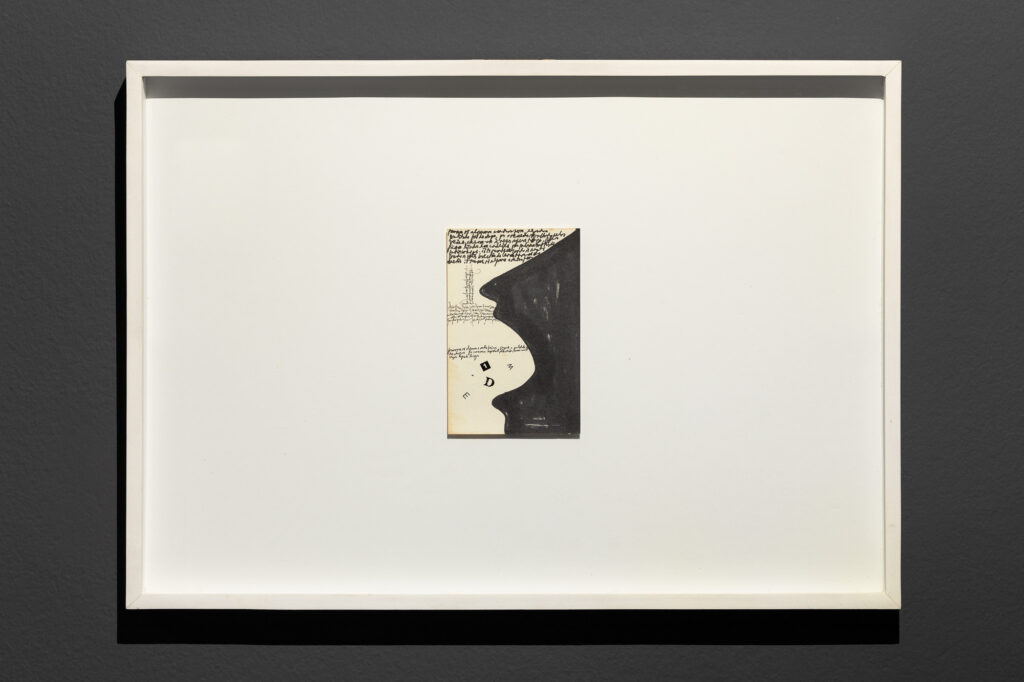
Ana Hatherly (Porto, 1929 – Lisbon, 2015) was a visual artist, writer, essayist and filmmaker. Interested in all forms of communication, she began by developing her work in the field of writing and drawing. She wrote her first book of poetry in 1958, “Um Ritmo Perdido”, as an allusion to the musical career that did not continue. It was the beginning of an extensive poetic work. A member of the Portuguese Experimentalist Group, Ana Hatherly was one of the theorists of this movement that began in the 1960s in Lisbon. She founded the Revista Claro-Escuro in 1988. She participated in numerous exhibitions, highlighting Alternative Zero, 1977; a full retrospective of her work, CAM, 1992; and a posthumous exhibition at the Gulbenkian Museum and Fundação Carmona e Costa, 2017.
Diogo Lança Branco (1993, Portugal) currently living and working in Lisbon. More recently exploring sound, performance and writing rather than focusing on their painting and drawing background. Concentrated on experiments rather than very polished and finished bodies of work, their endeavours rely on thinking (or rethinking) what ways of communication can be actual means to reach a sense of wholesomeness and integrity. With an always-present queer perspective on art and its ways of production, whether solo or as a partnership. They’ve had a few recent opportunities to work alongside friends, placing care, affection and community as the core goals of every project.








 /
/  /
/ 