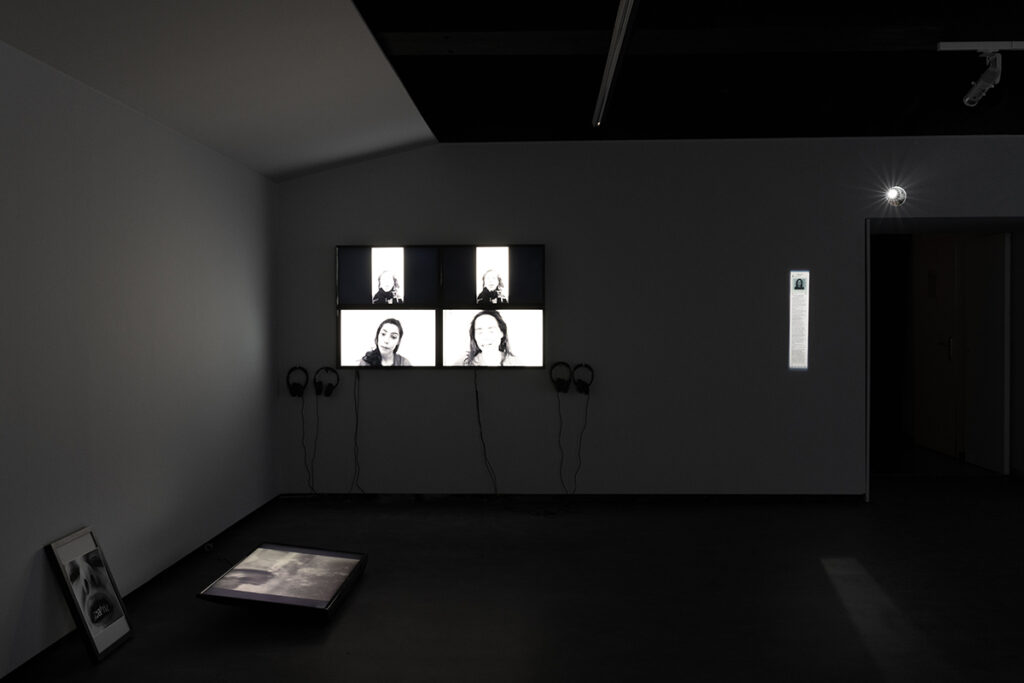
In the works brought together in Self-accusation, artist Bárbara Paz presents us with a sequence of elaborations around scars – real and symbolic – from a serious car accident she experienced when she was still very young, in which she suddenly saw her life hanging by a thread. In this process of elaboration, however, Paz does not to seek to entirely reconstruct or replicate her traumatic past experience as it actually was, but rather deal with the pieces, reminiscences, fragmented images that populate her memory of the event.
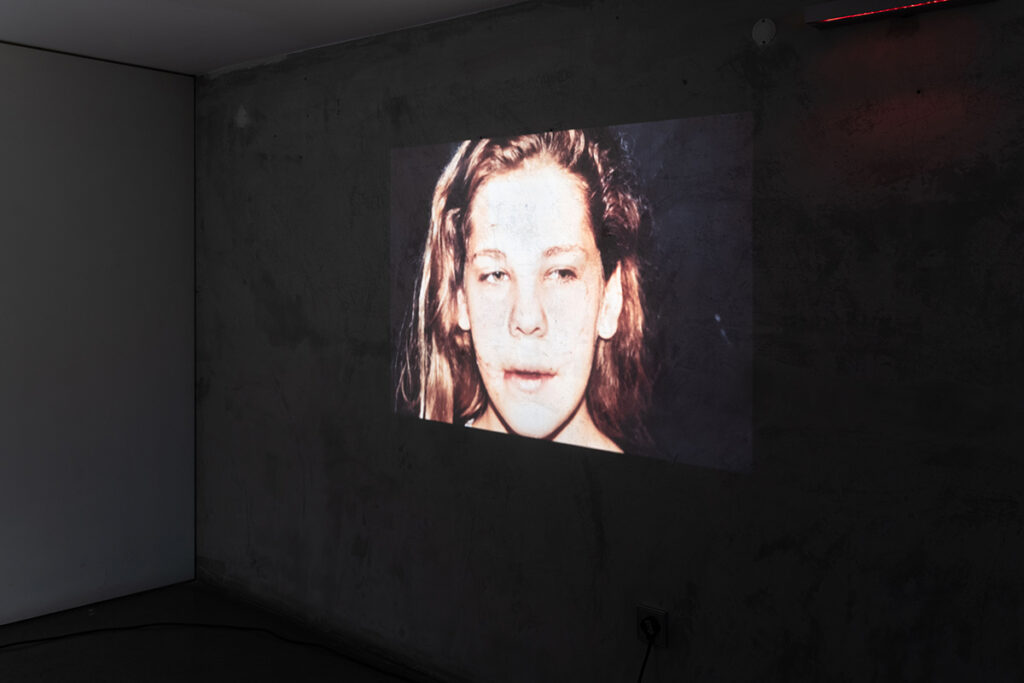
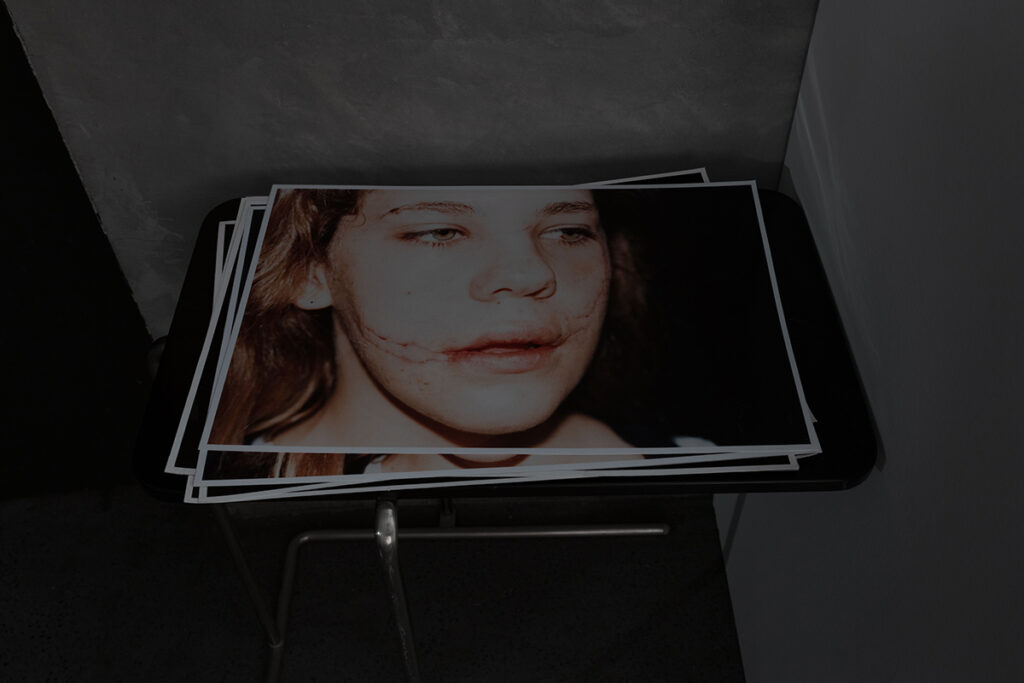
While the work Aquela menina [That girl] (1992) presents us with slides from the time of the accident, the rest of the works exhibited today were produced three decades later. From a tangle of past threads, Paz weaves a plot that goes beyond solely autobiographical details, resulting in images that are at once poetic and characterised by a latent violence. The artist’s gesture tells us that we never remember the past as it actually was, since memory is a mechanism that fabricates, constructs, edits and adds. Consequently, taking care of an open wound from the past is not about establishing facts, but rather making use of the fictional nature of memory itself in order to re-signify what happened – as if remembering that the future can only exist when the past is no longer. The images Paz creates are therefore imbued with an opaqueness and lacunosity, components of remembering that do not seek to restore a totality, but rather operate by means of fragments.
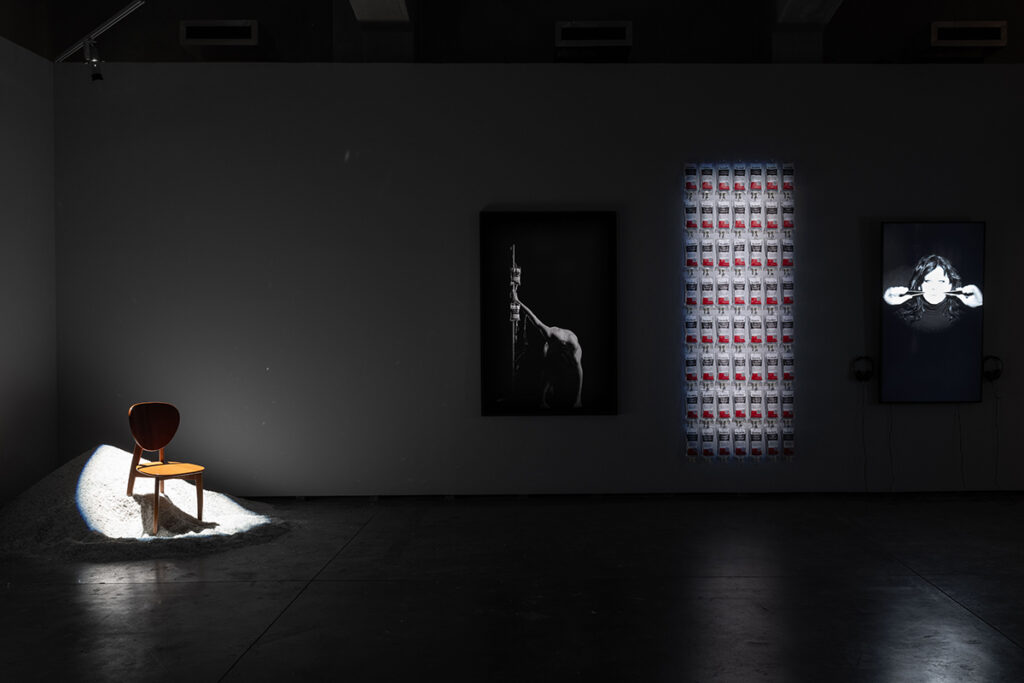
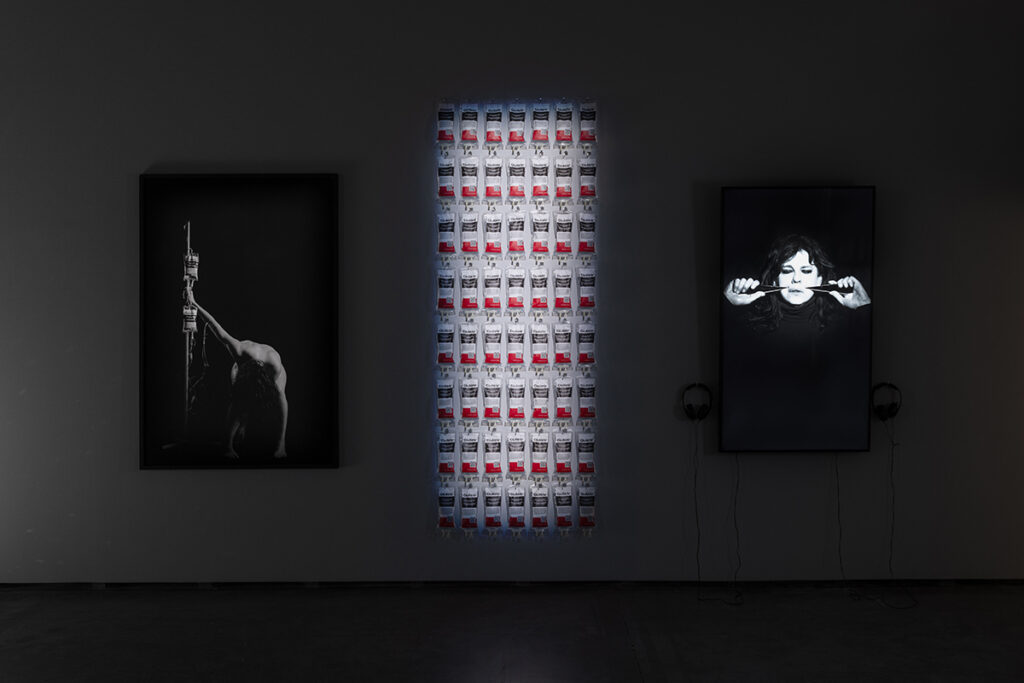
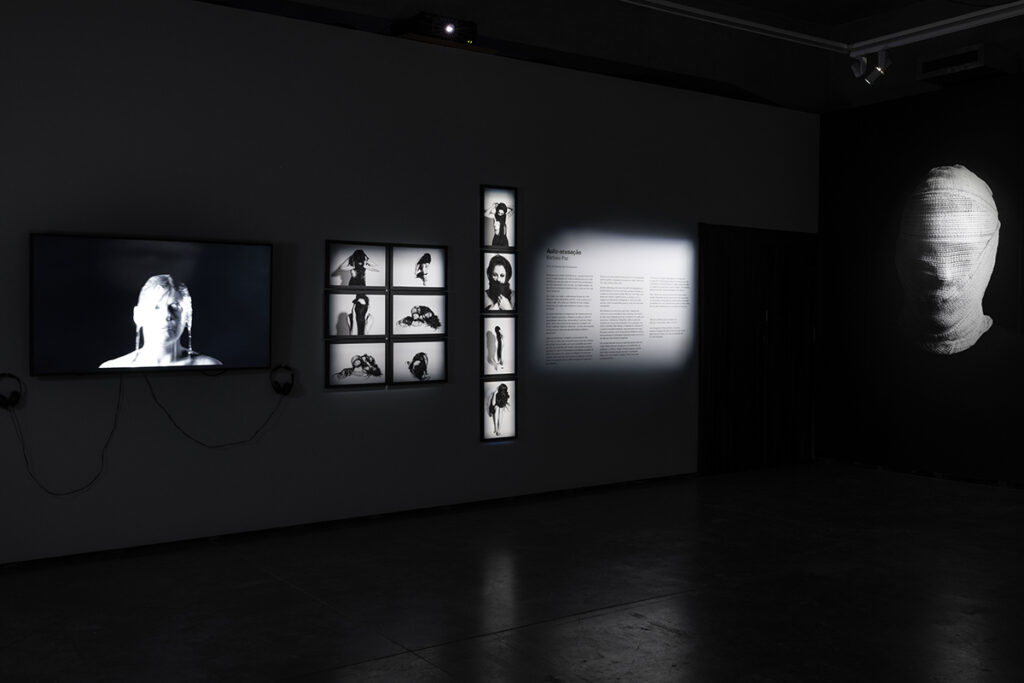
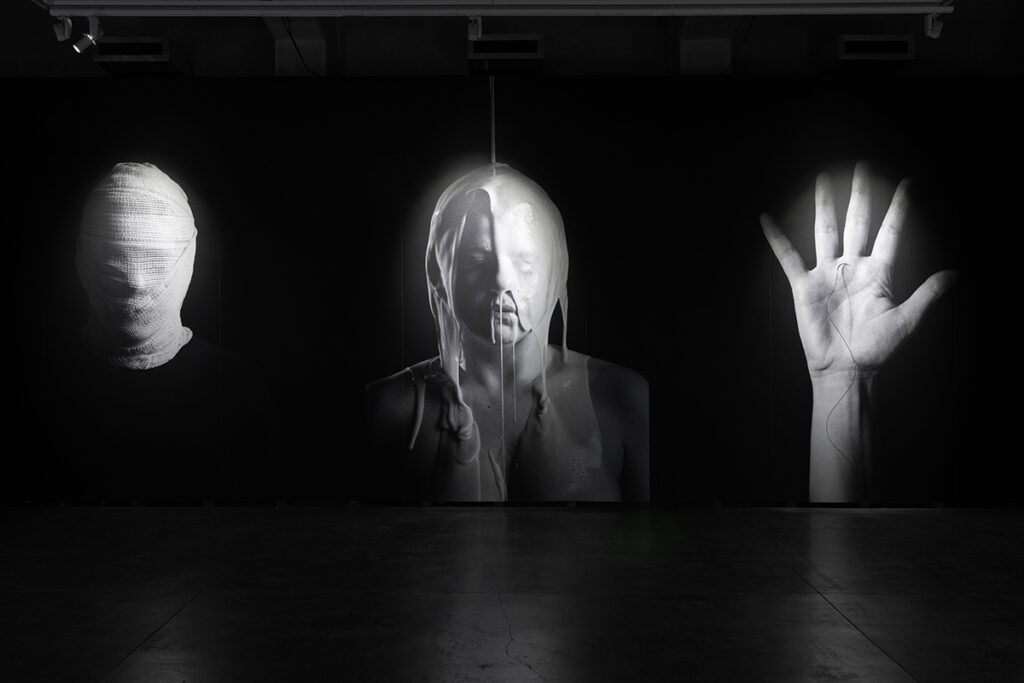
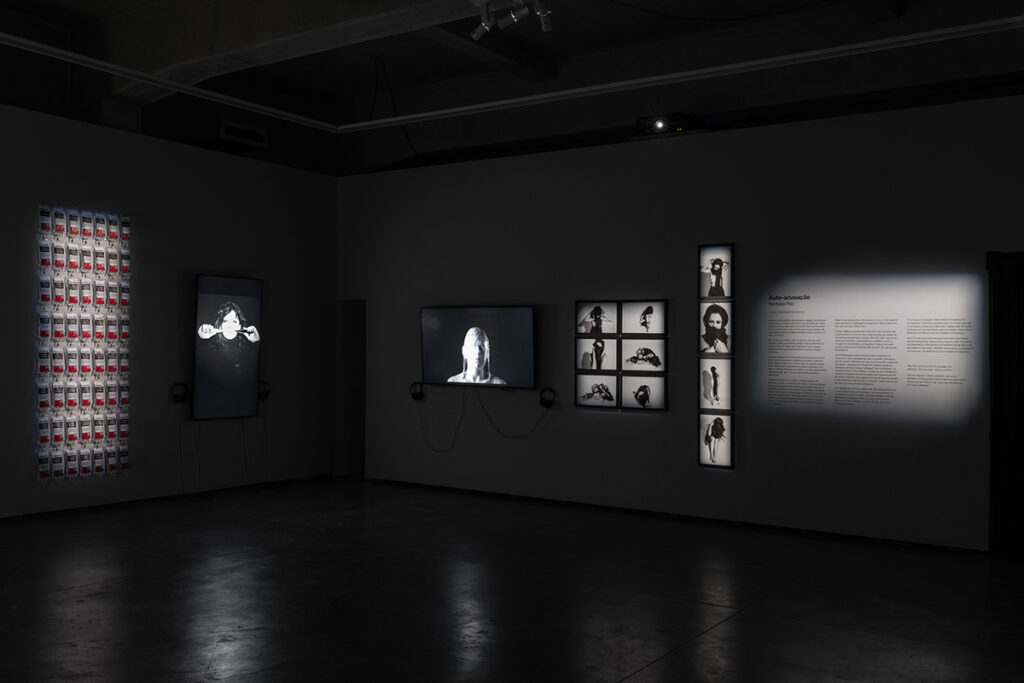
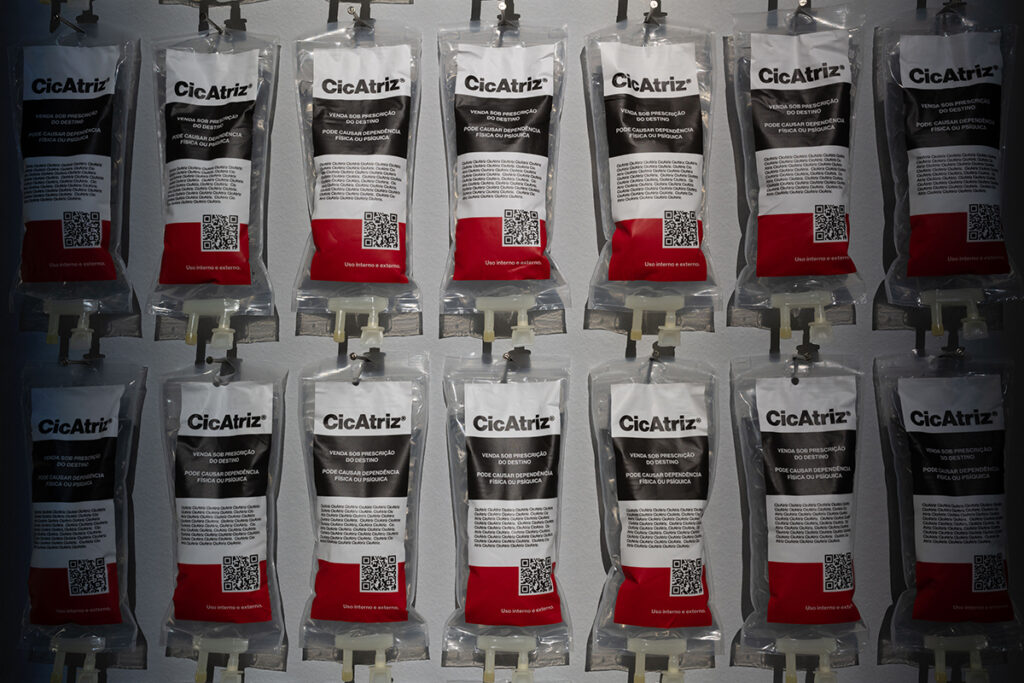
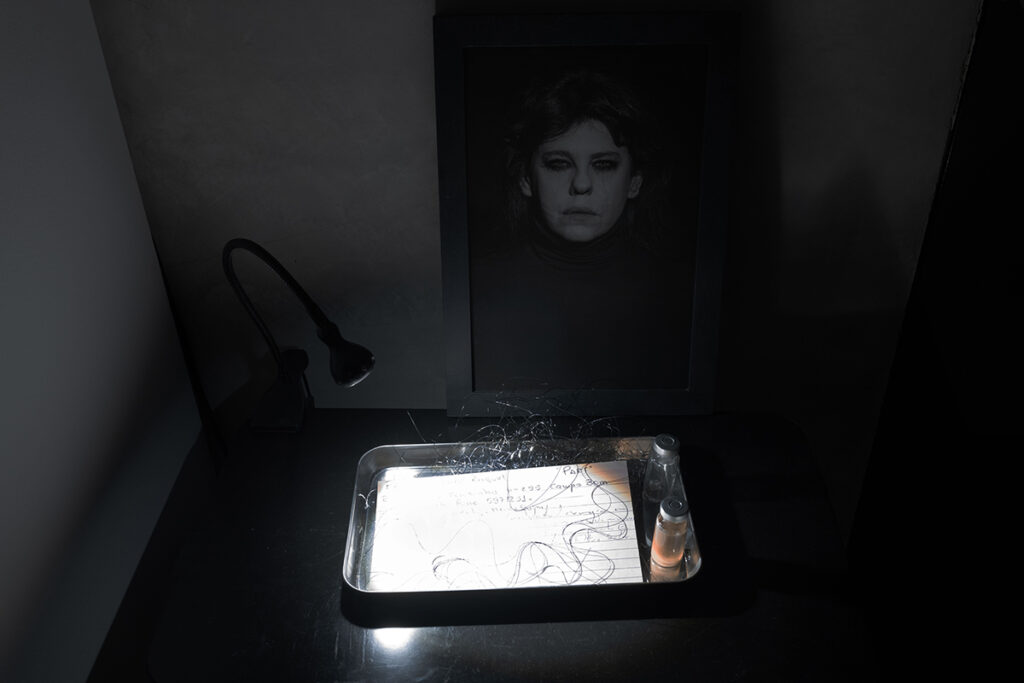
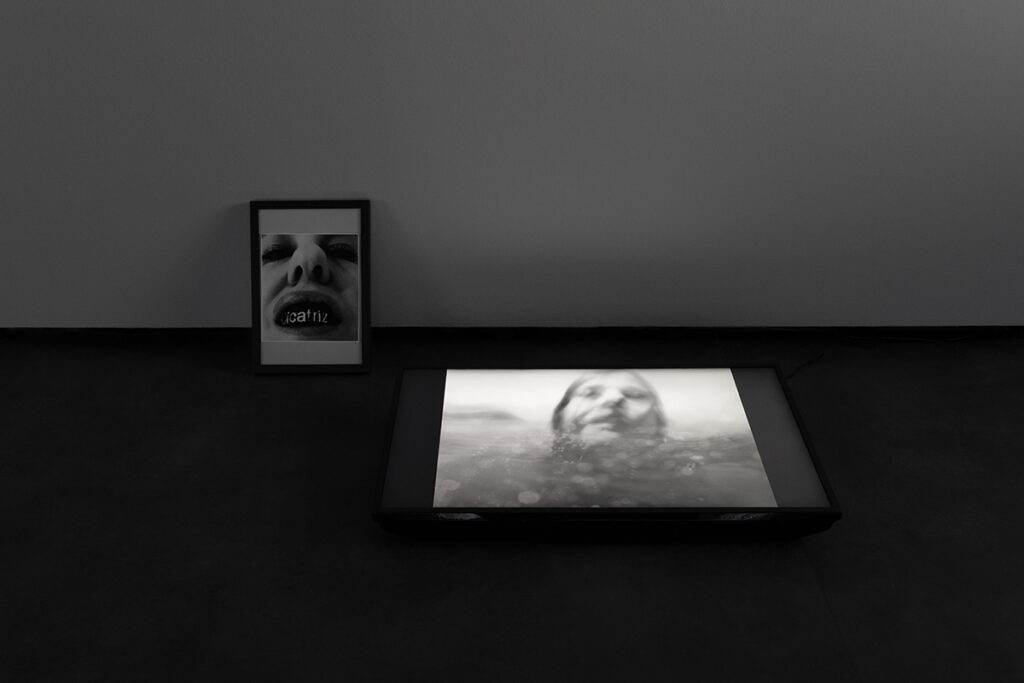
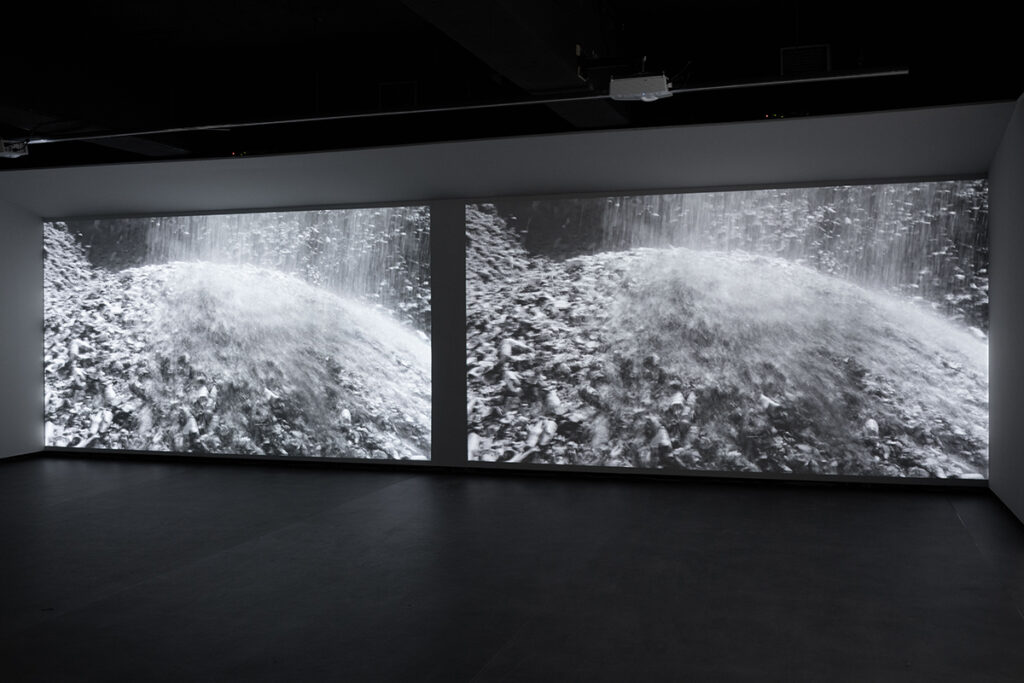
Shards of the traumatic accident appear, for example, in the video Festa de Natal [Christmas Party] (2023) and in the photograph A montanha com o peso nas costas [The mountain with the weight on its shoulders] (2023). While the matter that injured her – glass – shows up in these works, the elements that participated in her healing, such as gauze, surgical suture, saline and bandages, are revealed in a series of other works, like in the triptych of photographs Untitled (2023), and also in Soro de atriz [Actress saline] (2023) and A mulher com soro [Woman with a drip] (2023).
**
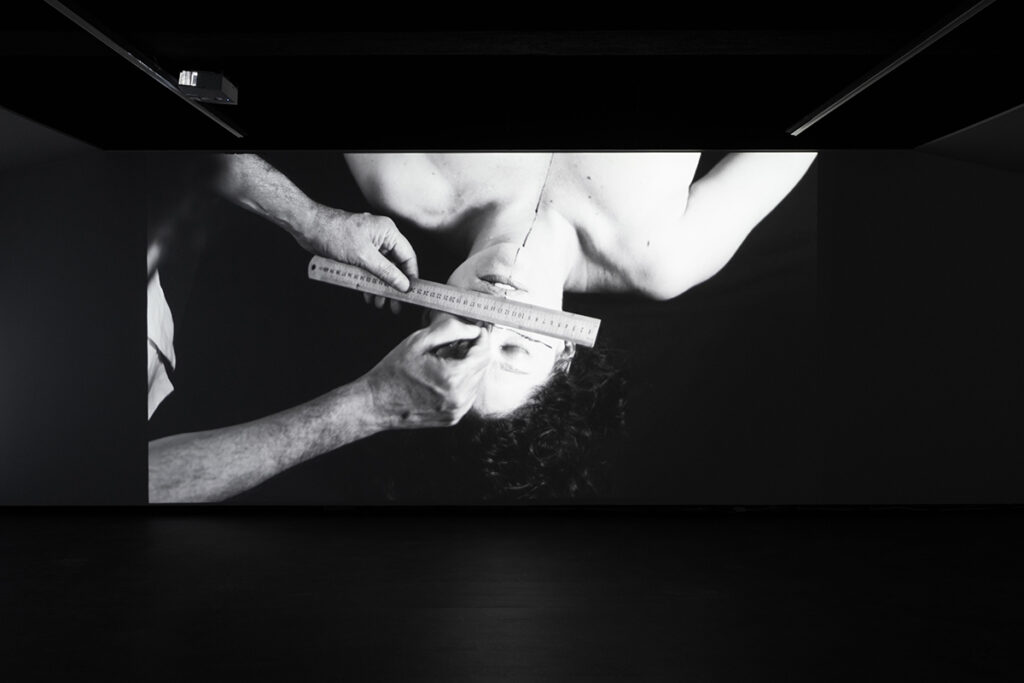
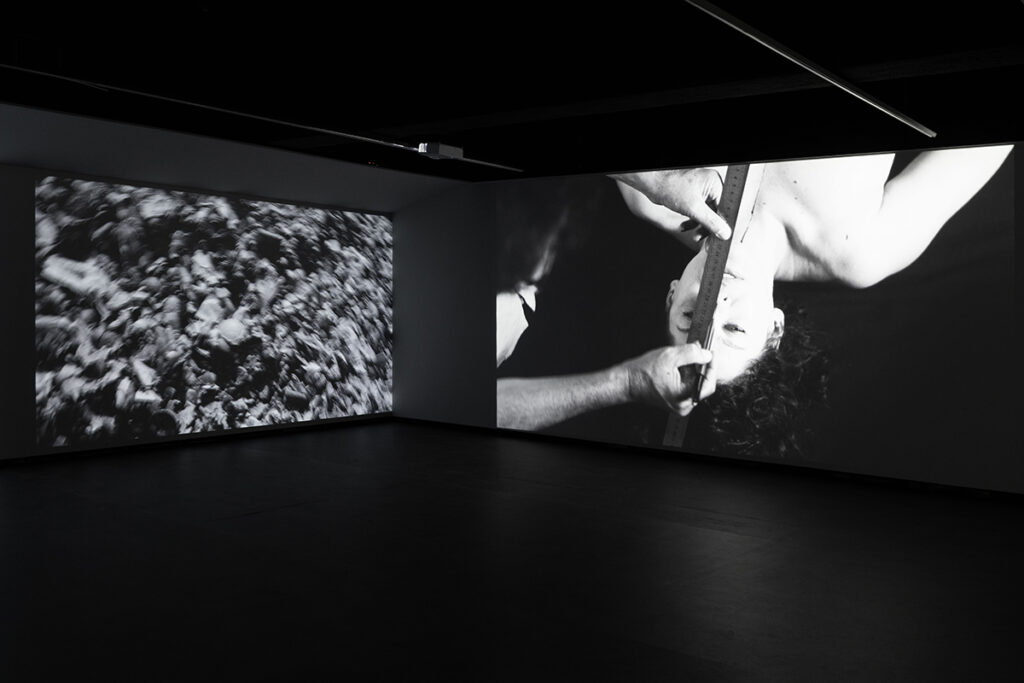
Skin is not only the misleading appearance of things, but rather, as Paul Valéry famously asserts,[1] ‘the deepest thing’ in the human being. This membrane that separates interior and exterior contains marks that reveal intersections between past and present. The epidermal surface of the artist is marked and subjected to measurements in the video De-marcação [De-marcation] (2023), fragmented in axes of symmetry and crossings-out, which evoke a scientific anthropometry. Her works operate on and from her own body, seen not merely as a biological organism but as a matter steeped in history.
Over the course of the exhibition the multidisciplinary nature of the artist, who is also, more frequently, an actress and director, becomes clear. Thus, we come across a kind of threshold between fiction and reality, dramaturgy and report. In some of her performative gestures, Paz carries out activities that put her own physical integrity at risk, in order to break with specular illusion. By affirming a carnal, palpable, finite body, her works distance themselves from the typical idealisation of classical paradigms of representation. These ideas/paradigms, it is worth noting, focus in particular on the image of the female body. Thus, we believe it is pertinent to consider connections between the works brought together today and a contemporary production that dates back to the 1960s, when experimentation related to body art and performance made the body the matter of visual expression.
In this context, confronting an idealising imagery imposed on female bodies, a series of women artists emerged as key figures. In Brazil, names like Sônia Andrade, Letícia Parente and Anna Maria Maiolino produced ground-breaking performances recorded in photos and on video, in which they subjected their own bodies to potential violence, as if emulating in the private territory of the body a larger violence that was taking place in the social and collective fabric of the country with the military dictatorship in place.
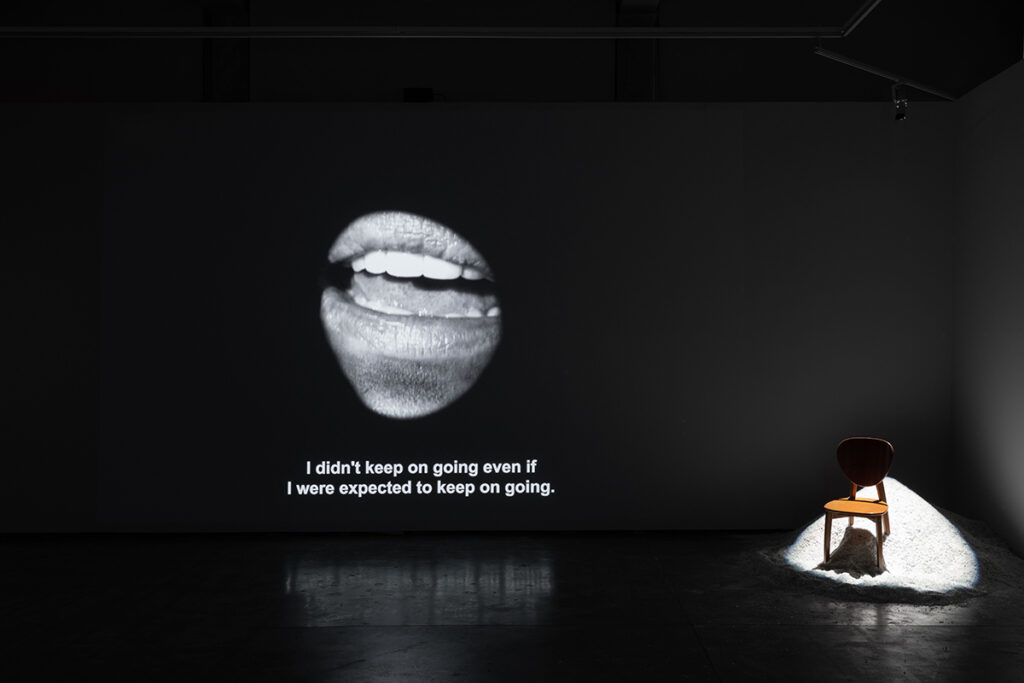
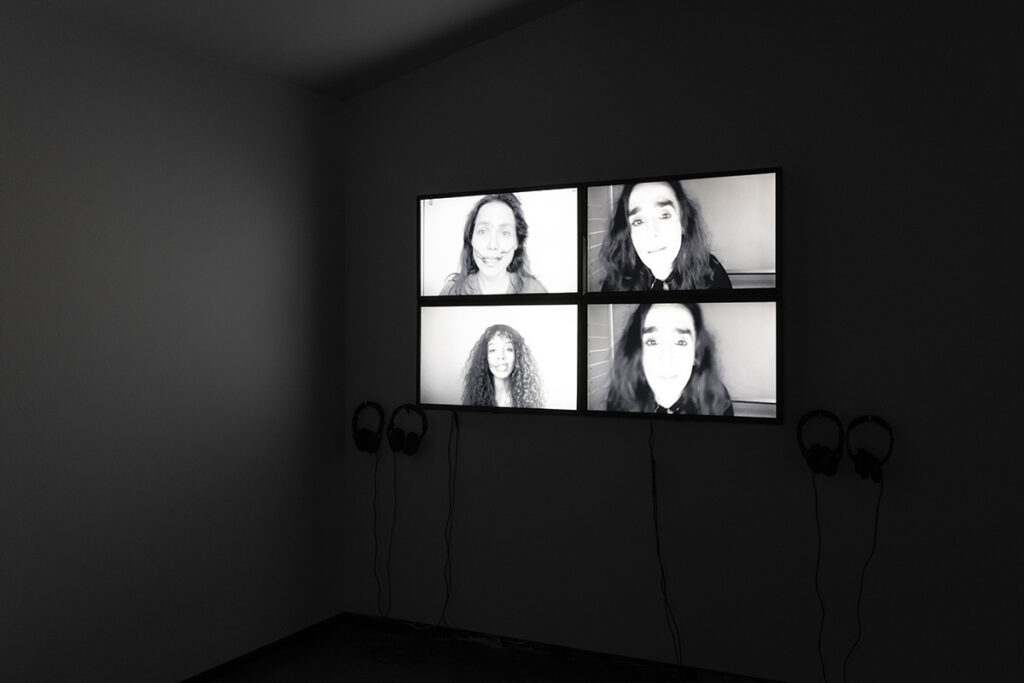
In the video Auto-acusação [Self-accusation] (2023), which gives the exhibition its title, Paz references the 1960s by paying tribute to Austrian playwright Peter Handke. In the play of the same name, written in 1965, the latter sought to make spectators aware of the artificiality of theatre, in order to break with the illusionary paradigms of classical dramaturgy. While Handke’s text was conceived to dispense with sets and reduce scenic elements as much as possible, the artist’s video also operates according to an economy of means. We see only the outline of her lips, which become almost abstract elements and remind us of an open wound. The detached mouth of the actress-artist recites the text of the play in darkness. Note that the play was written in first person, in order to blur the boundaries between character and actor. This dissolution of limits takes on other meanings in Paz’s poetics, which also operate on the limit between biographical details and fiction.
A central object in the exhibition, the artist’s body sometimes appears as a finite and fragile material, subjected to acts of imminent violence, like when shards of a mirror press into her face in the video Silêncio [Silence] (2023). Carried out by the artist herself, these acts verge on violating the surface of her skin, as if they seek to re-enact the tragic moment of the accident. At the same time, the mirror plays a singular role in her research, appearing as a simultaneously cutting and totalising element. It is through using a mirror that we are able to view ourselves fully; without this resource we would only see fragments of our body.
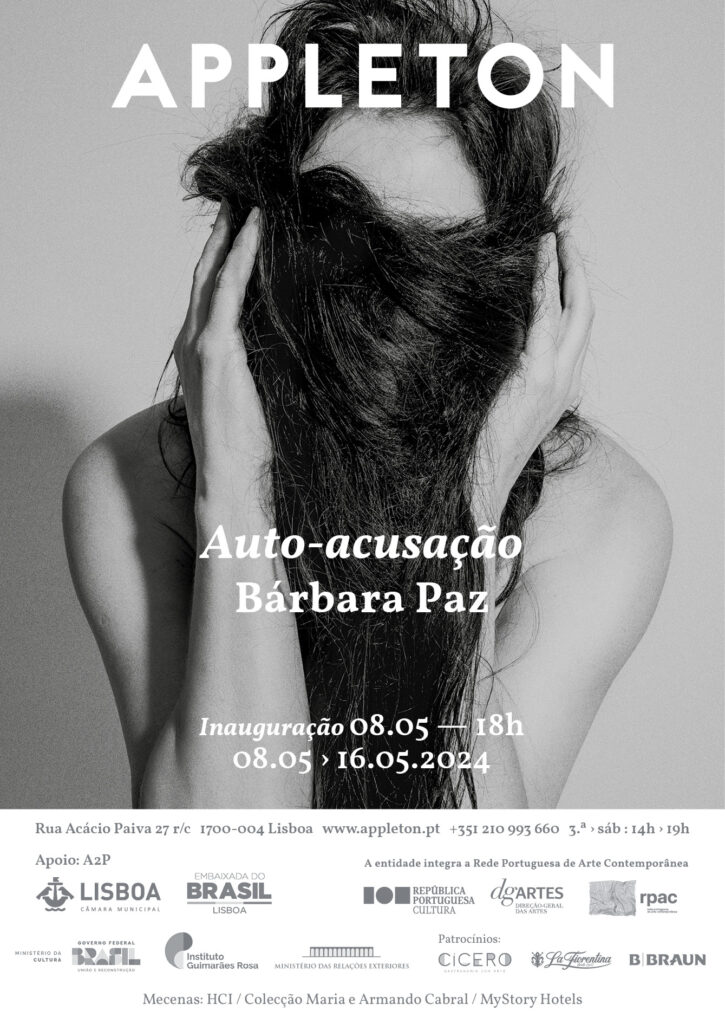
The face, on the other hand, the body part most impacted by Paz’s accident, plays a central role in defining what is unique in each of us, being the means through which desires, fears, pleasure, anger, a whole myriad of emotions find expression before the eyes of the other. Thus, the mutilation resulting from the car crash can be seen as something that ultimately called into question her own identity. It is no coincidence that in the series of photographs Cabelos [Hair] (2023) her face is camouflaged, oscillating between revealing and hiding, showing and covering.
Her hair, which somehow protects her from the invasive nature of the other’s gaze, can be seen as a multiplicity of threads. Threads, in turn, are a recurring theme of the exhibition. In the photograph Ponto de sutura [Stitch] (2023), we see her hand being subtly stitched together. Here, there is a dialogue between the taut thread that enacts the scarring and the lines of the artist’s palm. Lines/patterns that can, for some, bring clues about the future, as if indicating the opposite of the signs present in scars – traces that show how the past left its marks on the visible landscape of the skin.
**
Walter Benjamin reminds us that ‘to articulate the past historically does not mean to recognize it “the way it really was”. It means to seize hold of a memory as it flashes up at a moment of danger.’[i] The words of the Jewish philosopher, dedicated to rethinking our relationship with history in a broad sense, can be applied to the course of a life story. Ultimately, in ‘Self-accusation’ Bárbara Paz appropriates the memory of a traumatic event that had every likelihood of leaving her a paralysed present in order to construct, weaving the thread connecting fact and fabrication, a different future from the one the shards of the accident seemed to assign her. Luisa Duarte, May 2024
[1] VALÉRY, Paul. Idée Fixe. New York: Pantheon Books, 1965.
[i] BENJAMIN, Walter (Trad. Harry Zohn) Theses on the Philosophy of History In: Illuminations, p. 247




 /
/  /
/ 