


Michael Biberstein
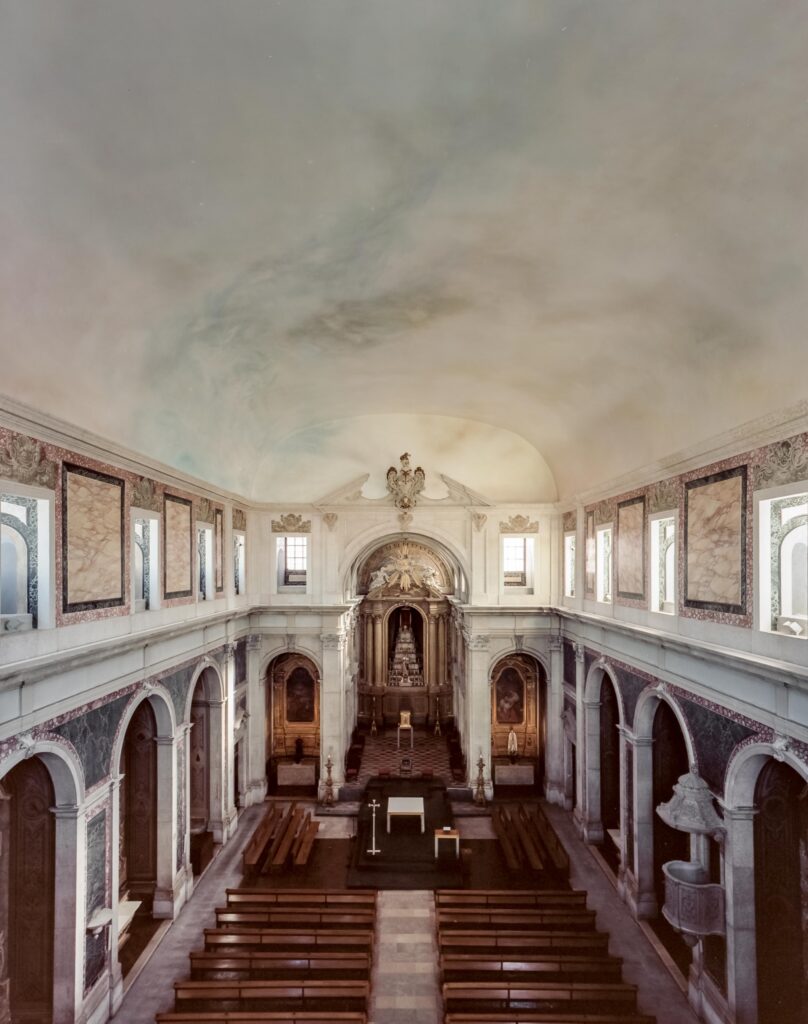
It all begins with a painted blue sky, broken by clouds, in one of the most important Pombaline churches in Lisbon. The vast painting is, in its entirety, a surprise, a charm, and a synthesis: the last work by the Portuguese-Swiss artist Michael Biberstein (1948–2013) invites us to gaze upon a utopian, dream-like firmament, which asks each of us, believers and agnostics alike, for spiritual recognition, and seduces us with its powerful trans-contemporary air. The ceiling of the Santa Isabel church, a note of timeless modernity in a sacred 18th-century space, offers itself up so that we might discover through the painting both the sonority of undulating free forms and, rather more arcane, the fringes of an incantation that has been sorely needed through time – before time.
We are in the world of that natura naturans that 16th-century artists and theoreticians noted on the agenda of the creative act, thinking about plural meanings of globalisation. In that light, the false sky spanning the church’s main nave is also, in its very structure, a work of synthesis, one of the final feats of the architectural genius Carlos Mardel (1695–1763), which imposed conditions on the painter from the outset. That timeless marriage was wise and the scenographic spectacle dazzling: the result has a flavour of the ‘naked words that silence wears,’ as in the poem by Ramos Rosa, and invites us to follow, unimpeded, those dense blue skies broken by clouds. With Biberstein, poetry and painting went hand in hand.
The sorcery of the clouds gathering in chiaroscuros that challenge the opacity of the shadows reveals itself obsessively in this painting of dreams interwoven with entanglements, supernatural at times, that make the ceiling of Santa Isabel church (‘the church that lacked a sky,’ as someone wrote) a challenge resolved with audacious wings.
On a much smaller scale, Biberstein’s canvases, produced in the borderlands of the Alentejo region, in his studio in the town of Alandroal, in the lands of the Lusitanian god Endovelicus and endless greenish-blue strolls amid places of mystery such as the river Lucefécit (Terena), were created to seek out the path of the clouds and in harmony with the pores of mother earth. They are often masterpieces of infinity, of eternal waters in shades of grey and green, in search of the route of the Seven Seas. The painter familiarised us with a sublime discourse around secrets hidden in the clouds.
Looking carefully at his (un)inhabited landscapes, I always felt that there must be a key, something coherent, that links these canvases to other creative sagas. And I recall the powerful outrenoir of Pierre Soulages (1919–2022) and, even further back in time, the flame that flickered through the English Romantics John William Mallory Turner (1775–1851) and John Martin (1789–1854) and the German Caspar David Friedrich 1774–1840), even going back to the 17th century and the dream-like landscapes of the fiammingo Paol Brill (1556–1626) and the fires painted by the Portuguese Diogo Pereira (c. 1600–1658). These references are enticed by an eternal ephemerality that allows us to sense both inexorable finitude and the pulsing of auras, in subtleties of foam and light on the path of that Sublime to which all arts aspire.
For me, Biberstein’s painting is on intimate terms with the stirring of twilights and the announcement of fair weather to follow the deluge: a sorcery that comforts and challenges, in sublimities formed of touches of paint brush, paints, light, fire, embrace, sweat, love, signs – a barometer of primordial things. Delfim Sardo described a creative process that aims to ‘slow down our perception in the face of the constant whirlpool of images.’ I would also emphasise the ‘aura-related ruminations of those able to dialogue with clouds’ – which brings to mind a poem by Herberto Hélder (in A Morte sem Mestre, Porto Editora, 2014) which speaks of kneaded bread and fire, which are anchors of Poetry-Painting: ‘(…) I wonder if writing a poem isn’t a bit like making bread / bread that you take out of the oven and eat while it’s still hot between the lines, / one of these days I see that I’ll never stop, / my hands suddenly full: / the world is just fire and baked bread, / and fire is what gives the world the foundations of form, / long bread in French lands, / short bread now in these salty kingdoms’
At the height of his abstract expressionism, Mark Rothko (1903–1970) admired Turner, whom he regarded as the romantic who opened the doors to modernity, and he paid ironic tribute to him in 1966 when, visiting an exhibition at the Museum of Modern Art in New York, he reputedly said ‘this man Turner, he learnt a lot from me!’ And because the opposite must be absolutely true, I think that, if he wasn’t so modest, Biberstein could have said the same, in his search for the imperceptible absolute.
These paintings are on first name terms with Liberty, Utopia, Discovery, Desire to know more, starting with the foam of the skies. In this foam, the painter uses raw colours and impermanent creases as a personal path. ‘Perhaps the condition of freedom is this elimination into white / That will make possible the nudity of a beginning / the splendour of the new,’ said Ramos Rosa (in the poem Eis a cal da página sem constelações , in the book Génese seguido de Constelações, 2005). The tones might be orchard greens, white and cloud grey, glittering reds and pinks, sky blue torn with lights (Blue Shift, 2009, for example). Permanent steps in daring gestures, tones of rebirth.
Vítor Serrão 2025
Michael Biberstein and the ceiling of the Santa Isabel Church
There is a very peculiar poetics in the fact that an artist who considered himself a militant agnostic, as he defined himself, decided to paint the ceiling of a church. And yet there are many reasons for this: Michael Biberstein was an agnostic, but he had a deep and continuing interest in transcendence, that is, in that which goes beyond the realm of perception of the sensory world and which points to a notion of the impossibility of totality. As an artist, his question was always about the magnitude of ignorance in relation to the world, with a certain nostalgia for the possibility of accessing the whole, at least that which transcends. He first tried this through his interest in analytical philosophy and its focus on language, or its performativity, in other words, the permanent impossibility of grasping meaning except through a certain performance. Then through music, perhaps the expressive form that comes closest to an untranslatability of experience. Thirdly, through painting, as an art form that invests in the production of an image, a dramatic impossibility of the totality of perception and of knowledge.
Finally, through his interest in astrophysics.
The path that led Michael Biberstein, from 1984 onwards, to a relationship between a certain idea of landscape and the location of the viewer, resulted from a transition between an attempt to understand the language of painting and subsequent research into the place of the viewer in relation to the work.
The idea that landscape in painting starts from a speculative possibility based on a certain location – which Biberstein, in the wake of Burke and Kant, located at a point of safety and refuge for the viewer – to become a contemplative possibility came to define the terms of his pictorial practice. Starting with the notation of this working method in drawing, the drawings from 1988 onwards frequently show a place indicated with a ‘U’ before a horizon line or a watercolour notation of an archetypal landscape. This place, defined by the artist as a place of prospection and refuge (where the letter ‘U’ refers both to ‘Ur’ (origin) and an appellation ‘you’), corresponds to the place of someone who is faced with an area of the world converted, by the fact that it is the object of contemplation, into a landscape. In this way, the landscape came to be established as a possibility exclusively by and for the viewer, and converted into a theme only by the viewer. Its order, therefore, is not an order of the visual field, but an order attributed by a speculative or reflective exercise – it is always, therefore, an interior landscape.
To better understand this exercise, which bridges the gap between an almost meditative process and a rigorous work in the sensitive field, it is interesting to recall the artist’s physical working process: Biberstein painted on unprepared linen canvas, stapled directly to the wall of his studio. He would first wet the canvas with water and then apply diluted acrylic paint; as wet canvas inevitably becomes very dark, the strokes were almost invisible and he had to wait for the canvas to dry to see what he had achieved. He then repeated the process countless times, in an exercise of successive liquid layers of blind painting in a game of corrections and adjustments without any prior plan, made even more complex by the often large size of the support. The landscape became thus literally a construction designed to absorb the viewer, to immerse them in the pictorial field transformed into a possibility of landscape and not its representation – not least because it doesn’t correspond to any existing visual field. In this process we find an aesthetic echo of the idea of empathy (Einfühlung) theorised by Robert Vischer in 1873, a possibility of an aesthetic relationship based on immersion, or the viewer’s empathic attraction to the work.
Although the translation of Einfülung points to the notion of empathy, i.e. a corporealised projection of the viewer towards the object – precisely what Biberstein had been seeking over the last 30 years of his work – the relationship with immensity and the sublime as an aesthetic category would propose immersion as a dive and always establish the mystery of the unknown. It is the complexity of the relationship between his fascination with the various understandings of the sublime and the approach to them (in which attraction, danger, proximity and distance coexist) and the search for a painting that promotes the viewer’s immersion, empathy, that make Biberstein’s work an idiosyncratic and very rare case of the intersection between analytical thought and poetic exercise.
Finally, the connection Biberstein made between a certain memory of Romanticism, summoned up in his interest in the Swiss painter Caspar Wolf (1735-1783), whose landscapes of the Alps, unlike Caspar D. Fiedrich’s, have no human presence, but only ravines, gorges, glaciers and caves, and the Chinese painting he knew from his frequent visits to the Rietberg Museum in Zurich, came to define a very personal version of summoning up a notion of contemplation – and temporality – perhaps at odds with the artistic practices of the end of the last century.
The ambition to, as he himself said, ‘make the viewer slow down’ in relation to the work implies a confrontation with the pictorial plane from a common ground, from a frontality in which the individual is measured against a zone in relation to which very few points of support and visual anchorage are given. On the contrary, the viewer needs to make an effort to orientate themselves in front of a painting which, liquid, doesn’t guide their gaze, but forces them to scrutinise, to try to see more, or to better feel in order to deal with the unknown.
For all these reasons, the Santa Isabel project has always been a huge question mark – as well as a major theme and investment – for Michael Biberstein.
On the one hand, for someone who hadn’t begun his career as a painter, this project represented the possibility of measuring himself against those with whom he had always measured himself, or who had established his field of possibility. A specific experience that proved fundamental to this project was a visit to the ceiling painted by Giovanni Battista Tiepolo in 1752/53 for the Würzburg residence designed by Balthasar Neumman. In this experience, he found a cross between metaphysics and materialism, which (as he himself said) he felt was a physiological need, and which would lead him to enthusiastically embrace the invitation for the ceiling of Santa Isabel. The experience of conceiving a painting for a church that had never known anything but blackness as a covering came as a strict necessity: it was necessary to find a way out, or an opening towards the field of reflective possibility that had always motivated him.
In short, to find a sky.
What is interesting is how this figuration corresponds to a possibility of heaven, inevitable because, in his materialist vision and as heir to a philosophically analytical way of thinking, the only possibility for a metaphysics would have to be born – and live the contradiction – from an entity that, although not mimetic, could be given a name and thus be a thing.
Although Michael Biberstein developed the project carefully and systematically, on various scales – notably in this large-scale model presented for the first time by Vera Appelton on the occasion of the Lisbon Architecture Triennale in 2010 – his abrupt death, just as he was planning to execute the painting, led to a series of debates with those he worked with most closely, namely Julião Sarmento – with whom he shared a studio for many years in Cabriz – to find the most correct formula for translating the models, directly painted by the artist, into the real space of the huge surface of the Church’s ceiling, now painted by someone else. The chosen option is based on a reinterpretation, as faithful as the scale allows, realised after a careful study of Biberstein’s pictorial methodology. The large washes, the quality of the idea of opening up space, the light that radiates from the painting, are a guarantee of its closeness to the artist’s intentionality, which could not have been better respected, although we know that Biberstein would likely have changed the project during its execution. One of the most important contributions to the realisation of the ceiling and its chromatic adjustment was, of course, Julião Sarmento, who, in the end, helped to find the chromatic racords of the ceiling in relation to the Church, a process that Biberstein would do in his adjustment process and that only Julião understood in depth – and here is a second layer of evocation.
And so it is that, on the ceiling of the Santa Isabel Church, the sky looks down on us as if challenging us to look at what goes beyond us, opening up the possibility of seeing a ceiling as an opening to what we can only understand on the level of sensitive sharing.
And from there, projecting itself into a heterodox transcendence.
Delfim Sardo 2025
Bio
Michael Biberstein (Solothurn, Switzerland, 1948 – Alandroal, Portugal, 2013)
During his formative years in Art History at Swarthmore College (Pennsylvania – USA), Biberstein spent an important semester with British writer and art critic David Sylvester, who encouraged him to dedicate himself to artistic practice. Also decisive for the artist’s career was his encounter with the work of Mark Rothko, which particularly marked him.
Michael Biberstein’s artistic career began in the 70s.
His career began with conceptual art, emphasising the philosophy of language and logical positivism. Until the early 1980s, his work focused on the decomposition of painting processes and the topology of the exhibition space. From 1982 onwards, however, this interest in spatiality led him to embark on a journey through landscape theory, developing an approach to painting in which the romantic tradition intersects with the landscaping of some oriental painting. Interested in pre-Romantic and Romantic landscape painting – and the work of painters such as Claude-Joseph Vernet, Caspar Wolf, Giotto di Bondone, Tiepolo, Ticiano and William Turner – Biberstein carries out an in-depth reflection on pictorial landscape space and how it is affected by the concept of the Sublime and its inherent idea of expressing the inexpressible.
Biberstein’s paintings encourage us to take our time, to really change the temporal regime of vision. Constructed from the patient juxtaposition of thin layers of acrylic paint, these paintings invite us to enter the ‘wide field’ of Landscape, among melodies, meditation and Astrophysics (to which many of the titles of his works refer).
Michael Biberstein’s last work was the painting of the unfinished ceiling of the Church of Santa Isabel in Lisbon. This project was realised posthumously and can be admired today thanks to the generous support of private and institutional patrons.
HCI / Colecção Maria e Armando Cabral /  /
/  /
/ 