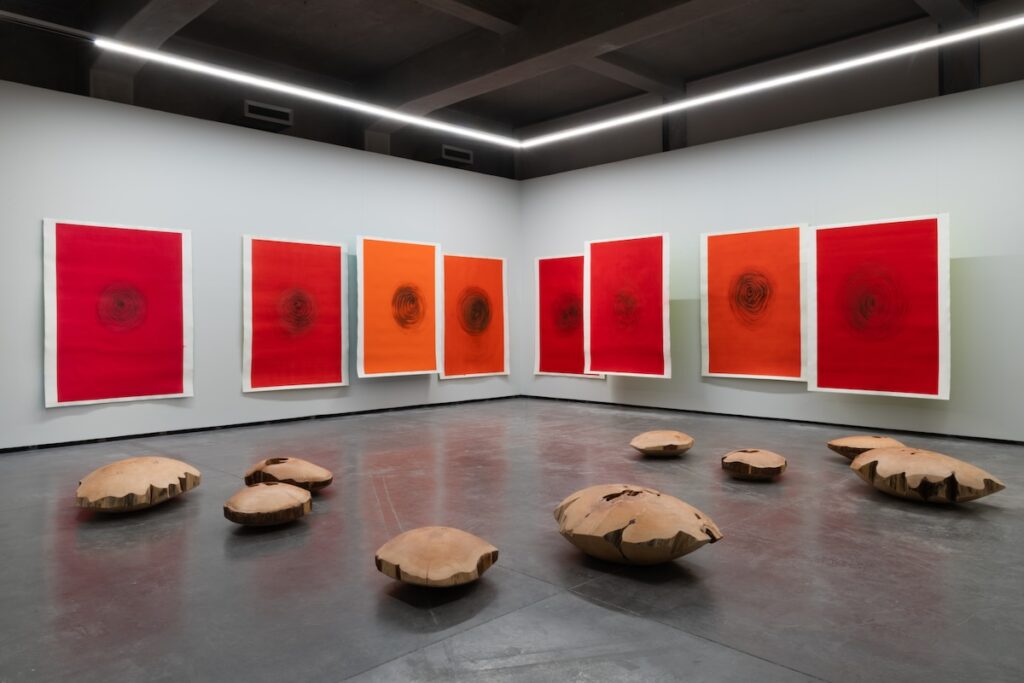
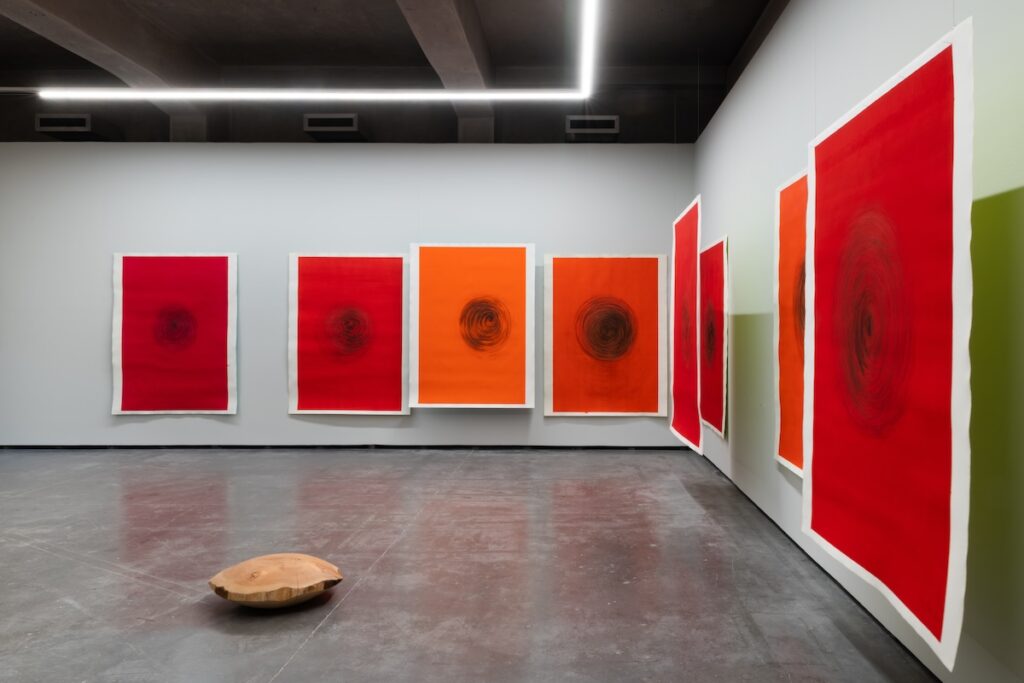
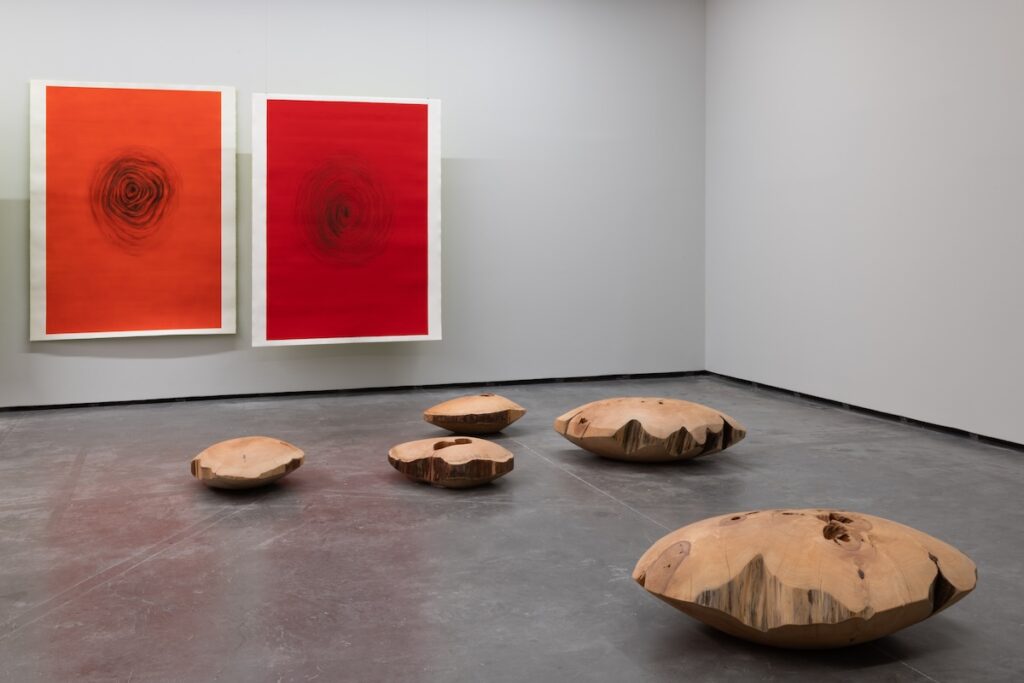
In the exhibition Espaço Intermédio [Intermediate Space], Cristina Ataíde presents a series of large-scale drawings and a group of floor sculptures that occupy different corners of the room. Working with an idea of presence grounded in the complementarity between void and material density, the artist continues a line of enquiry into how opposing entities converge, giving rise to a third way or the possibility of an intermediate path.
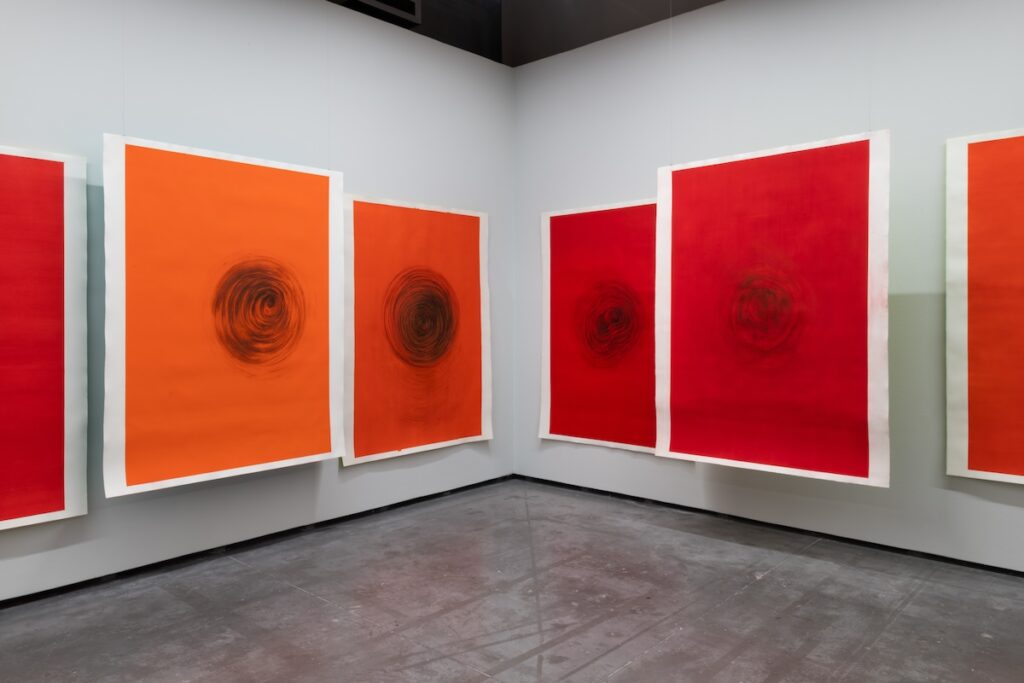
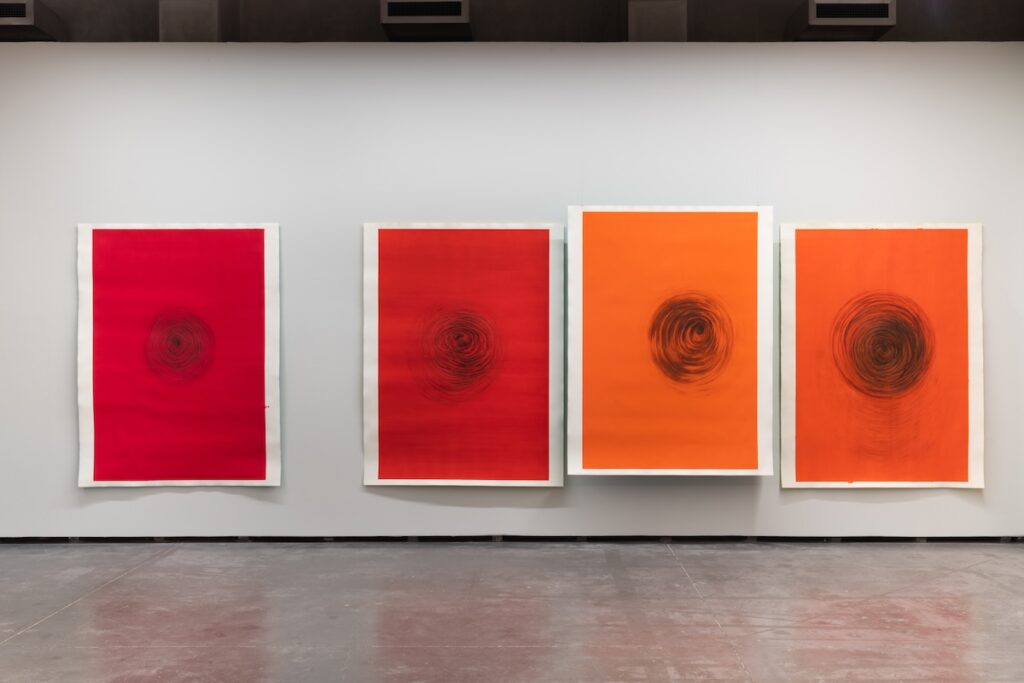
The drawings are formed through layers in which paint (pigment and gouache) fills the paper, charcoal marks the painted surface and the image emerges when, in a final stage, different erasers partially remove it.
Between the dark lines and their softening, a repeated circular gesture becomes perceptible, outlining the figure of an apparent opening, an aperture or a void. The summoning of this void, which at the centre asserts a primordial negative, contrasts with the intensity of the colour that, in the background, maintains an energetic presence. Thus, while the inscription marks a depth that draws us in, the base takes on a vibration that exceeds the support, moving outwards to meet the viewer.
Exploring the relationship between what is inscribed and what dissolves, between decision and consequence, the drawings oscillate between the perception of each element and the reading of the whole, producing a pendular movement that is pictorial but also physical. Something that, on several levels, appears between what recedes and what comes forward, on the wall at eye level.
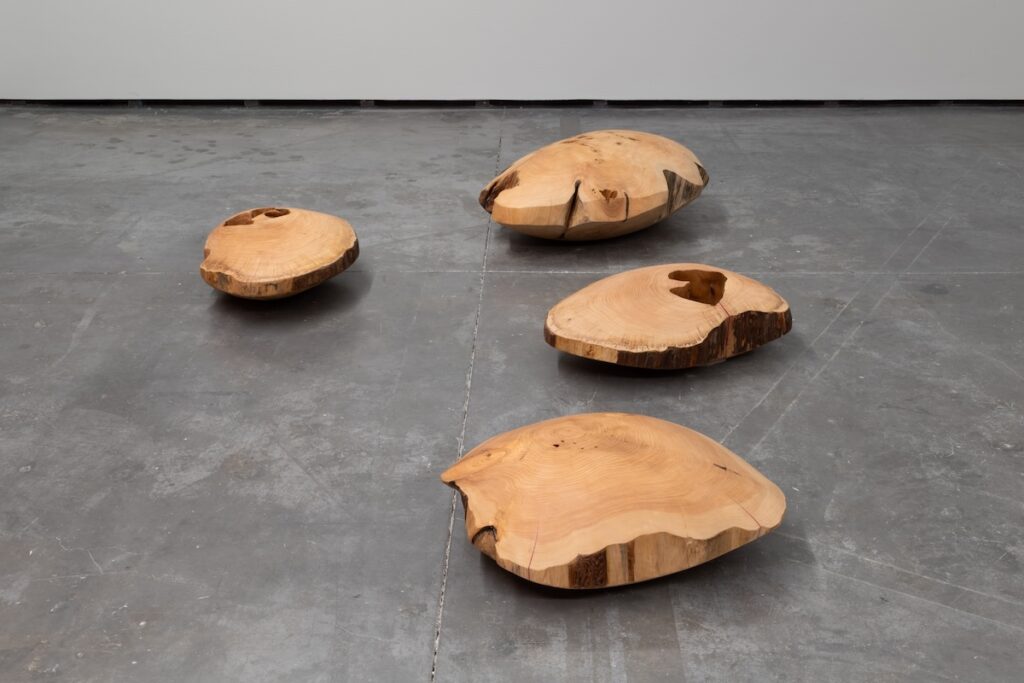
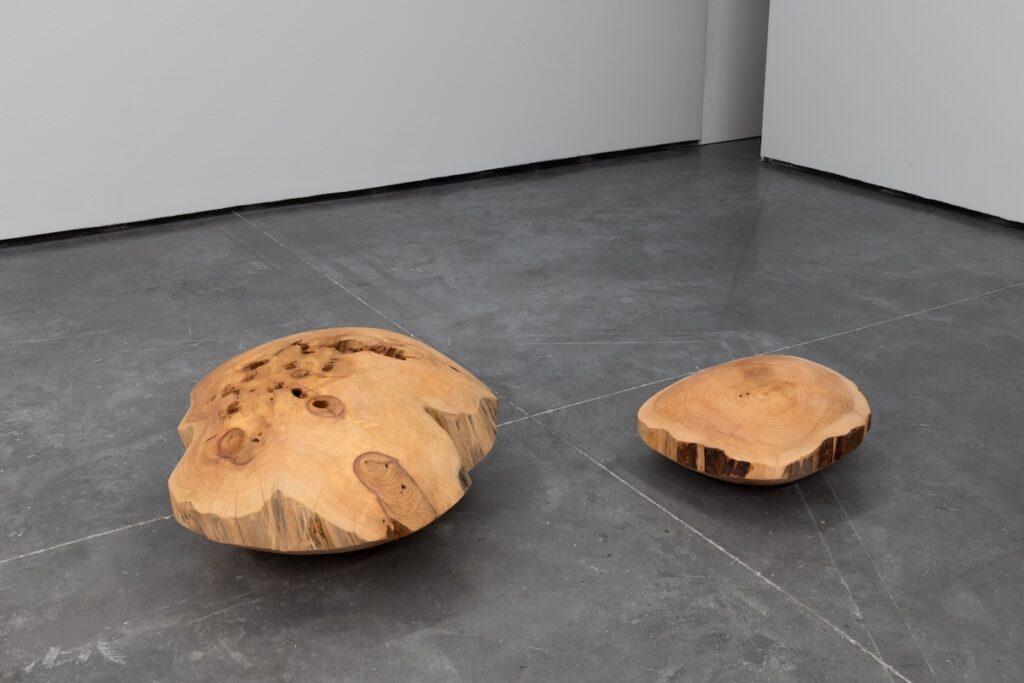
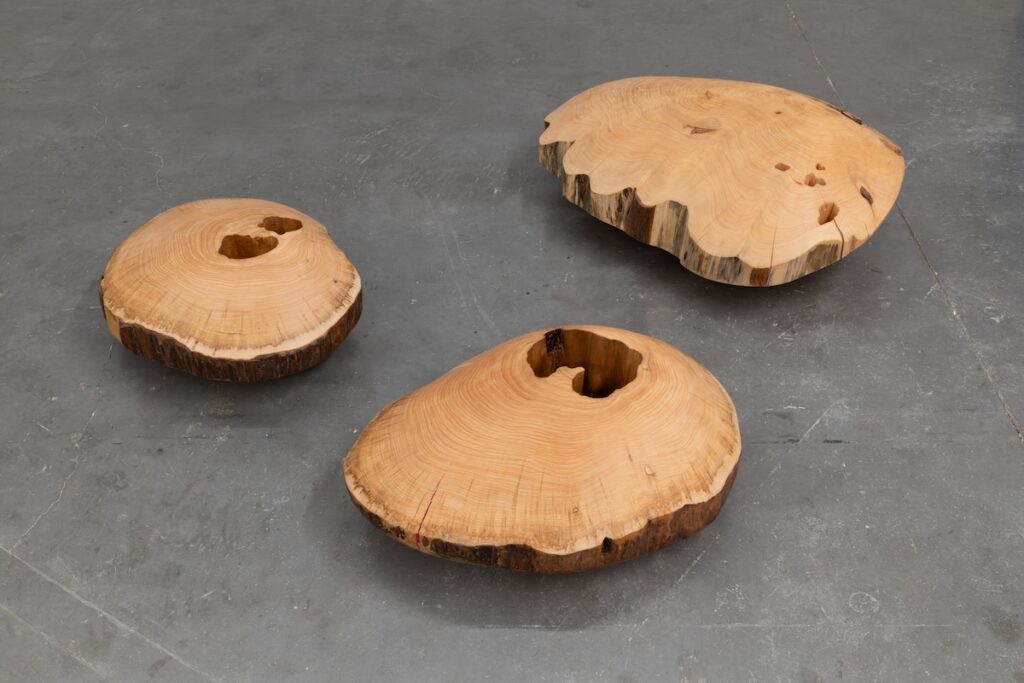
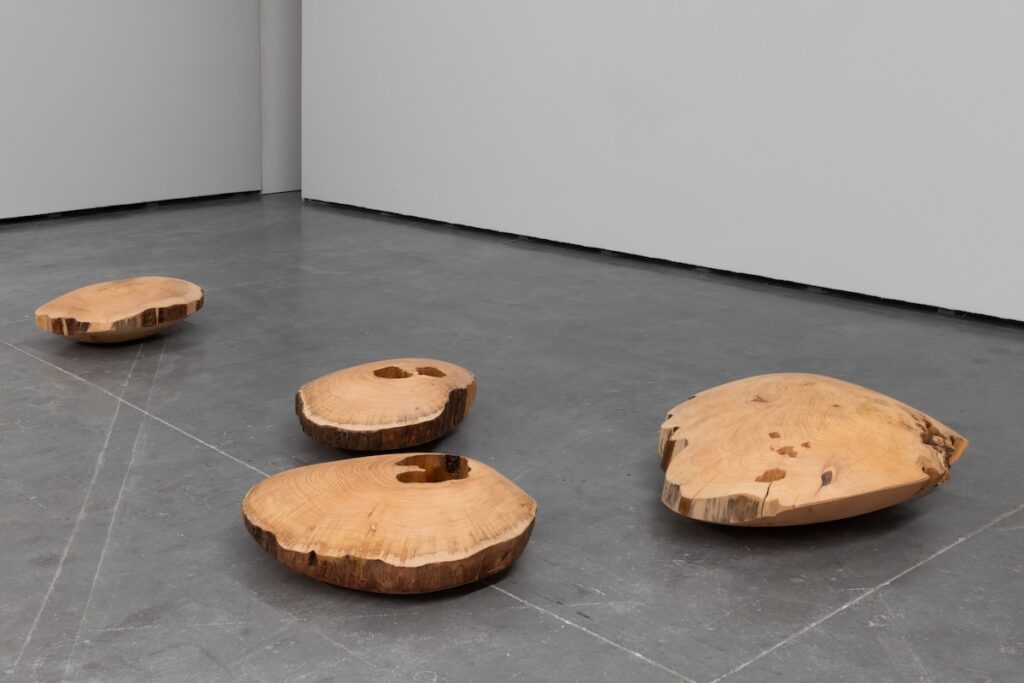
Making use of the cut sections of three trees (cedars) that once stood near the artist’s studio, the sculptures take up the trunks’ cross-sections and develop through an elliptical movement. This movement, which echoes the gesture of the drawings, carves the volume and smooths its surface, transforming the elements into oval-shaped pieces.
Inside each piece, all the areas once occupied by organisms that consumed the wood are hollow, revealing a constellation of openings that give form to a central void. This is a logic of grooves that have not been drawn by the artist but by the passage of time, dictating the removal of what no longer belonged to the tree.
The surface is progressively sanded, bringing out the grain, the growth rings and the particularities of the tree’s development (the record of trunks that split, branches that emerged from the main trunk, cuts that affected the internal structure, and other traces). One might say that, both in the core and on the surface, in each internal cut and in each element that comes to the fore, these pieces function as maps that chart the growth of the species, as well as its inner decay.
The works are arranged on the floor and, in a way analogous to how the drawings operate, attention gravitates between depth and surface, now guided by the void and the matter that surrounds it. Thus, while in the drawings the gaze wanders across the walls and into the depth staged on the paper, in the sculptures it sinks towards the floor and into the density of the objects presented.
As a whole, everything unfolds gradually, in a field of strata where the artist’s action and the will of the matter enter into dialogue about existence and its obliteration. It is a gesture that questions consolidation and absence, giving poetic form to the notion of an intermediate space.
Sérgio Fazenda Rodrigues


 /
 /
