


Albano da Silva Pereira
The first time I saw Albano da Silva Pereira was also the first time I saw Robert Frank. It was 1988, and I was in a room somewhere in Coimbra, during the Encontros de Fotografia, attending a lecture by the American curator Anne Tucker on Frank’s work. Suddenly, the lecture was interrupted by a laugh — unmistakable — coming from the doorway. It was Albano, who, between bursts of laughter, announced: ‘Anne, Robert is here.’ And Robert Frank stepped in shyly, almost like a shadow, only to leave again shortly afterwards.
I saw him again twenty-two years later, in Madrid, at an informal lunch, accompanied by June Leaf. We ended up sitting side by side. When I introduced myself as a Portuguese curator, he immediately asked: ‘Do you know Albano?’ — and then, with an almost childlike tenderness, he added: ‘Did you see my exhibition at the Caldeiras? It was one of the best exhibitions I’ve ever done.’ Over the years, Albano spoke to me many times of his boundless admiration for Robert Frank, with whom he shared a deep friendship.
As a photographer, Robert Frank was one of the key figures in the aesthetic shift that redefined photography from the 1950s onwards. His book The Americans dismantled the modernist, purist grammar of straight photography, paving the way for a restless, subjective and almost elegiac vision of post-war America. In an era of euphoria and prosperity, Frank revealed the reverse: disenchantment, isolation, the anonymous sadness of cities. As Jack Kerouac wrote in his 1959 preface, Frank captured ‘that crazy feeling in America when the sun is hot on the streets and the music comes out of the jukebox or from a nearby funeral… whether a jukebox is sadder than a coffin.’
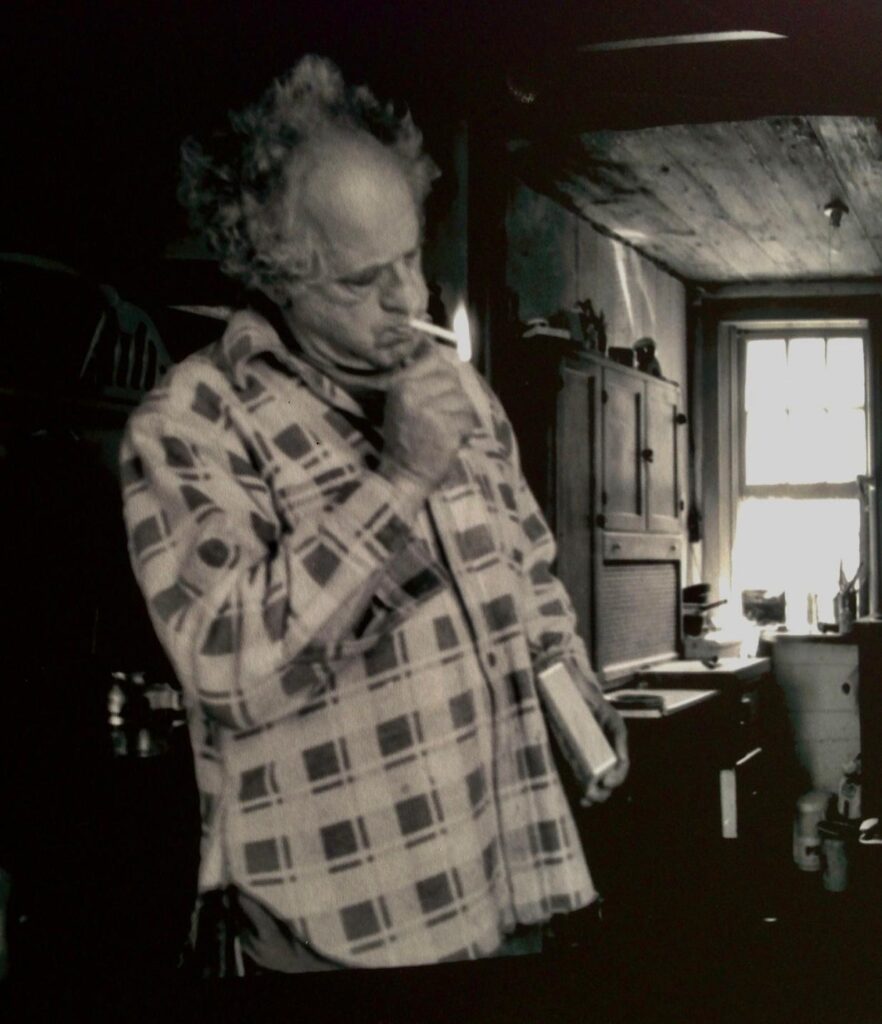
It is that same gaze — lucid and wounded — that resonates in Life Goes On, Albano da Silva Pereira’s film about Robert Frank. A film that defies easy classification, it blends documentary form with an intimacy that only friendship can allow. Its starting point is an interview conducted by Maria João Seixas in 2001 for RTP2. Using footage and photographs taken in the United States, Albano constructs a fragmentary portrait, composed of echoes and pauses, revealing the more human side of an artist famously reserved, and at times resistant to public exposure.
Much of the film unfolds in Robert Frank’s homes — in Mabou, on the Atlantic coast of Canada, and in his New York apartment. These are intimate spaces, inhabited by objects, images, memories. The camera moves through them as if groping its way: lingering on details, textures, shadows. There are long takes, slow movements, a light that wavers between reality and remembrance. It is the gaze of one photographer upon another — a gaze that watches time settling over things.
Albano does not merely film the interior of houses; he films the interior of memory. The images seem suspended between present and past, between gesture and recollection. At times, we are unsure whether we are following the movement of the camera or drifting through Frank’s own mental landscape. The editing alternates fragments of voice and silence, handwritten letters, photographs taken by Albano himself — portraits that echo the melancholy of Robert Frank’s images. It is at this point that the documentary becomes an essay: the film is no longer only about Robert Frank, but also about Albano and his own way of seeing.
There is a moment when Albano films his reflection in the glass of a frame containing a reproduction of The Last Supper. It is a minimal gesture, yet revealing — the author’s presence within the image, a double mirror between the one filming and the one being filmed. In another scene, a playful conversation about a fax brings back the lightness of friendship, the humour that runs through the disenchantment. And when, in the final minutes, we see the sequence of images of Robert and June to the sound of Love Sick by Bob Dylan, the tone becomes elegiac: Albano celebrates and bids farewell.
The film was edited in 2014, before Robert Frank’s death in 2019. Yet now we see him as if reading a posthumous letter. The time that separates the images from the present is also the time of loss. ‘Put it on memory,’ said Frank — and that is precisely what Albano does: he records, preserves, returns to memory what time has taken away.
Life Goes On is less a documentary than a gesture of friendship. An essay on the persistence of images and on the power of art to resist forgetting. It is a correspondence between two artists who share the same disenchantment, the same love of imperfection, the same faith in the fragile beauty of things. And perhaps that, in the end, is what endures: the promise that even when all fades, life — and the image — go on.
Sérgio Mah, 2025
Bio
Albano da Silva Pereira (Coimbra, 1950) has developed an unorthodox career in photography. The public presence of his work began in 1980 with a set of images on the island of Mozambique and would always develop in parallel with the other activity that has occupied him, the direction of the Coimbra Encontros da Fotografia (and later the Visual Arts Centre), which began in 1981. Perhaps this second field of activity has gained more visibility than his artistic work, but the creation and production of images is at the center of his world – which also includes his obsession with collecting artefacts, stones, cacti and images.
To make an archaeology of his creative work we would have to go back to the beginning of his photographic activity, during the Colonial War, when he was in Africa for the first time, the matrix to which he returns permanently. Then we need to understand his connection to cinema, having been an assistant and photographer for António Pedro Vasconcelos and Manoel de Oliveira – and cinema is his way of seeing.
Thirdly, we should mention the connection to Robert Frank, whom he met in the 1980s and brought to Portugal for the first time for an exhibition as part of the 1986 Encontros de Fotografia (Photography Encounters).
Today, some of his photographic works are part of NOVO BANCO’s Contemporary Photography Collection and the Museum of Fine Arts Houston (MFAH), among others.
HCI / Colecção Maria e Armando Cabral /  /
/  /
/ 