


SQUARE
—
Carlos Nunes — Proncovô
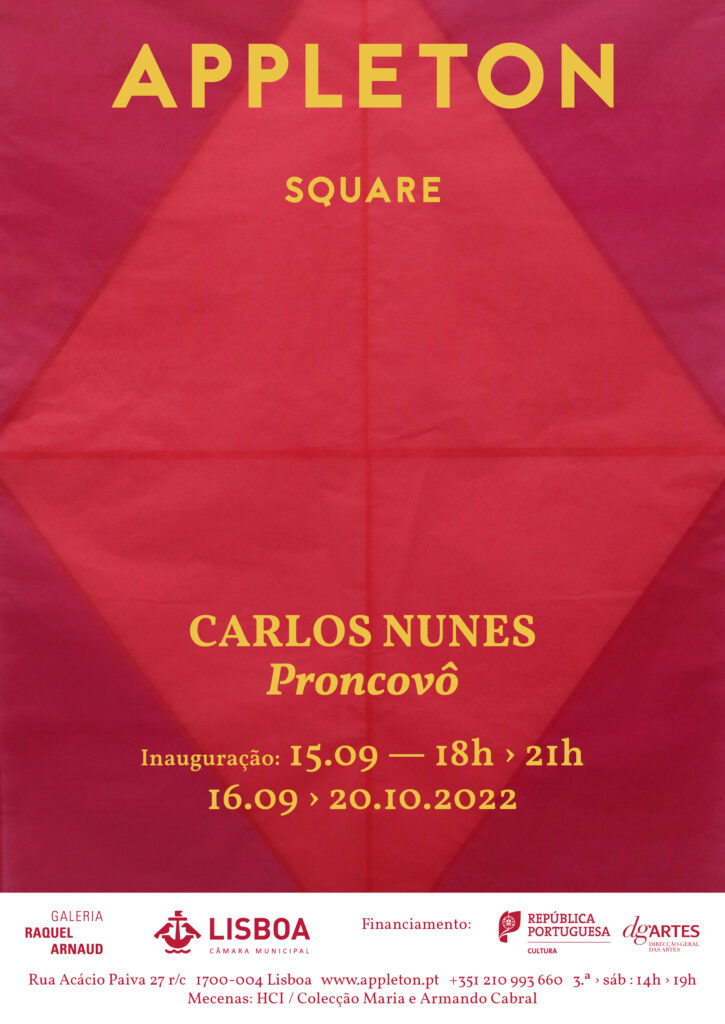
proncovô or the desire for escape that can take hold of a body.
The profile of Carlos Nunes (São Paulo, 1969) is that of an artist whose modus operandi is linked to certain processes of waiting, and to a profound interest in the graphic potentials of the sign and the image, which he imbues with a craftsman’s know-how, careful and far removed from any form of gimmicky immediacy. There is a work by Carlos Nunes that somehow defines the durability of his proposal; a process stemming from the importance of building a climate based on friendship, of generating a family nucleus around art, outside blood relationships, and maintaining the care in that friendship that resides in barely perceptible gestures.
Amarillo limón (yellow lemon) is a screen print and an object that gives its name to the colour of that screen print. The signature, the print number and the year of the piece are included in that perishable object that gives the colour its name. But what really interests me how it can circulate through affection. That’s why I’ve chosen 50 friends and colleagues, who have some connection to my work, to receive it. What I keep is nothing but that list of friendships. Love, Carlos.
The first time I saw one of those lemons signed by Carlos Nunes, with its title and the print number accompanying it in a folder, as well as the year when that friendship was cemented, I began to understand the dimension of many of the works I had seen in his studio. Pieces lying fallow, abandoned to the whims of a process carried out by time, the passing of days, months and years, the places where the sun strikes them and/or the acidity of cheap paper. Suddenly, I was no longer surprised at the photographic self-portrait that Carlos Nunes takes every year – and has done for many years – with his son Diego; the silk paper in various colours, folded and pinned up in the windows, waiting for the sun to hit them; or the blank sheets of newsprint paper hanging from the highest part of the workshop, each more yellow than the next, every sheet bearing a number, the year when it was unfolded.
I look through the emails he has sent me over recent years. Our meet-ups, whether in Brazil or in Spain, are a constant and translate into long hours of conversation, silences and strolls. In one of his emails, he revealed the projects that gave rise to his next two exhibitions: one presented last July, with the title a ira ria (anger was laughing), in Raquel Arnaud’s gallery in São Paulo; and proncovô, the subject of this text, in Appleton Square in Lisbon. I told him that in both I could make out the significance that his work had, for various reasons, at that moment in time. On the one hand, I was referring to the affirmation of an artistic maturity that I have started to detect over these five years, with proposals appearing in a language of his own, referring to many other things because he never denies his sources – but now considered from a more defined position, unique to the artist. And obviously, within these reasons, I was also aware of his emotions at the current political situation in Brazil, a topic that tends to occupy a large part of our conversations.
A ira ria culminated in the exhibition of a long-term project that began some years ago thanks to a growing interest in palindromes, which in 2021 led Nunes to build a tower several metres high on which he placed the slogan a torre da derrota (the tower of defeat), with which he travelled, in the company of his son, to Brasilia, and which was displayed in all its dignity in Galeria Raquel Arnaud. Meanwhile, in Appleton, proncovô – an expression from the Minas Gerais region meaning pra onde que eu vou, or where am I going, linked to oncotô (where am I) and quencosô (who am I), the three basic existential questions – re-approaches some earlier visual experiments, started in 2019, using coloured silk paper and lines of string with a structuring function, that reinforce a feeling of levity by reacting to each observer who passes by.
I propose more of an ‘open living experience’ than anything that could be called an object clinging on to old formal ideas,’ said Hélio Oticica of his Penetrables, and this somehow brings to mind the effect caused by installations such as the one Carlos Nunes designed in 2019, at the ACAC in Aomori, Japan, in a project that, with the title oncotô, quencosô, proncovô, marked the start of his work with kites, an object that originated in China in around 1,200 B.C.E., whose function was initially military signalling, but which over the centuries turned into a children’s game.
But Nunes, aware of the lack of innocence that still lingers today in the use of such an object, works through several layers of meaning in proncovô. First, there is the wealth of possibilities, in compositional terms, allowed by the materials and structure of the kites; but also an economy of means that, in this case, supplies definitive clues as to his recent decision to transfer his studio to the Bixiga neighbourhood, in the centre of São Paulo, where he buys most of the materials with which he works. Also present is that symmetrical – palindromic nature that so appeals to Nunes, and which, although originally present in classic kite designs, is undermined almost systematically in those he produces, generating compositions without that mirroring effect, as if in this case he has decided to break the balance. The use of kites also holds a veiled political intention, through the suggestion of that military memory, the message launched to the skies to warn of an undesired presence; that of manja – a mix of powdered glass and glue that impregnates the kite strings to give them a sharp edge that can cut the strings of enemy kites – and that of Carlos Nunes as a citizen who must cross the city on a daily basis, travelling through diverse realities, and constantly taking the temperature of a country drowning under the mud of multiple endemic evils, exacerbated at present by the genocidal government in power.
Strolling among the works that compose proncovô, we cannot fail to see the omnipresence of these objects, kites, in the skies of the windy neighbourhoods furthest from the city centre, where these structures fill the horizon with colour, despite everything. Proncovô also sets out a visual inventory for a part of Brazil’s iconographic memory, from Cândido Portinari’s Meninos soltando pipas (Boys flying kites) to Oiticica’s Parangolés, or from Alfredo Volpi and his recurrent festive flags to Lygia Pape’s Divisor (Divider); and all this inevitably takes in the geometric visual repertoire of the art of indigenous peoples. In the colour, geometry and movement, there is an expression of the desire to escape that takes hold of the bodies. Those same bodies that can activate, with their pace, the lightness of these compositions that structure the exhibition route in spatial terms and which in some way link contradictory feelings such as joy and absence.
~ Ángel Calvo Ulloa
‘The good thing about the kite isn’t showing it to others, it’s feeling the kite individually,
sending our message to the sky.’
‘What message? Explain it properly!’ João regarded me
with delicate disdain.
‘I didn’t think I needed to.
You let the little fellow go and you let yourself go too. It’s your freedom,
your self, spinning about up there, discarding all limitations.’
~ Carlos Drummond de Andrade

HCI / Colecção Maria e Armando Cabral /  /
/  /
/ 