This is a design exhibition.
“Ceci n’est pas une pipe”. The implications of the phrase written by René Magritte on the painting La trahison des images (1928-29) go far beyond the Belgian artist’s intentions. The Belgian painter intended only to denounce the mimetic fallacy that had accompanied artistic practice for centuries. The artist was claiming only that there was no pipe in his pictorial composition: this is not a pipe; it is just an image of a pipe, Magritte explained. In its apparent simplicity the (master) piece seems to bring about the implosion of the most basic (but sacred) triad of semiological correspondence: object – image – word. It is not by chance that Michel Foucault devoted a series of reflections to it.
But is the pipe really absent from Magritte’s work? Are objects really absent from the representations that we make of them? The representation is not situated on this side of the object but goes beyond it in blatantly referring to. This is not a pipe because it is much more than that, Magritte could have written. And in this respect, Partícula is not a design exhibition.
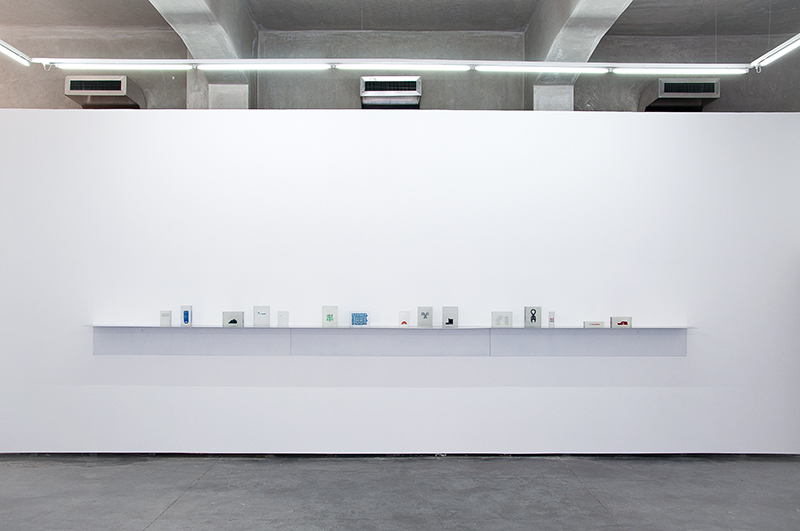
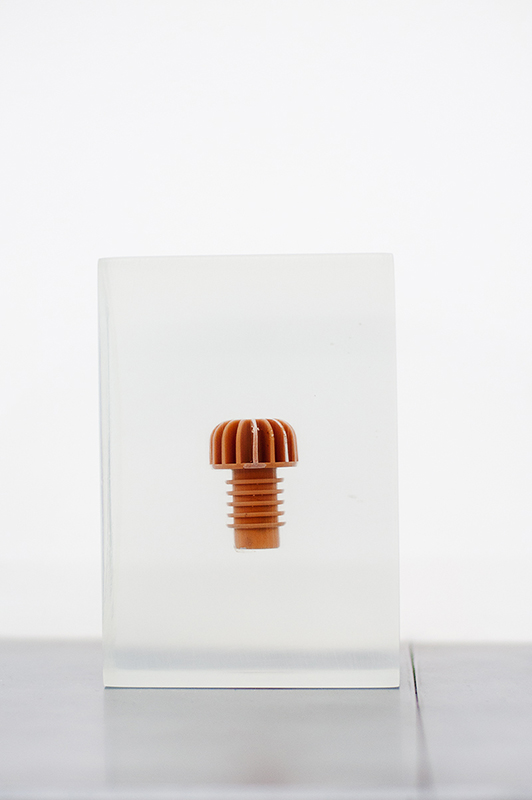
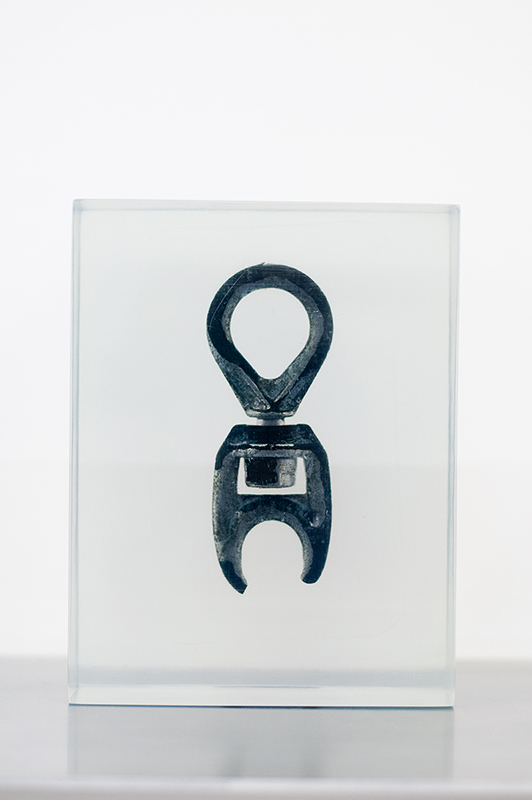
Filipe Alarcão, designer[1], brings to the territory of the gallery reflections on the ontological and axiological status of objects in contemporary life. And is there any more pressing reflection than this today? From a collection of fragments of objects found on the granular topography of the beach, the designer rescues plastic entities, and plastic, from the aesthetic and functional purgatory to which they had been condemned, designing an afterlife for them. The fragment of an initial (disaggregated) object is transfigured into a particle, a participating part of a new composition of objects.
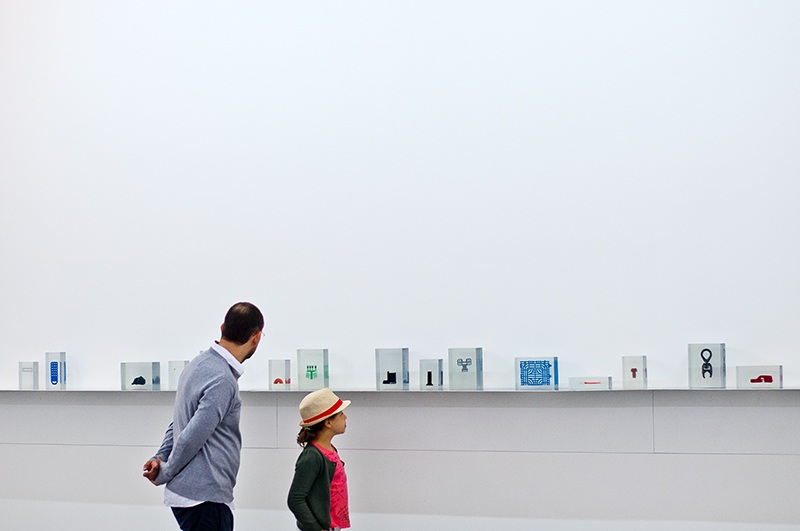
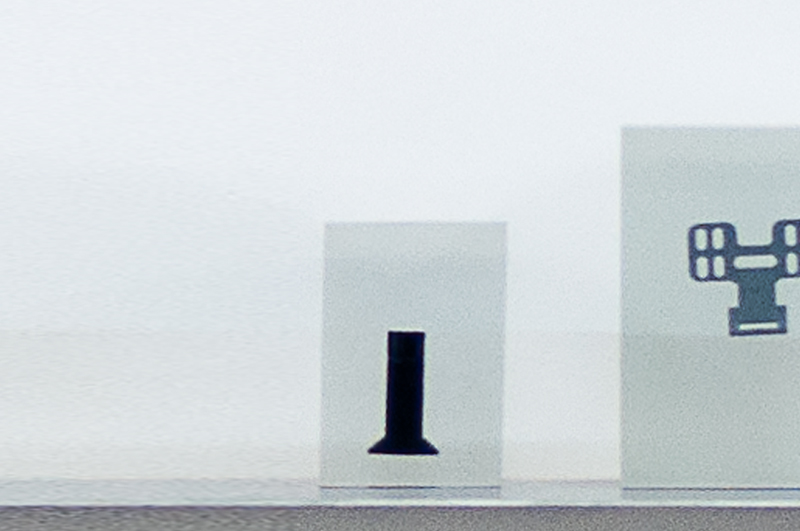
This act of liberation is immediately cancelled out by the action that follows, the enclosure of the objects in acrylic blocks (hygienic cages or translucent showcases) – opaque transparencies. It is in this opacity that these elements reveal everything that they are hiding, a temporal out-of-field, a different moment, earlier or later: that which the object was, is and could come to be. This ambiguous movement of liberation and imprisonment nullifies the play of simple referentiality.
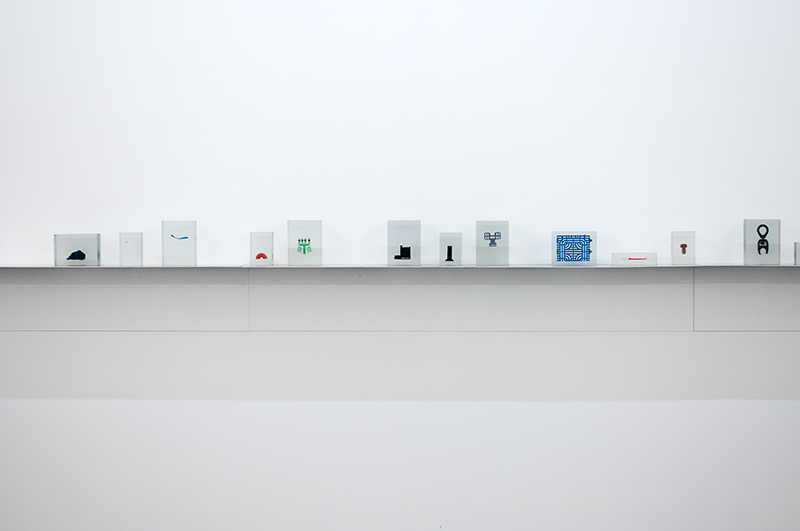
However, more than the ex-position of each particle it is the exhibition of the object that matters. There is nothing innocent about the fact that the capsular device chosen by the designer should exert an amplifying force on each element, behaving like a sort of magnifying glass that highlights and isolates it in the (recently acquired) uniqueness of its identity. These dilated particles, arranged and exhibited on a horizontal plane, are presented as total objects, subjected to some kind of alchemy of freezing, holistic formations in their plastic ontology which must not be interpreted/observed in the light of a dissociative logic of contents-wrapping. The acrylic block resists the status of container: the relationship that is established between the inside and outside is symbiotic rather than proxemic.
The exhibition, as well as all the spectacle of the display, offers, in accordance with the physical distancing and conceptual formatting used, distinct possible ways of reading/seeing the elements: either as a series of objects or as a composite object. In Alarcão’s layout (in which evidence of Warburg’s law of the good neighbour can be detected) there are, on the one hand, palimpsests on the modernist found object, on seventeenth-century cabinets of curiosities, and on the atemporal urge to collect. And on the other hand, what the designer proposes, always as a designer, is a (retro-) genealogy not of art, or even of the image, but of the object, a constant variable in the creative act.
While the physical object was once ostracized from the field of representation, in this exhibition the object is pure representation and the exhibition is presented as a meta-reflection on the representation of objects: what does an object that represents itself represent? The metamorphic process to which each particle has been subjected (its re-objectification rather than its reification) challenges the contemporary scopic regime and demands a new evaluative literacy of the visual, a new stance in the face of the design object as unique object. The designed, functional and operational thing takes on the auratic status of the unique work.
Filipe Alarcão’s work thereby transforms the territory of the gallery into a heterotopic place, a different site, where no aesthetic or formal language acquires hegemonic ascendancy: the space of uncategorised artistic alterity. This is not a design exhibition because it is much more than that.
This is a design exhibition.
Ana Cristina Cachola
(June 2012)
[1] Filipe Alarcão, designer is the subtitle of the author´s exhibition Instrospectiva shown at Mude – Design and Fashion Museum, Francisco Capelo Collection, between September 2011 and January 2012.



 /
/  /
/ 