Robert Wiley: A Net That Moves
Lure
Not everything that comes up in the net is a fish. Not everything that appears to be, is.
Robert laughs when I comment on how tidy the studio wall is. “You say that because you can’t see the noise of everything I hide on the wall I look at, behind the screen.” I manage to resist the urge to turn around and look at that wall, that it isn’t even behind me. Laughter ripples along both sides of the liquid-crystal surface.
And I let myself linger on the joke longer than I normally would on a punchline. My smile begins to tilt, flooded by a meditative wave. What tangles and heaps has Robert assembled there? At what moment did the ordering of that wall tip into disorder? Can I imagine ways of tracing the point where nothing becomes something?
Robert notices quickly when a line of thought runs aground—and he knows just as quickly how to free it. I could attribute that talent to the extroverted, pragmatic American mindset he grew up with, or to the tricks demanded by the craft of teaching. But I prefer to see it as something shaped by fishing: as if time spent by the water had formed his hand, and the metaphysics from which he builds fine threads
grids, nets, crystal exoskeletons,
bodies of light that are liquid,
like—what do I know—
molten glass,
the outline that rigs
a wire
for something that got caught there
and slips away
without ever showing itself.
With the gentle voice of someone waking you from deep sleep, Robert draws my linear attention back to the surface when he adds, “Everything I do is an object that sounds”—Everything I do is sound. I cannot tell whether he means that he makes things that
ring, that sound, that sweat
undulations,
briefness,
transience,
transmissions, or whether sounding names another kind of making altogether:
solid,
faithful,
reasonable,
confident,
logical.
Words are finely made lures. And until they begin to flow together, meaning moves in whatever direction it pleases.
Robert makes nets for meanings to pass through—meanings that the nameable would cut short. His works are forms: both ways of doing and form itself, matter itself—acts of holding and outlining, an outer line. And perhaps, a line that slips out of line. They are forms for something that flows without form, without time. Forms through which his poetics of openness throws itself forward. Lines of knowing that hook into waiting. Lines that hold tension without rigidity. Traps set for whatever might appear.
Caught by the mouth.
A fisherman’s waiting is not a vigil over luck, nor over the effectiveness of the bait he has prepared, but over the hunger that draws a fish out of immeasurable aquatic vastness. It is a hunger that leads the fish to show itself, and to surrender to the pleasures of capture.
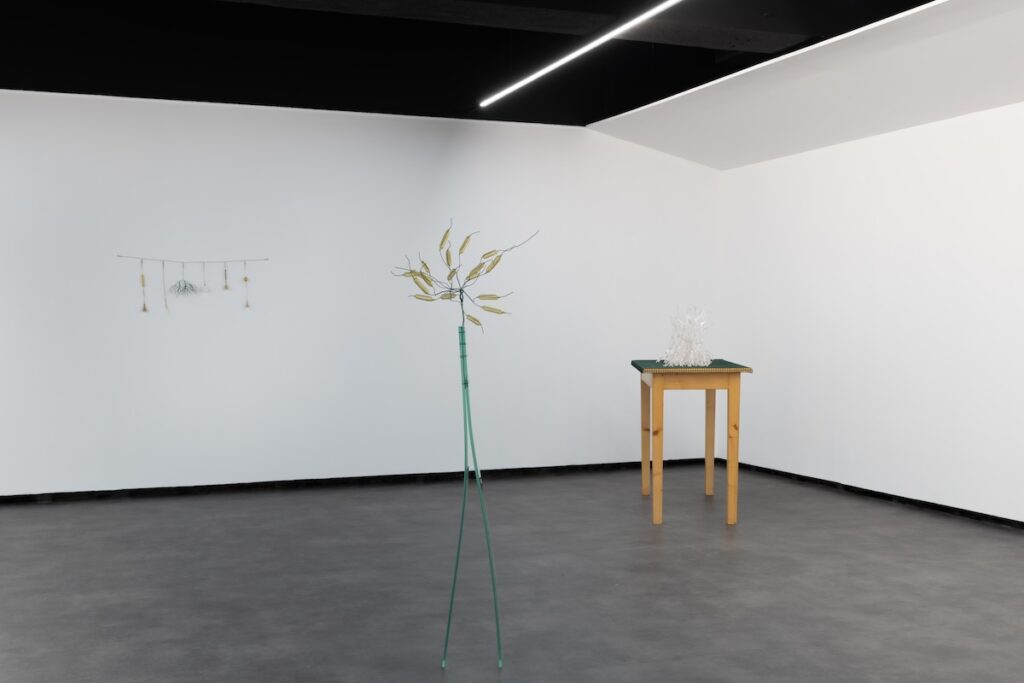
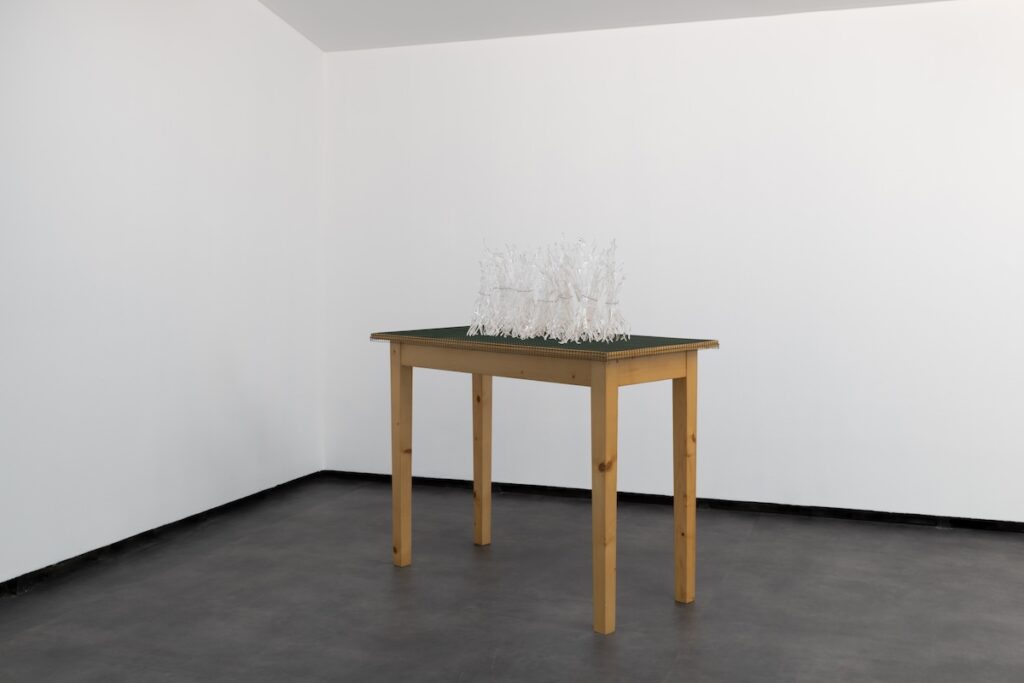
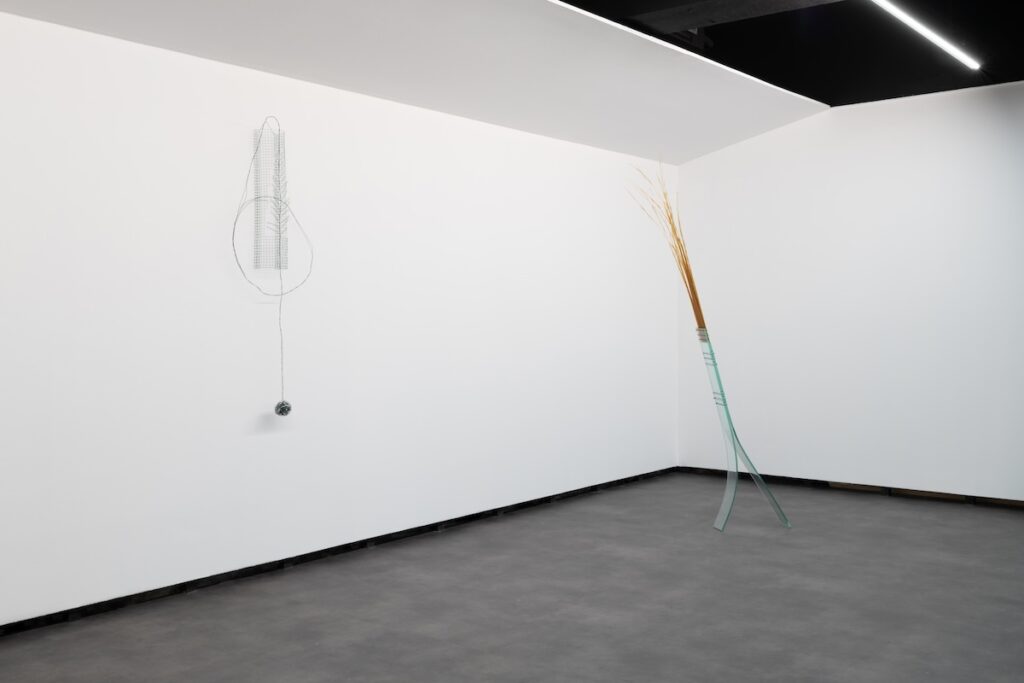
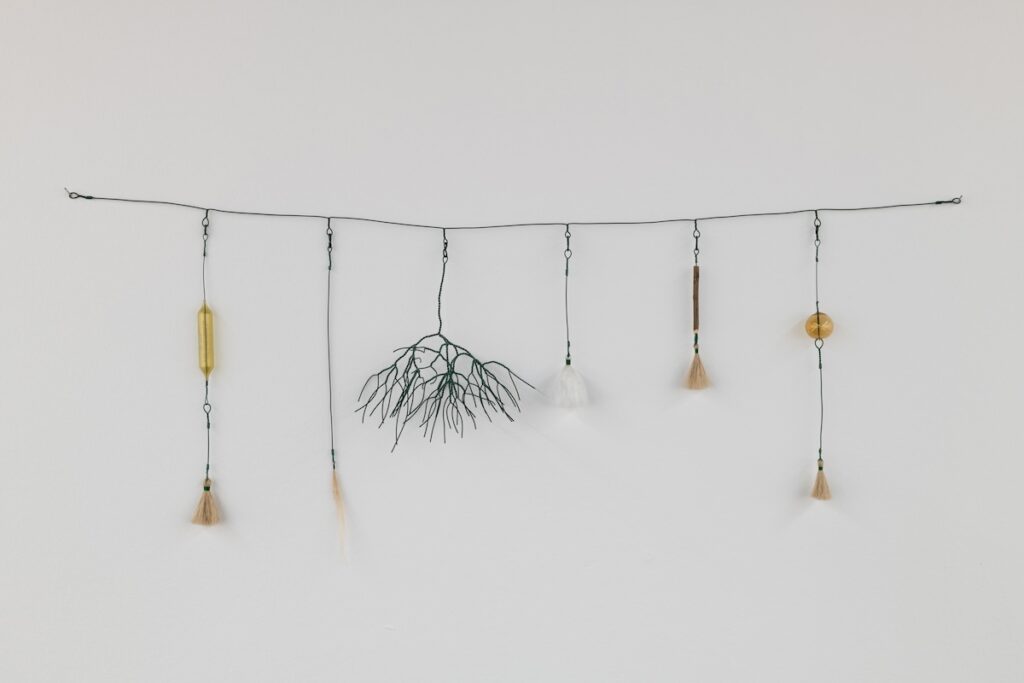
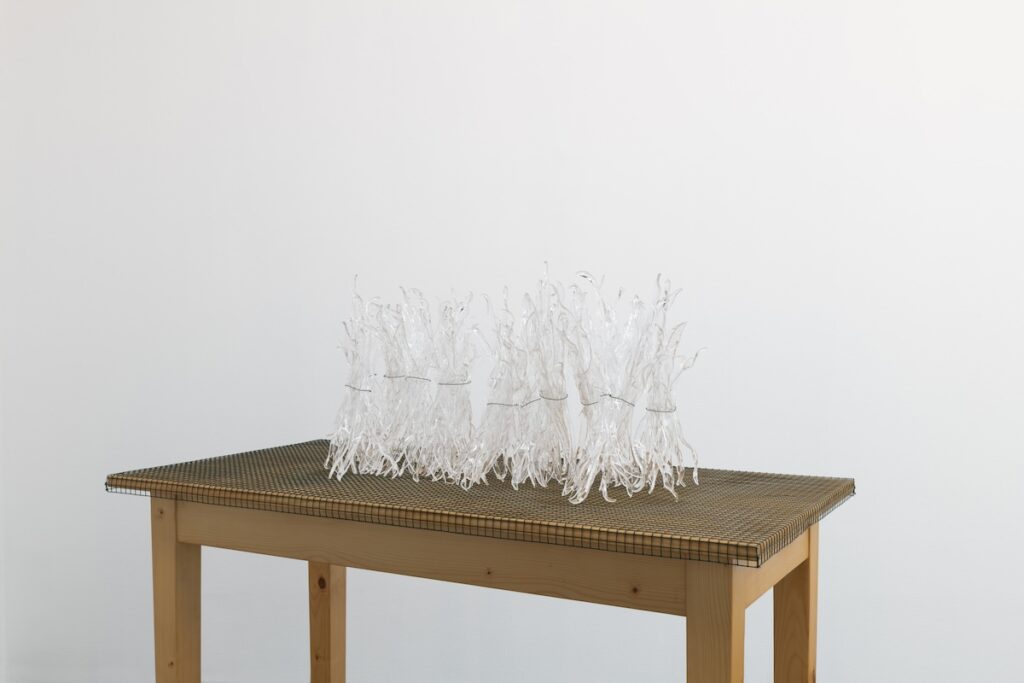
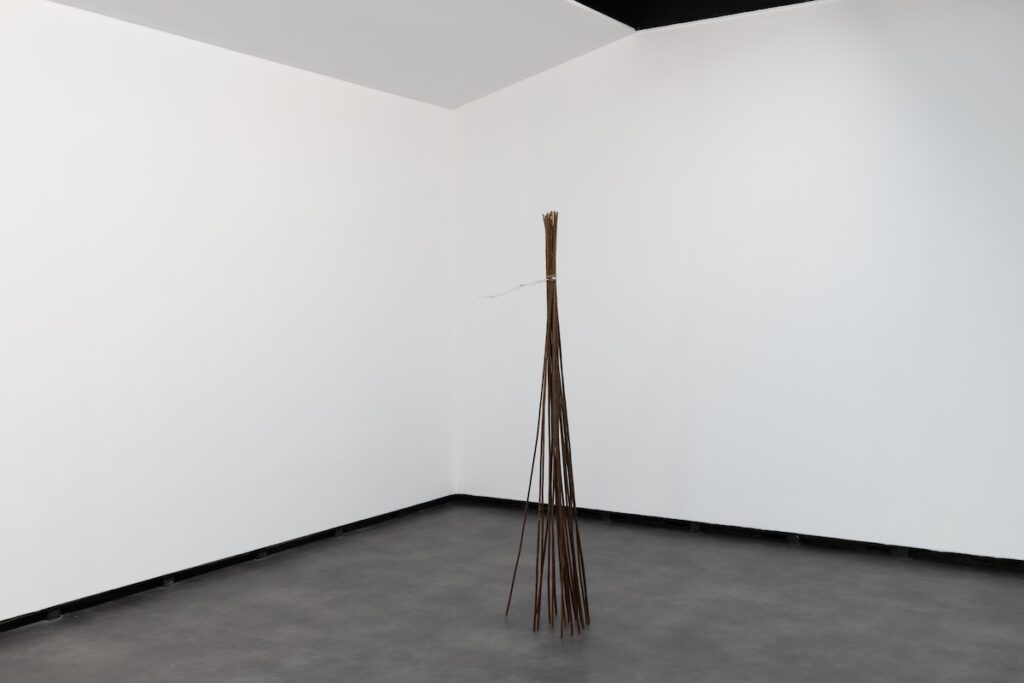
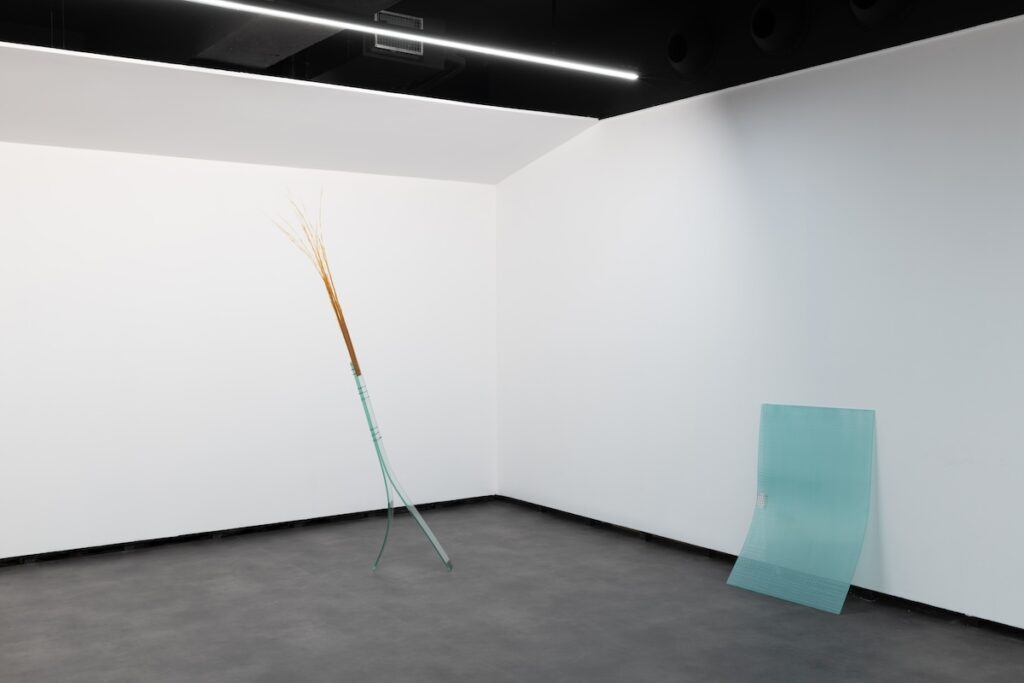
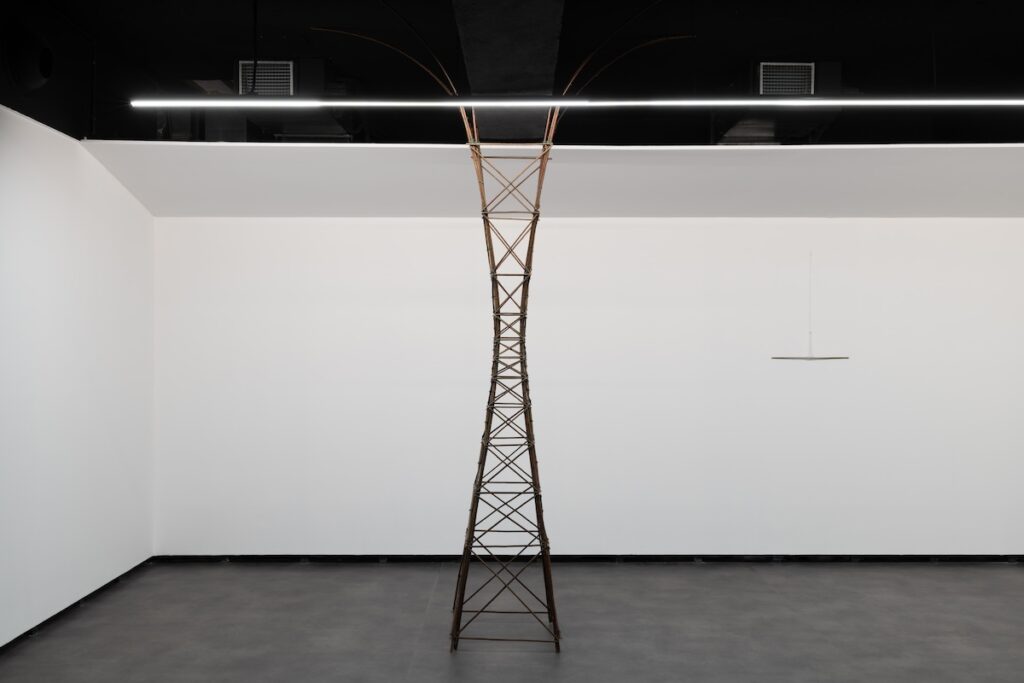
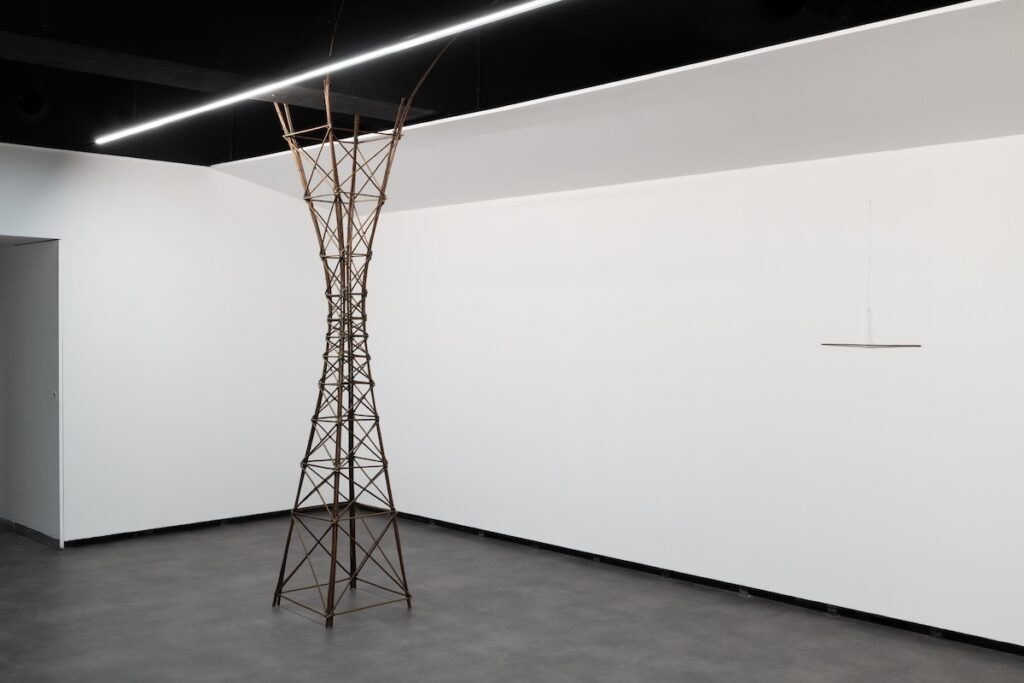
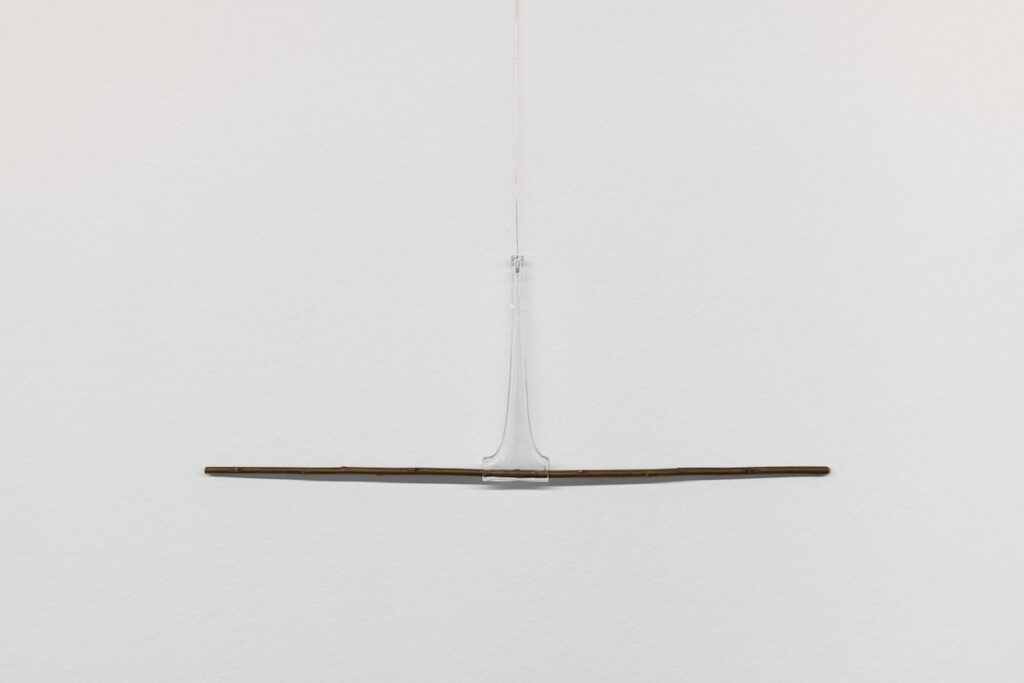
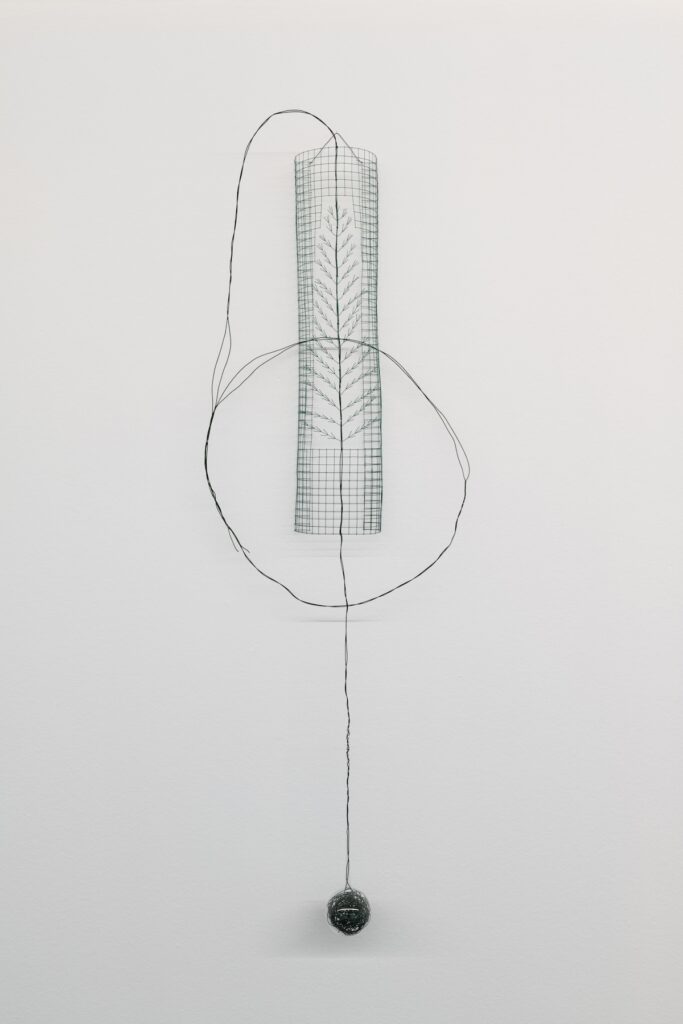
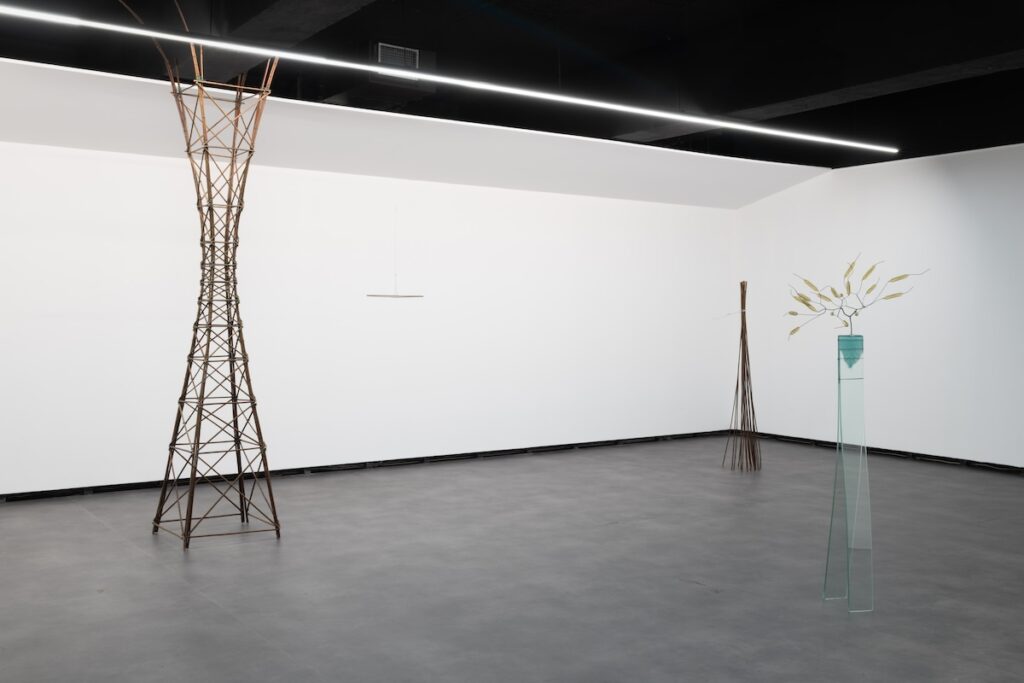
Robert Wiley describes his creations as artefacts of waiting rather than of aim. Creations made for a looking for rather than a looking at. Sculptural contraptions, drawings made spatial, objects with a skeletal air, which seem to hold something formless, delicate, fleeting. Creations that pursue a hunger that passes through without ever being named. Delicate outlines for something delicate, something that spills beyond the rigid, determining knots with which intellect so often tries to anchor the directions art takes.
Robert would say that the relationship between words and creation—especially visible in the domain of research on/in/through/from/with the arts—remains bound to the terror of losing one’s footing. It does not dare to let go of a notion of “making sense” steeped in, drowned in, the tangible. Hasty words, which do not even nibble at risky readings. A refusal to linger with what seems to be but is not, and what seems to be present but is not there.
Robert’s irritation with the hard line of concrete intellect brings my smile back. I notice the flush soaking his face, the voice sharpening into shrillness, the brow folding into creases. My smile widens, sensing a protective side of him rising to the surface. The gentle, measured manner with which he had been speaking gives way to something livelier—oppositional, assertive, slightly cranky. I know well this zeal of his for the unnameable, the numinous, the infrathin, the non-verbal nature of artistic creation, which bursts out whenever we speak about his (delightful) doctoral project.
The shoreline hides under the mist. Through the veil, what can be heard: a siren’s chirp, or a fisherman’s whistle?
Robert does not seem to notice the seductive power of his own words—the way they trace feeling, enchant it, and draw my attention into the sensual. The mastery with which he untangles words that are not naturally hostile to the senses. Contour lines for transient presences, fragments without identity, strange meetings of materials, the subtle joining of scraps of air and light. Words cast out like a line, cutting through the air of obvious interpretation, through the complacency of familiar grammar.
A lining in time. The line lies.
Creative inspiration arrives without an appointed hour. That is why the catch depends on waiting and preparation: on being available to notice—sensing—its passage, and on knowing how to draw it from the current of the subtle into ordinary reality. And on luck. May inspiration not come peering in when the fisherman shuts his early-morning eye. May it not show itself when he is distracted, gathering rubbish others have left behind in the landscape. May the line be able to hold it and bring its force to the surface.
A line that vibrates does not lie. But Robert’s hand is not fooled by the mere tightening of the rod. He waits, ponders, until the bobbing cork sinks before he gives his hand to the reel.
Robert’s hand knows all of this. A hand that never hesitates, yet is meticulous, sophisticated. A hand that mirrors the character of the one who carries it: vigorous, resolute, unembarrassed; traits that seem almost at odds with the tremendous, contagious gentleness and emotion he does not hide. I want to hear more of these stories of artistic creation in which men, too, align themselves with sweetness.
This creator’s hand does not fish for ready-made ideas. He tells me: There is no identity, there is the taking of an idea. There are no identities—only something whose grasp lets you feel the slip of its immeasurability. Like a fish out of water: whatever you hold too firmly begins to suffocate its living meaning.
I follow the deftness of his hand. The ease with which it loops nets and mends them when, inevitably, they tear. The meticulous preparation of new nets, and even more discreet knots. The strong hand that never pauses, never complains of the aches brought on by the repetitions any craft demands.
How many crafts are tied into those hands.
Robert grumbles whenever I bring up his training in glass sculpture as a way of defining him. I would say it is my own hunger at fault. My hunger that does not know how to wait, and allows itself to be tempted by the aesthetic I see in his sculptural work: drawings of fusions, unions, juxtapositions, and above all that irresistible material and intellectual tension between urgency and release, in which my own mind has made its home.
Robert’s fishing comes to an end. The equipment is gathered up; the remnants of the catch. And yet the hand cannot withdraw with the rod. It never rests. The hand’s awareness does not sleep; it does not save itself for another day. It follows the current of whatever comes next.
The hand may be the least moralising, least judgmental part of the self. Consciousness moves easily between habits and customs—now loosening, now tightening; now dragging, now letting go—pressing as much as it caresses. The hand that knows how to weave a net, set up supports, undo knots, wash clothes with eyes closed, run a finger along the inside of a nest to savour the cool freshness of its cleanliness. The vigorous hand that knows how to strike down, that feels the withered skin of lovers, that settles a child into sleep in the cradle of affection, that dances alongside the speaking mouth and reminds us of the inseparability in which we exist. The hand that knows how to be the least sentencing part of the self.
The display of his creative contraptions does not make the exhibition space feel more orderly. If anything, it expands perception—space felt as material. Something unfathomable happens. Or, in passing, something dissolves all limits. Something appears while seeming not to be there. Is it not there, or am I the one who fails to catch it?
André Alves
2026


 /
 /
