


Sara & André
Sara & André (Lisbon, 1980, 1979) operate on an ambiguous threshold between artistic practice, research and critical intervention. Their projects tend to develop an incisive commentary on the processes of artistic legitimisation, making explicit the institutional, commercial or academic mechanisms that determine notions of value, visibility and artistic relevance, both of artists and of artworks. It is therefore unsurprising that they are often affiliated with the practice of institutional critique, an approach that questions the structures, norms and practices of institutions, challenging their forms of power, authority and control, and proposing alternatives or reflections on their impact on society. However, and unlike more established institutional criticism, which positions itself in a distanced exteriority in relation to the critical object, Sara & André work from within the artistic system itself, participating in its dynamics and using its rules both as working material and for their own benefit. In this way, they create a body of work that is both critical and participatory, raising questions without offering unilateral answers. This complex positioning outlines a notion of criticality, not as a distancing, but as an active and contradictory involvement in the processes it addresses.
An example of the complex way in which the duo questions the processes intrinsic to the art world can be found in their solo exhibition presented at MNAC in 2014. Entitled Exercício de Estilo (Exercise in Style), the project was based on an approach of quoting and paying homage to Julião Sarmento, one of Portugal’s most internationally recognised artists. By referencing the work and authorship of a leading artist, Sara and André took the calculated risk of seeing their own authorship eclipsed, confronting a legitimisation dilemma that has always intrigued them. Between the fame acquired by Julião Sarmento’s prestige and the easy accusations of plagiarism or lack of originality, in this exhibition Sara & André rehearsed a critical and problematic reflection on the limits and characteristics of authorial singularity and subjectivity in the context of the visual arts.
In addition to critical reflection centred on leading figures such as Sarmento, Sara & André have also investigated the mechanisms of artistic validation associated with the private sector and, more specifically, with the figure of the collector. O Colecionador de Belas Artes (The Fine Art Collector), presented in 2022 at Galeria Quadrum in Lisbon, was based on António Areal’s painting of the same title to present a series of portraits of collectors surrounded by their works of art. In so doing, the duo exposed part of the power dynamics that shape contemporary art, making visible how collectors play a decisive role in defining which artists and works gain legitimacy, and questioning how networks of influence and financial dynamics are essential to the perpetuation of a certain artistic canon.
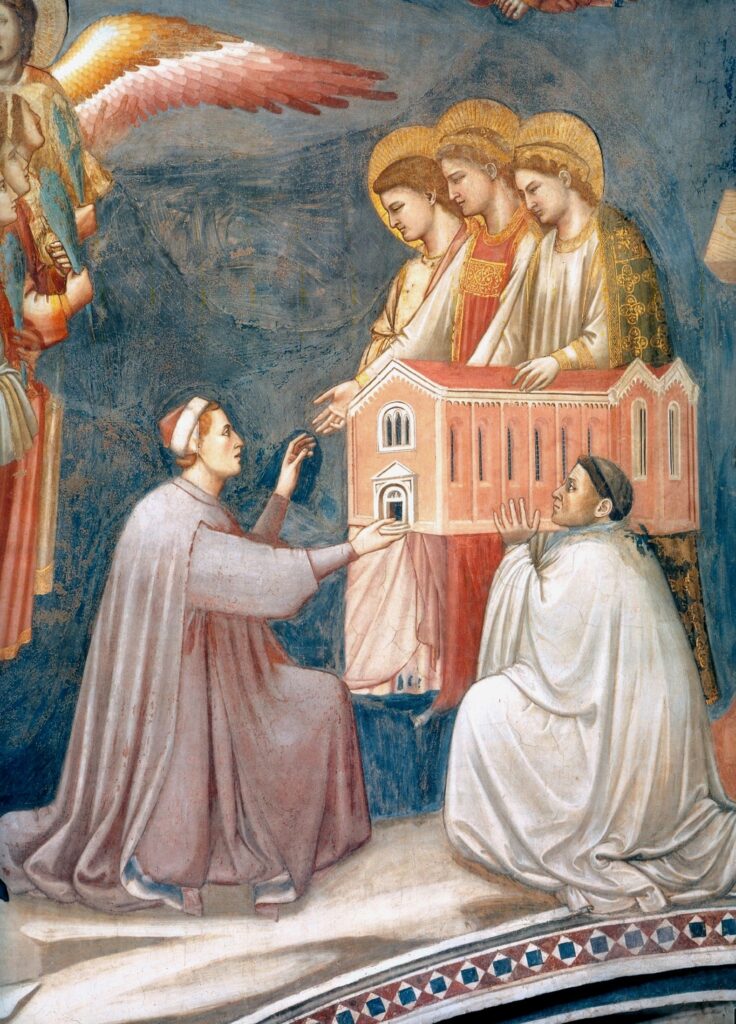
The duo’s most recent project, developed in 2025 for the exhibition Diante do Tempo (Before Time), follows on from the project presented in 2023 at Casa-Atelier Vieira da Silva in Lisbon, and both seem to signal a turning point in Sara & André’s research. In Atelier, Lisbonne, the artists reinterpreted Vieira da Silva’s abstract painting of the same name, creating an installation in the very studio where the work was conceived and which it depicted. Through this spatial transposition, from the two-dimensionality of the pictorial representation to the three-dimensionality of the sculptural installation, the artists explored the studio not only as the central theme of Vieira da Silva’s painting, but also as a place for experimentation and reflection on the processes of artistic creation. The new project also materialises the impulse to three-dimensionalisation, this time taking Giotto’s frescoes in the Cappella degli Scrovegni in Padua as its starting point. This formal inflection in the artists’ work is no more than an appearance or formal feature, since a closer look at the new project soon reveals the structural dynamics that interest Sara & André so much, even if they are inscribed in a historical context other than the contemporary one. Despite being a medieval painter, Giotto is in some ways one of the first ‘international’ artists, with a status at the time that went far beyond his region of origin to have a lasting impact throughout Europe. The Cappella degli Scrovegni, in turn, commissioned by Enrico degli Scrovegni with the aim of promoting his father’s absolution from the sin of usury, is an example of medieval patronage and its objectives, and is not dissimilar to the practice of contemporary collecting, already addressed by the artists.
The duo’s proposal consists of two sculptural objects with a markedly scenographic character that reproduce architectural elements from Giotto’s frescoes in the exhibition space. Untitled (Annuncio a Sant’Anna) reproduces the house where Saint Anne received the announcement of her pregnancy, however, Untitled (Giudizio Universale, scena della consegna del modello della cappella) does not reproduce any architecture of a religious scene, but rather the model of the Capella degli Scrovegni itself from a fresco in which the chapel’s patron is depicted offering it to the Virgin Mary as a symbolic gesture of devotion.
These sculptures are therefore of particular importance, not so much in their representation of religious devotion or because they are a contemporary revival of a fundamental work in the Western artistic canon, but because of the historical context in which Giotto was commissioned to build the chapel and the frescoes, and the objectives of the patron, who sought to obtain salvation through this process. In this new project, using scenography and the performativity intrinsically associated with it, Sara & André appropriate the medieval idea of salvation and the role of the patron, updating them in the light of their critical concerns and the contemporary context. The duo thus questions the role of the patron and how art is inscribed in a narrative of redemption, not only on a moral level, but also, and perhaps above all, at an aesthetic and social one. By revisiting Giotto’s frescoes in the Capella degli Scrovegni, Sara & André once again propose a critique of power relations and values in art, which remain as relevant today as they were in medieval times.
João Mourão and Luís Silva 2025
Bio
Sara & André are visual artists. They studied respectively Set Design at Escola Superior de Teatro e Cinema (Lisbon, 1999-2005) and Fine Arts at Escola Superior de Arte e Design (Caldas da Rainha, 1999-2005). Together they studied painting at the Sociedade Nacional de Belas Artes (Lisbon, 2008-2011). They live and work in Lisbon and have been exhibiting regularly since 2006.
They have held and participated in several solo and group exhibitions in museums, galleries and independent spaces in various cities, such as the recent: Impressões Digitais – Coleção MNAC at MNAC (Lisbon, 2024); 74 x Caldas = Uma Ideia Clara, at Centro de Artes (Caldas da Rainha, 2024); Cravos e Veludo, at MNAC (Lisbon, 2024); #Slow #Stop…#Think #Move Território #2, at Culturgest (Porto, 2023), the anthological Look at me, at CAV (Coimbra, 2022), or the group show 48 artists, 48 years of freedom at MAAT (Lisbon, 2022).
In 2014, they presented the exhibition Exercício de Estilo at MNAC-Museum of Chiado (Lisbon) around the work of Julião Sarmento. In 2017, they curated the exhibition cycle Curated Curators at Zaratan – Contemporary Art (Lisbon), from which the book Uma Breve História da Curadoria (Documenta, Lisbon, 2019) emerged. In 2021, they conceived the special edition of the magazine Contemporânea – Inquérito a 263 Artistas (Lisbon) and between 2022 and 2024 they developed the project O Colecionador de Belas Artes, consisting of an exhibition at Galeria Quadrum and a book published by Galerias Municipais (both in Lisbon).
They were part of the Commission for the Acquisition of Contemporary Art of the Ministry of Culture (2019-2020), which led them to co-curate the exhibitions Memórias Futuras at MIAA (Abrantes, 2021) and Dark Safari at Museu do Côa (Vila Nova de Foz Côa, 2023). As curators, they signed the projects House of Tigre, a group exhibition at Maus Hábitos (Porto, 2022), Rio, an individual exhibition of Mestre José Pimenta, at MIAA (Abrantes, 2021), O Verdadeiro Lado da Manta, a co-curated group exhibition at Centro Cultural Vila Flor (Guimarães, 2022), and Descuradas, a group exhibition at Centro de Arte Oliva (São João da Madeira, 2023), among others.
Since 2023 Sara & André have also collaborated with theatre companies such as Plataforma 285, Teatro Praga and Cão Solteiro, as well as with collectives such as With ≤3 to Palestine, Arte pela Palestina, Climáximo e Greve Climática Estudantil. They are represented in various public and private collections, and their work is regularly published in books and specialized magazines.
HCI / Colecção Maria e Armando Cabral /  /
/  /
/ 