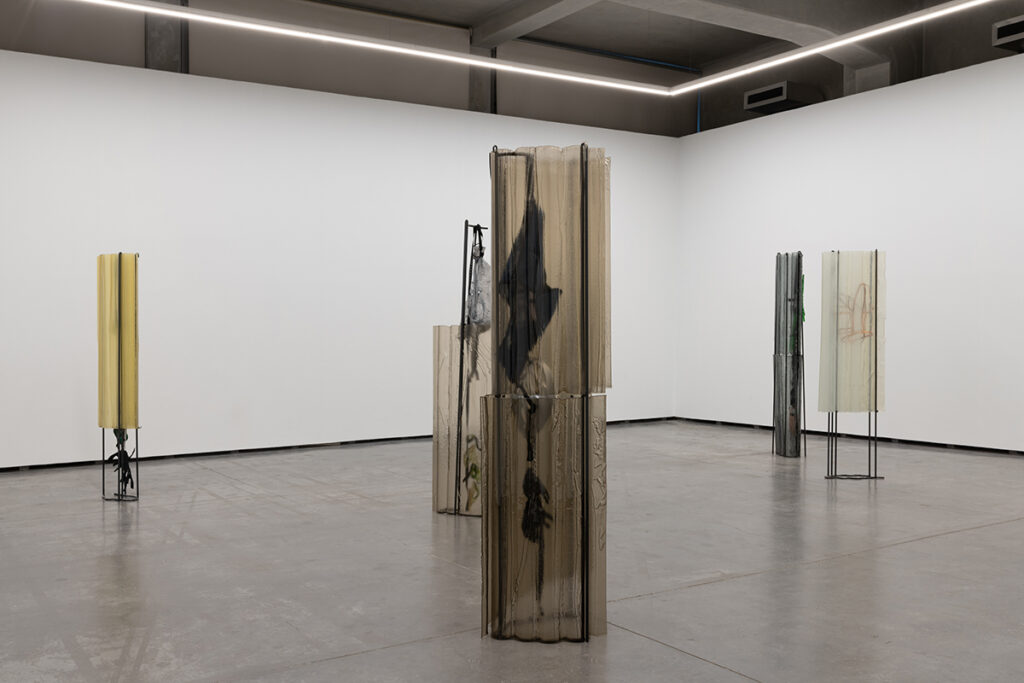
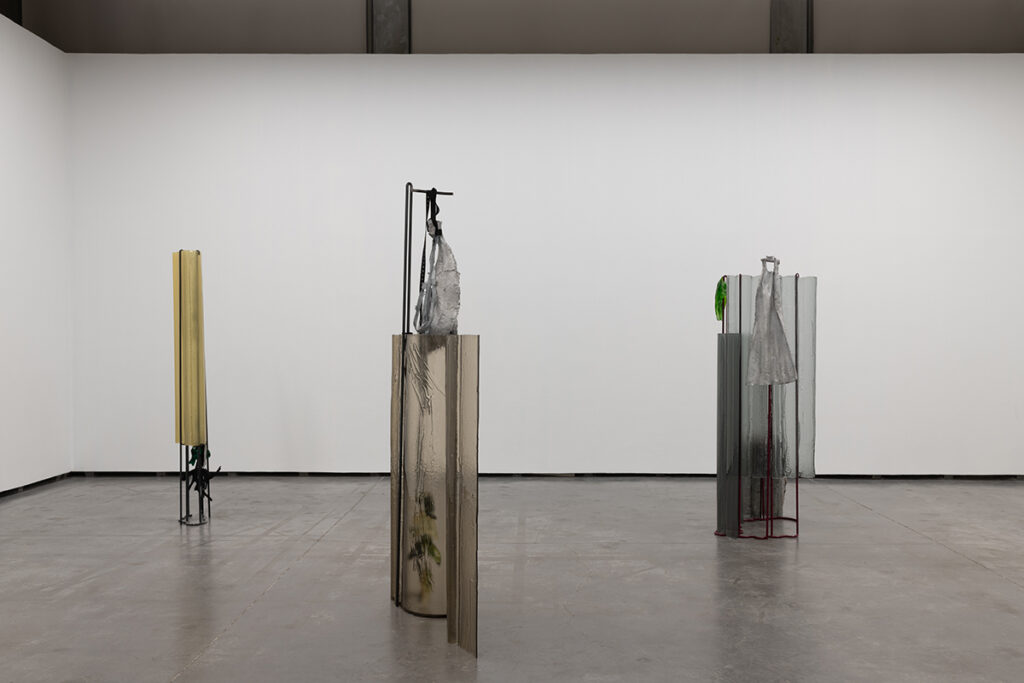
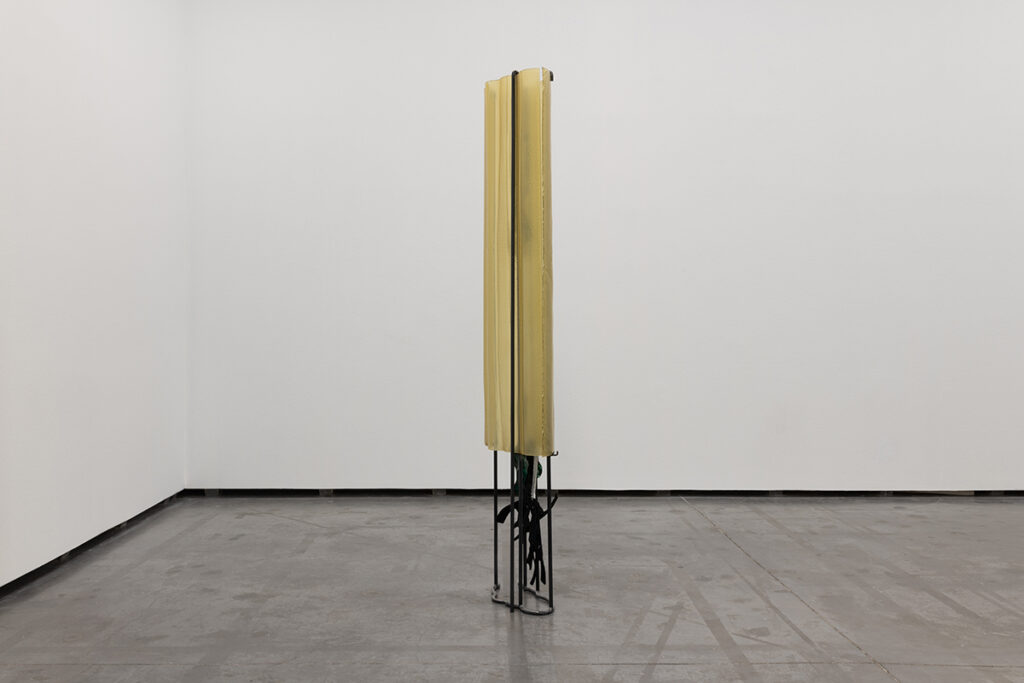
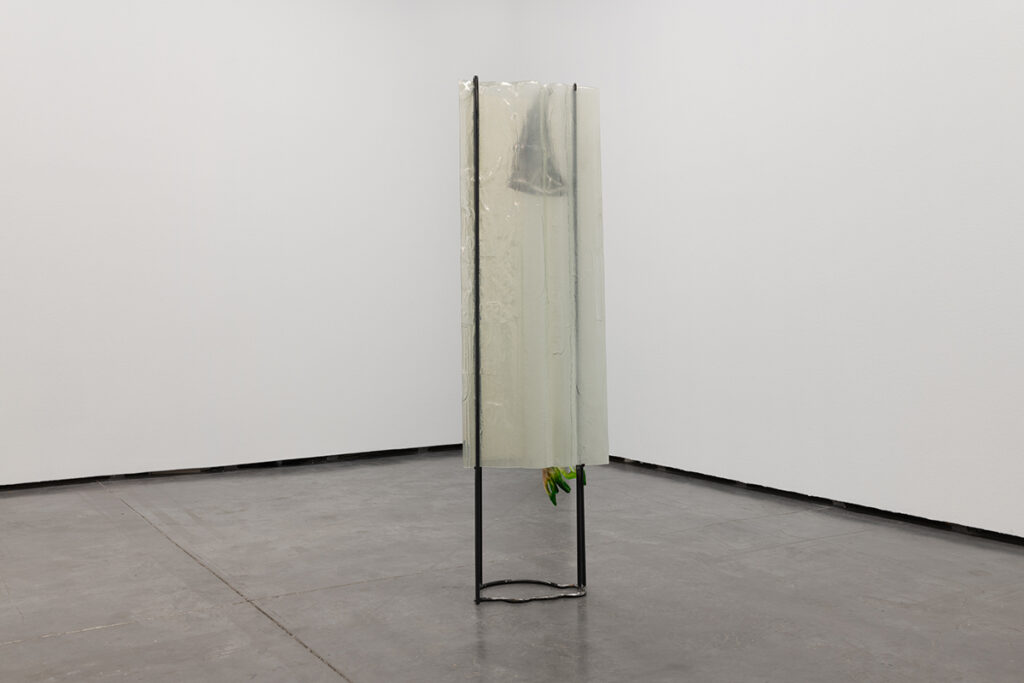
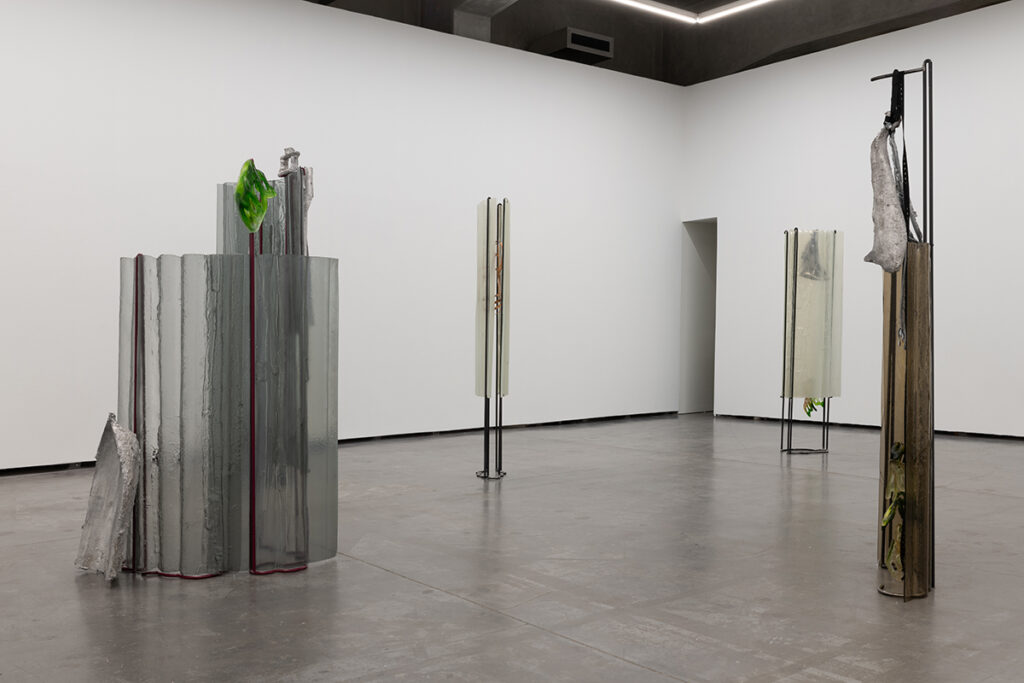
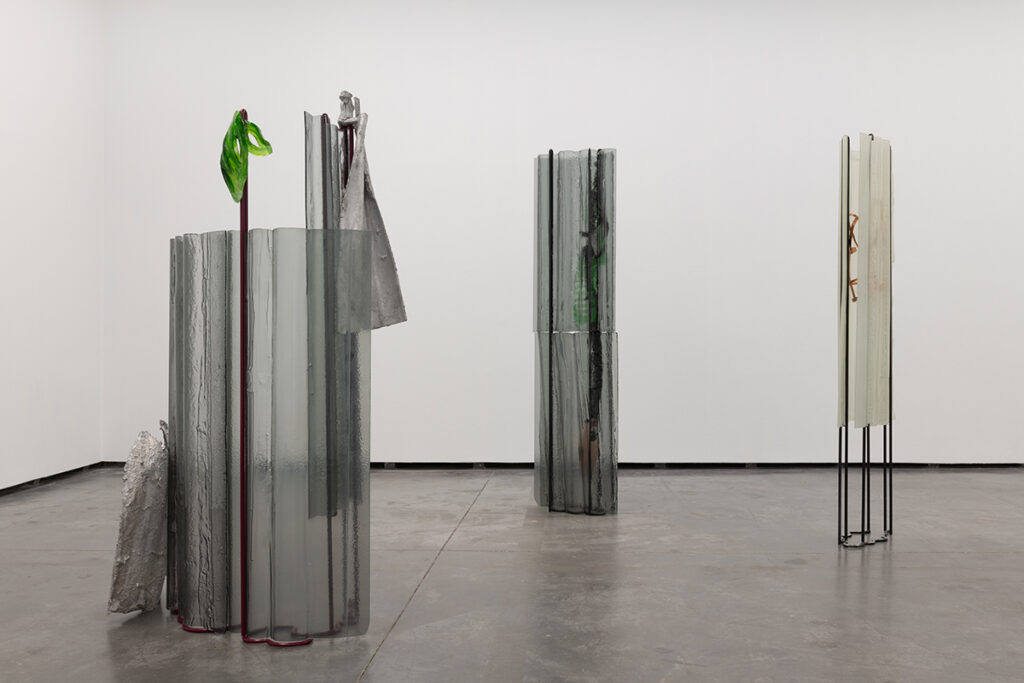
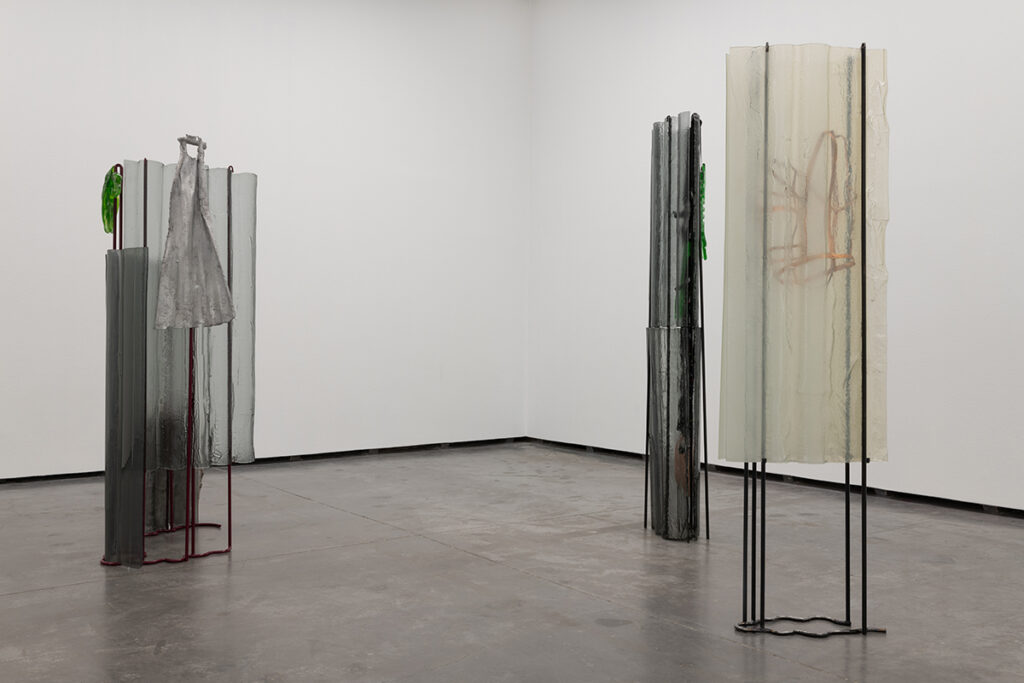
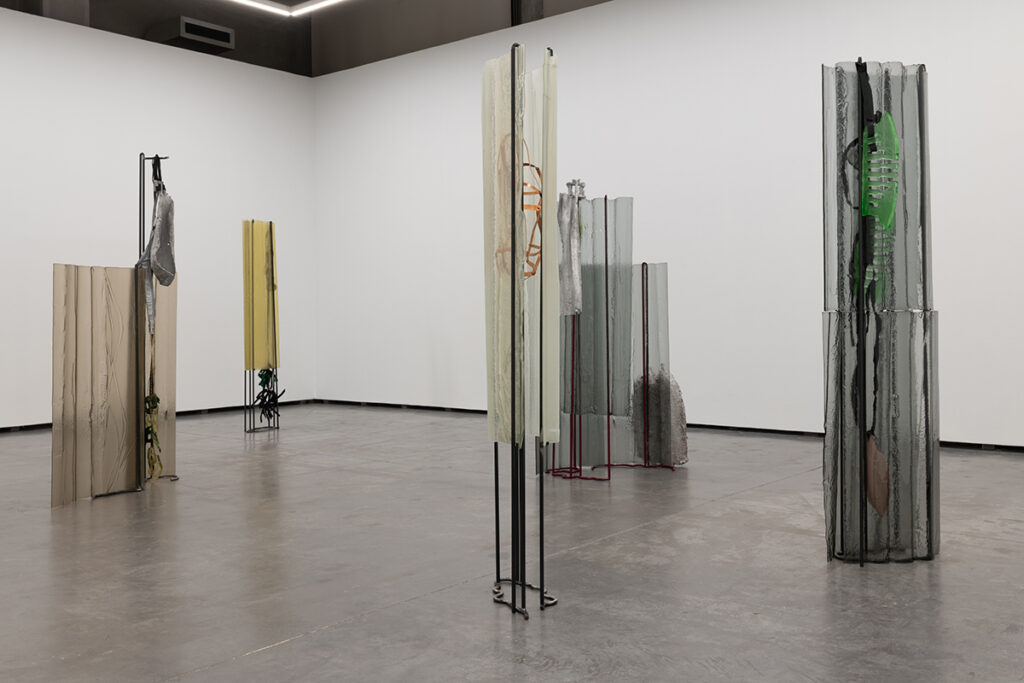
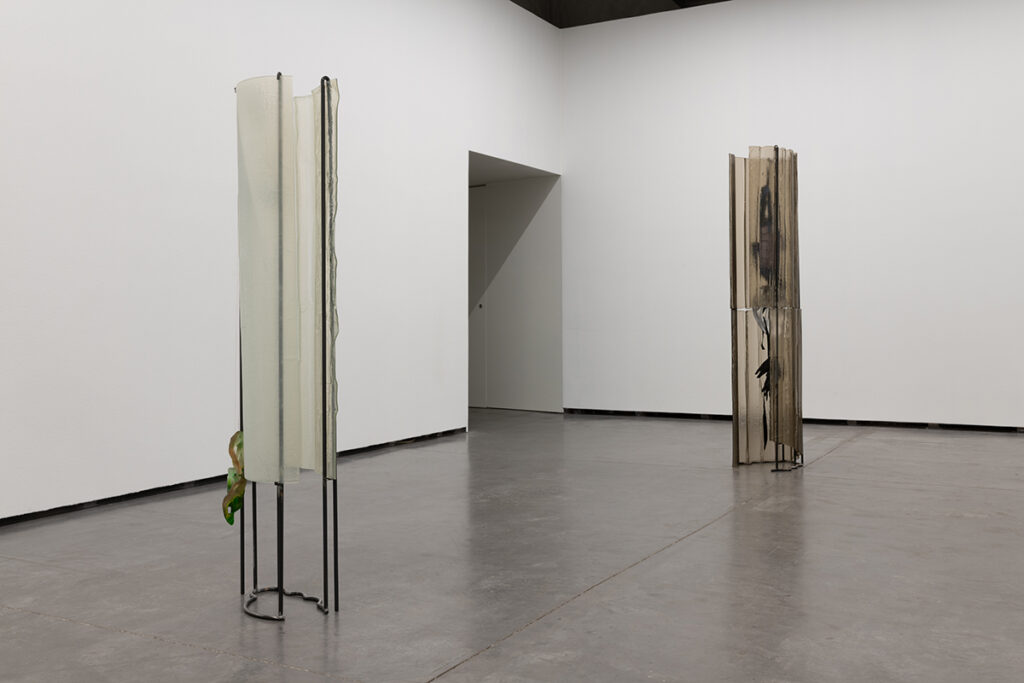
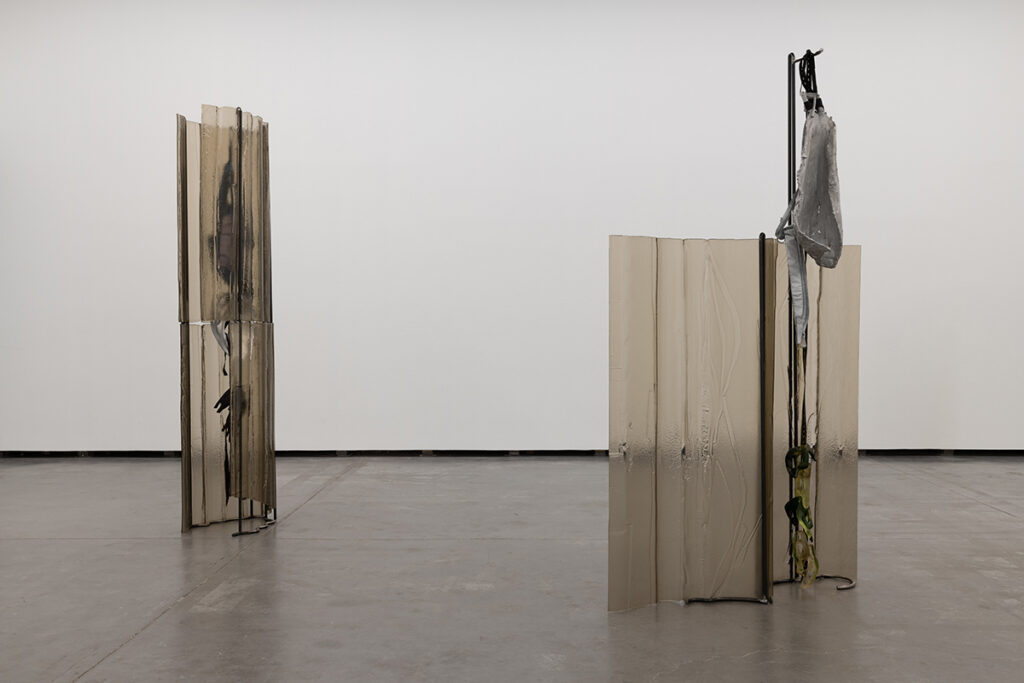
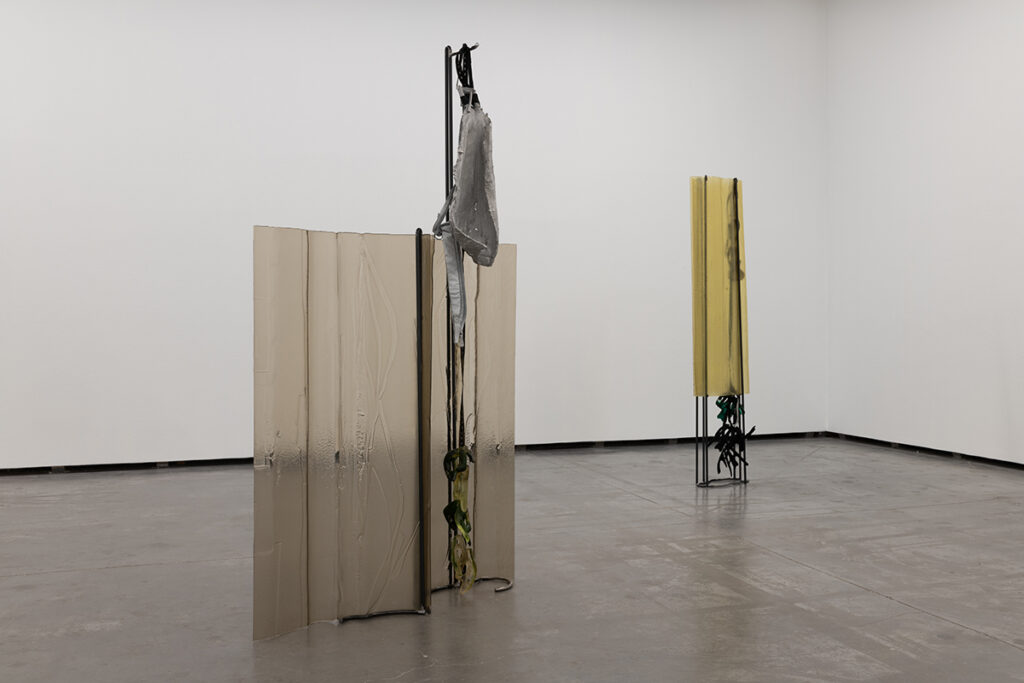
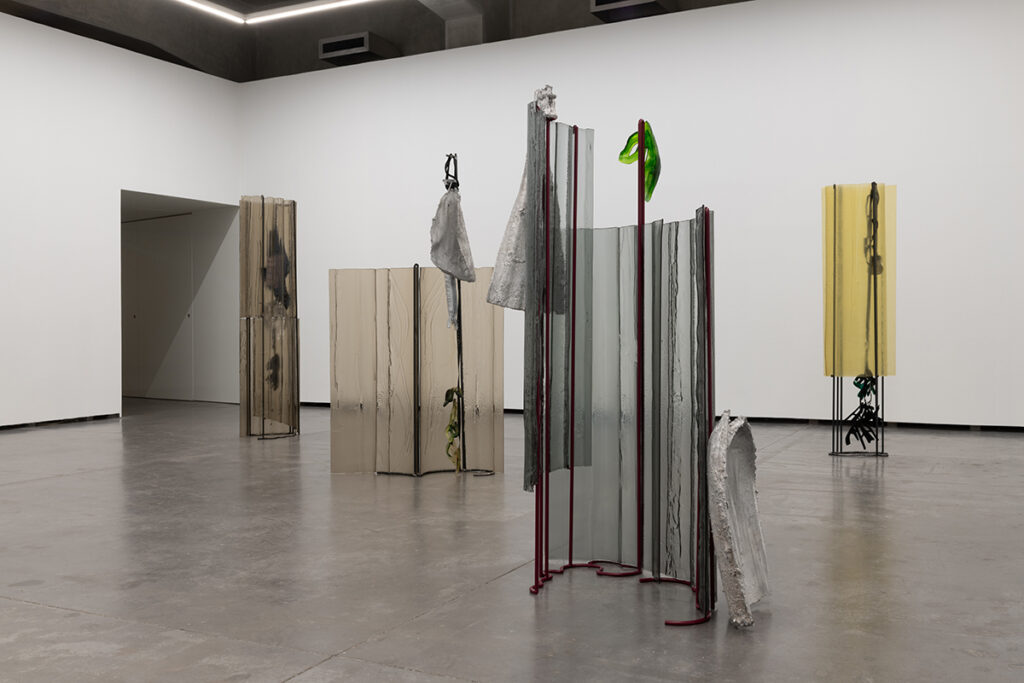
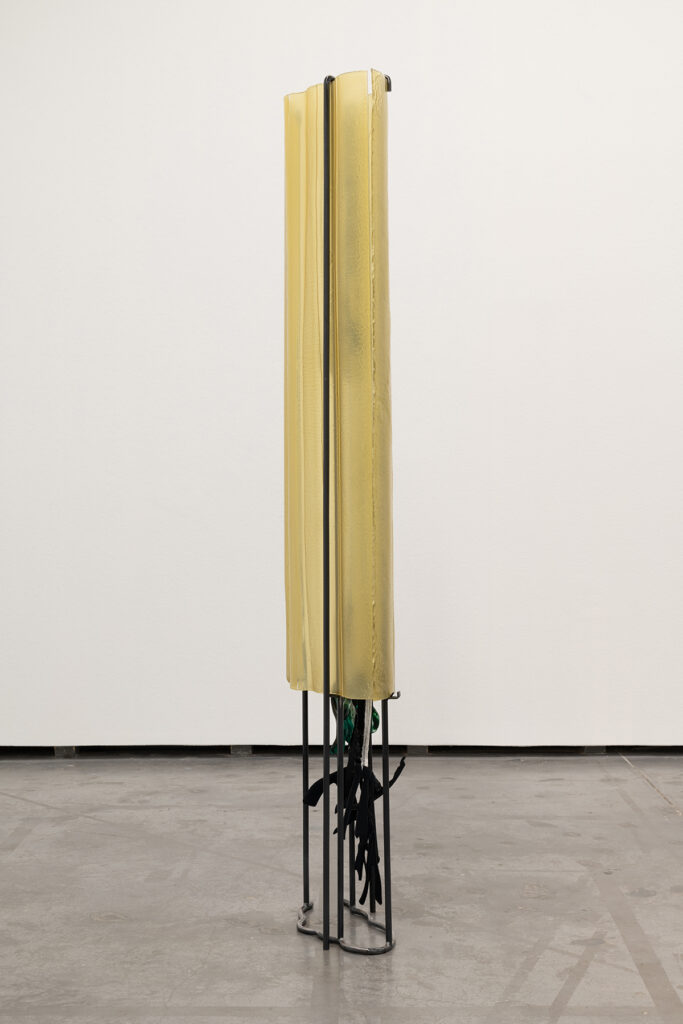
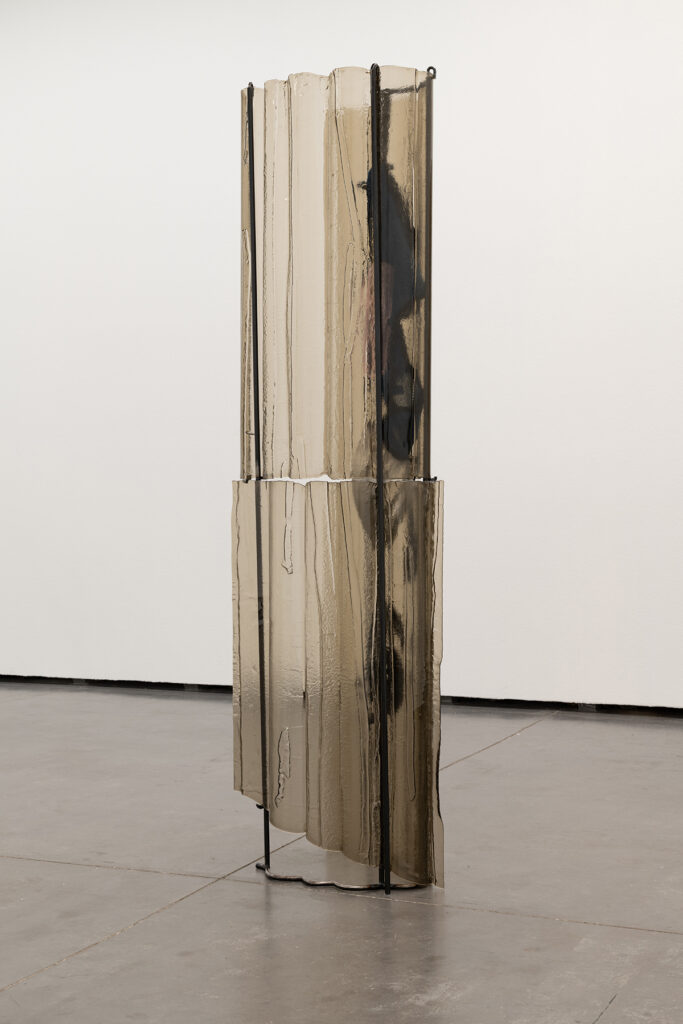
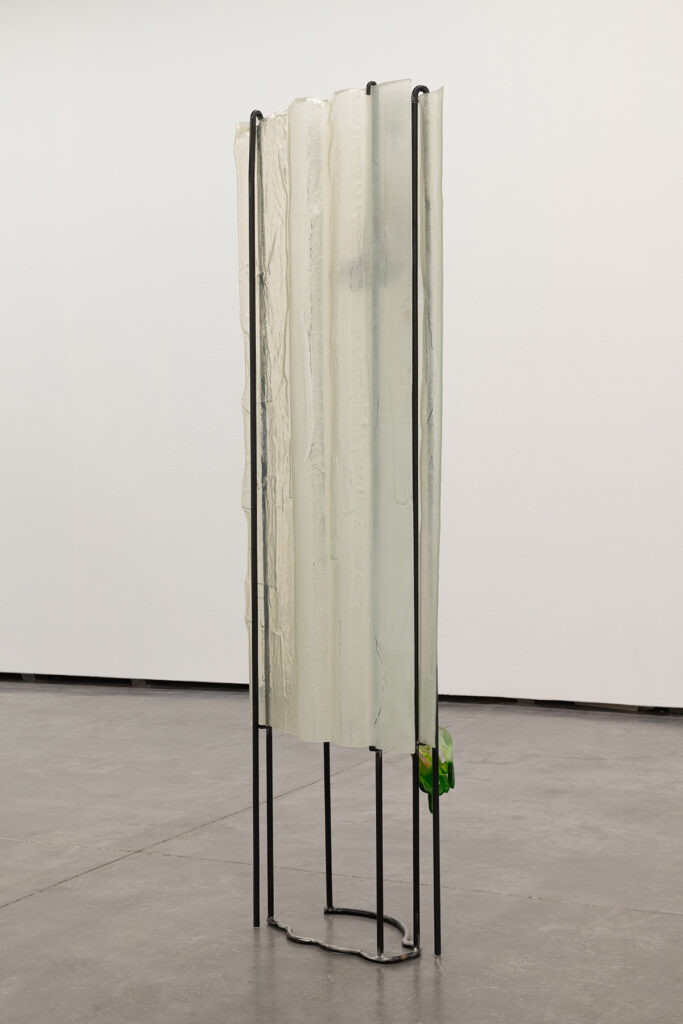
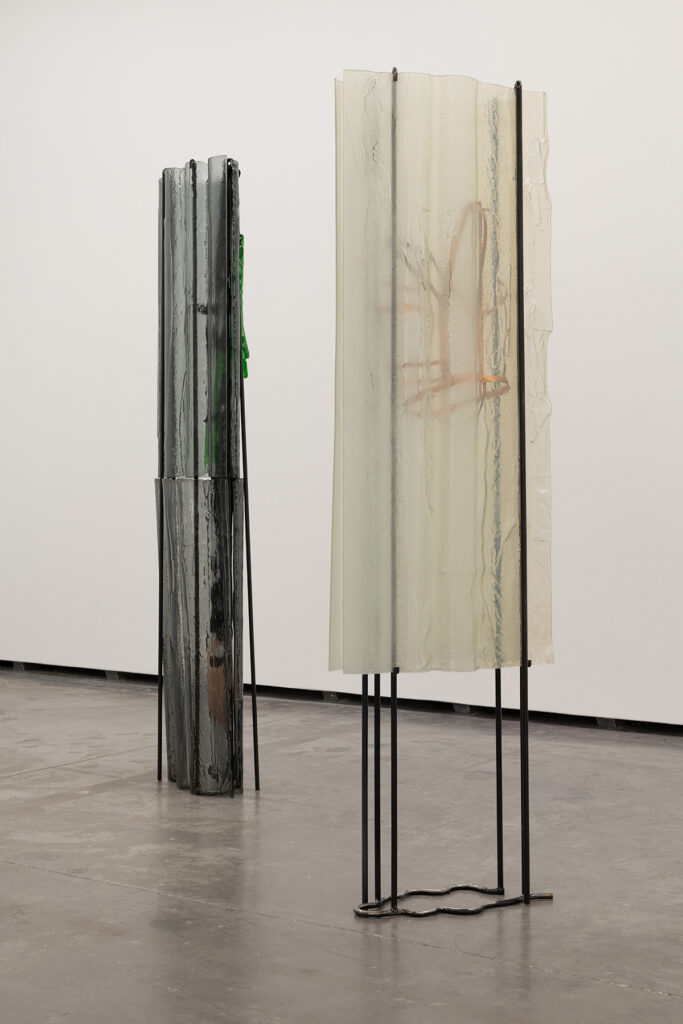
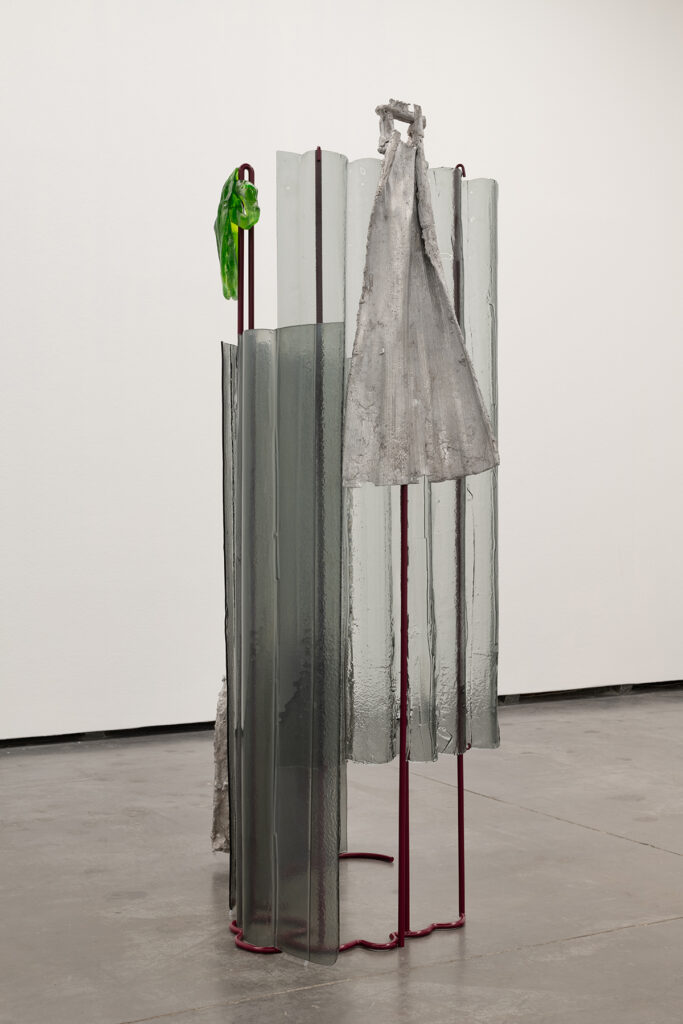
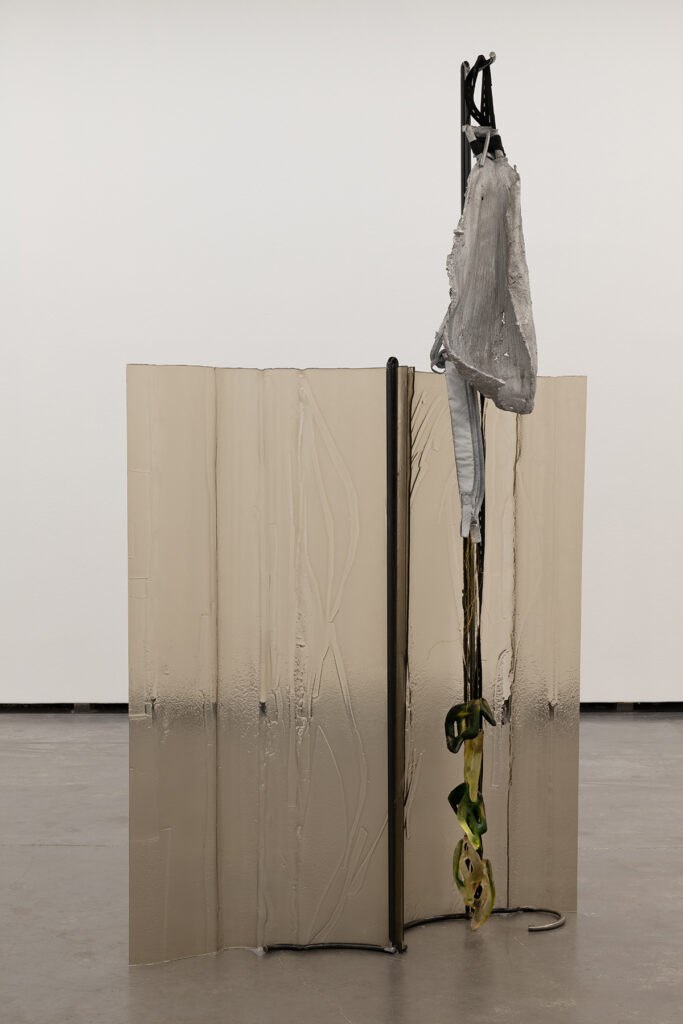
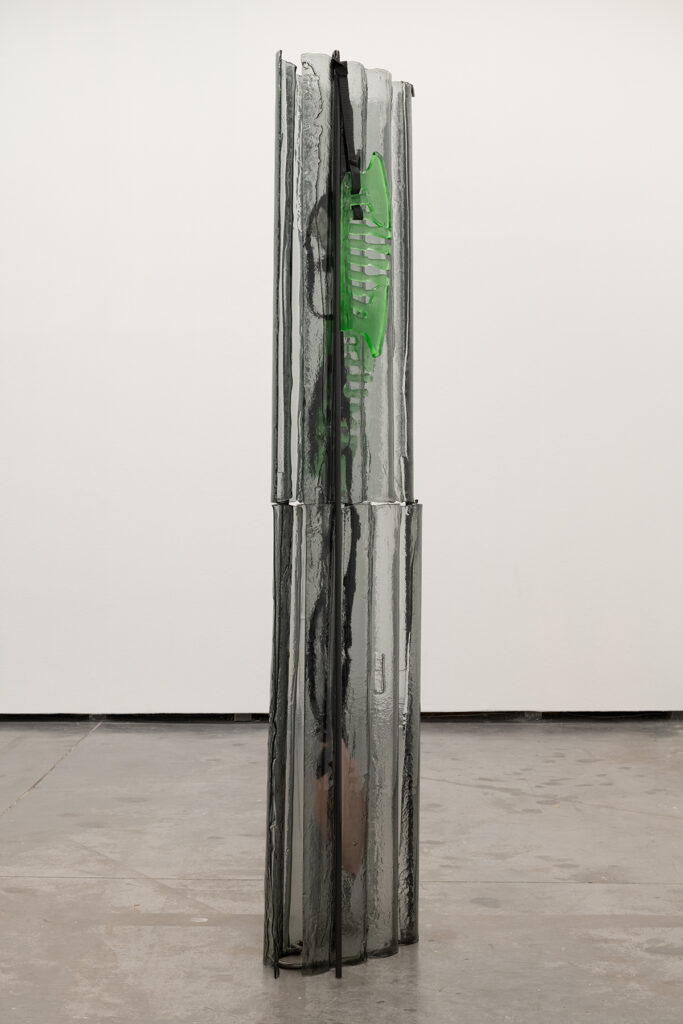
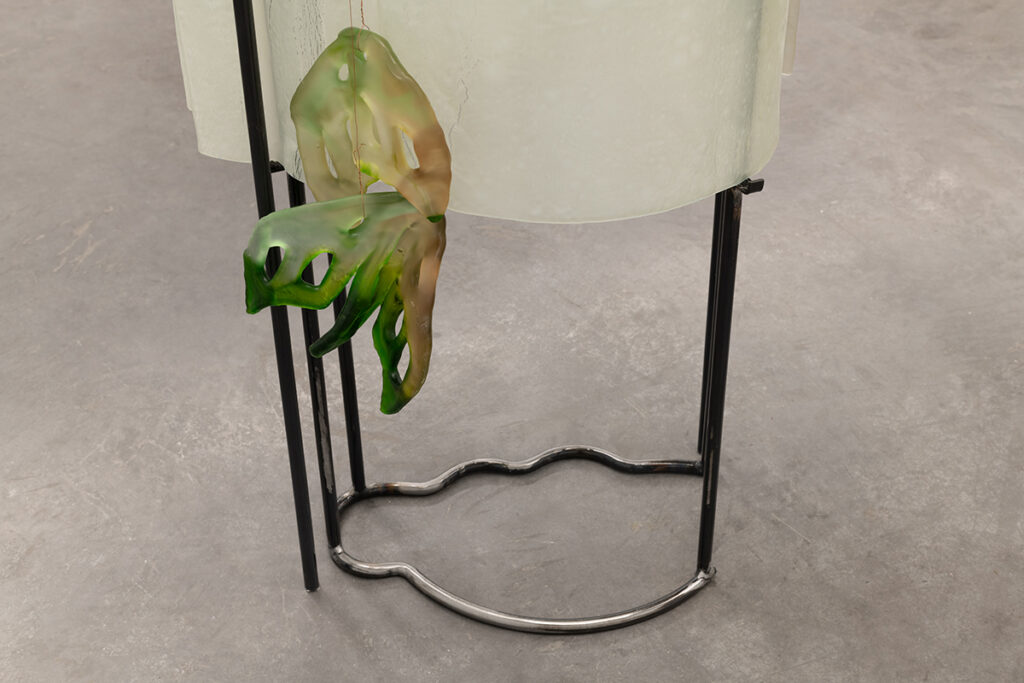
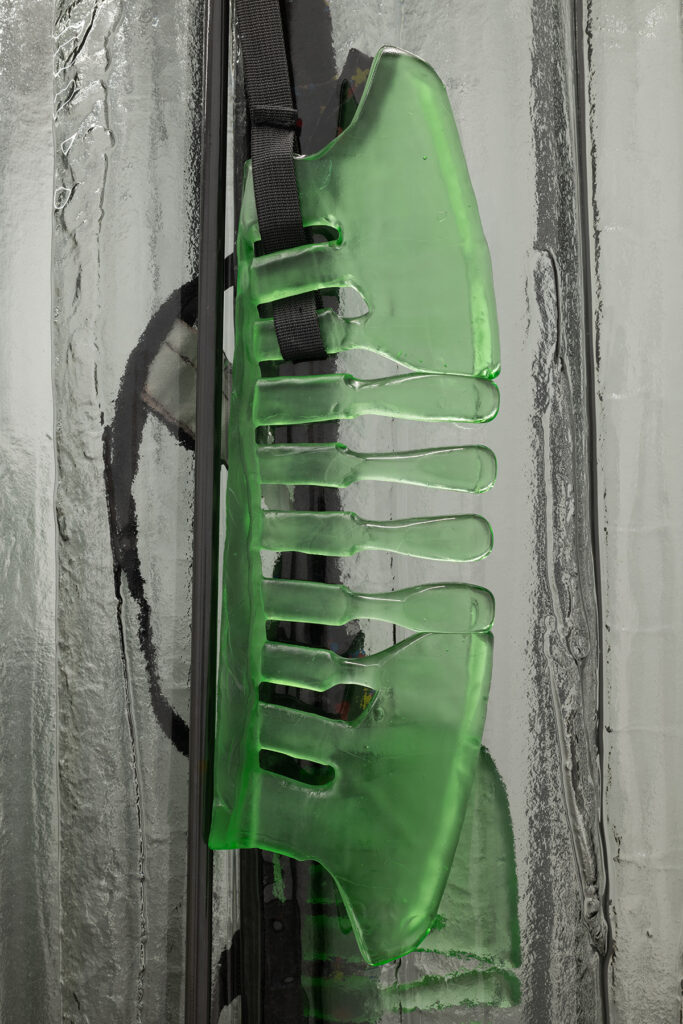
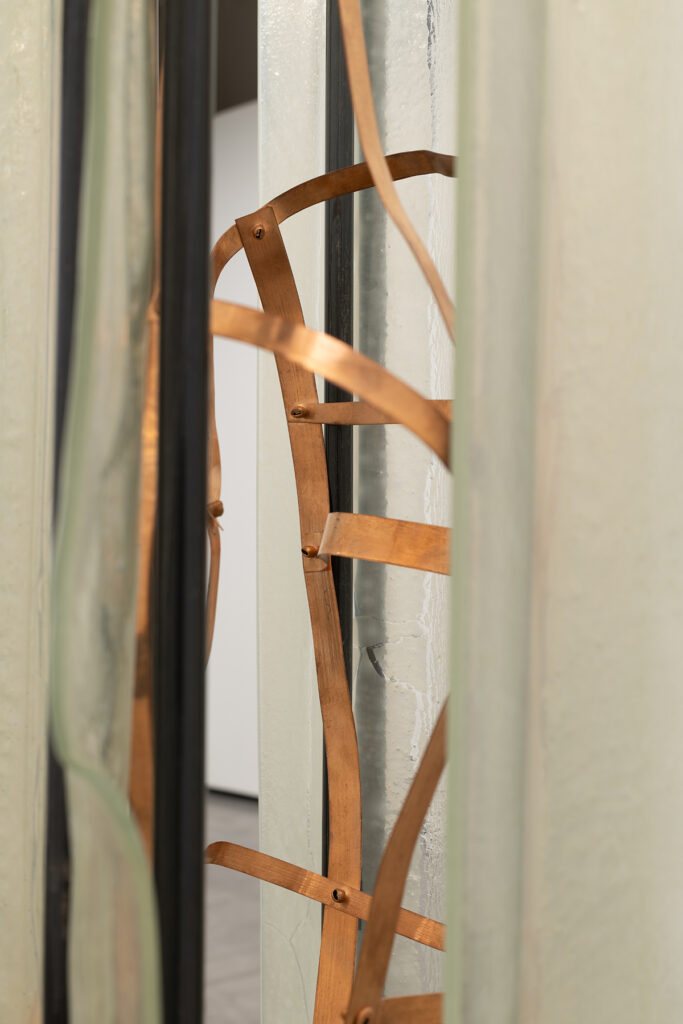
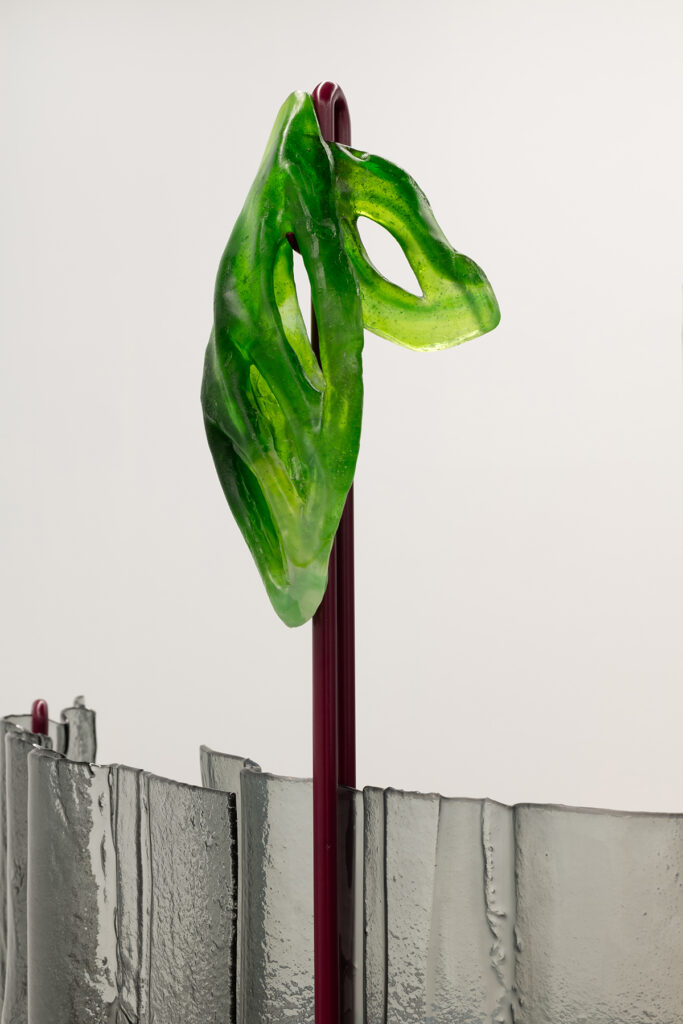
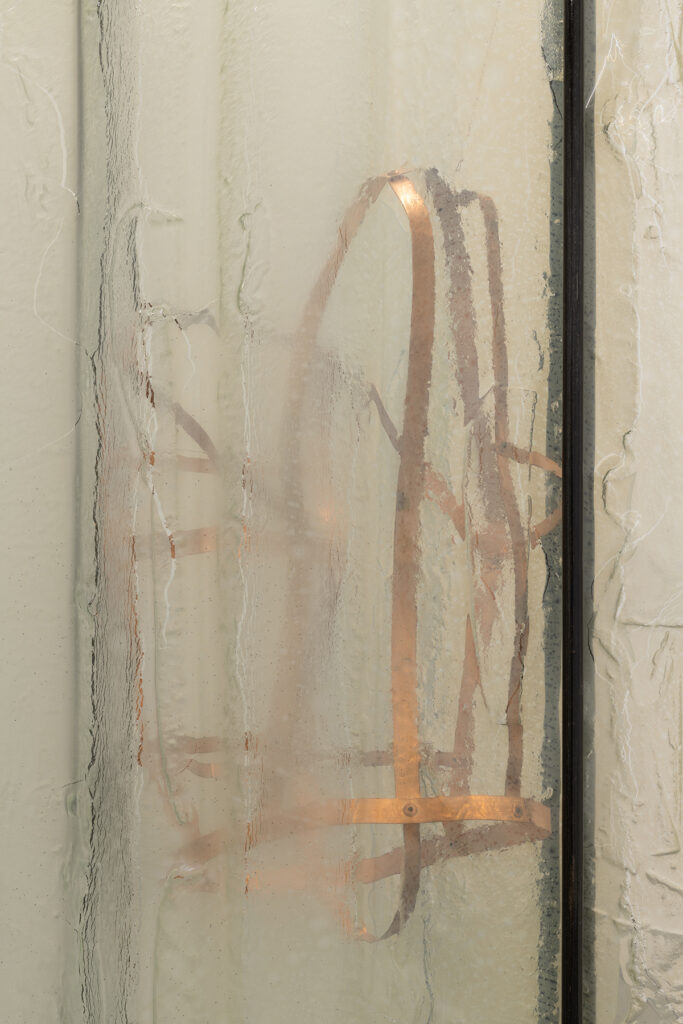
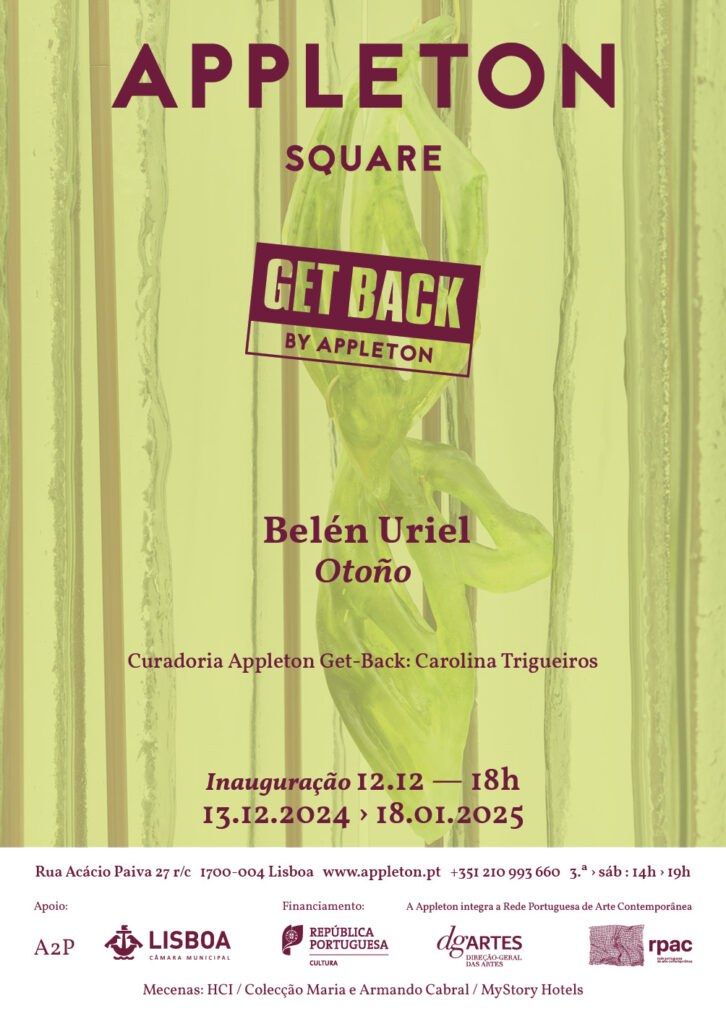
It is autumn, and we are reminded of this season’s capacity for regeneration; the leaves fall, the days grow shorter; we ask for a moment of contemplation to follow the changes in colour and temperature outside. Here, it is autumn now, and so it was a few months ago in São Paulo, when Belén Uriel embarked on the production of these works at a residence with Projeto Fidalga invited by Appleton. At this time of year that lends itself to introspection, we find sinuous and sheltering qualities that expand in these sculptures that rise from the floor and inhabit the space through their anatomical and inorganic composition. Their scale is that of the body and those who inspect closely will find their gaze held by the concave opacity of structures of frosted glass that, like carapace, retract the light and its revelatory capacity.
There is an inherent rigidity in these elements that act as a shield, possibly against the adversities of the passage of time or their own contingent condition. The fixed materiality of the glass and its later construction contrasts with the malleability of its mould, which has added textures, memories of plants and minerals, scars like those of a living skin. They are protective capes that encourage circulation and contemplation of their interiority. It is at the boundary between exterior and interior, positive and negative, that the gaze comes up against objects that appear intimate in their details and relationships, both communicational and suggestive, which can be activated by means of a collective magnificence.
The objects, in turn, are mutants. Rucksack straps merge with filaments; the spoils of industrial monoblock chairs with the physiognomy of a skeleton; pieces we understand, where the supports are openly revealed; the point of contact that indicates their prosthetic idiosyncrasy. They are members of a body with an in-built fragmented memory, emotional or industrial, inseparable from an often omnipresent quotidian and the signs of unchecked globalisation, devoid of context. In the realm of the anthropomorphic, we identify a torso or an ear; a helmet that echoes the memory of its utilitarian purpose, sometimes unmade through a rigorous appropriation, sometimes through its transformation by the artist, who uses the technique of casting, with glass or aluminium.
It is possible that these works [Shell, 2024] and their delicate immobility speak of a place of morphological transience, familiar in the artist’s production over recent years. After all, ‘Otoño,’ on top of everything else, marks Belén Uriel’s return to Appleton and is a revisiting of past themes and interests of almost 14 years. It was at this very address in Alvalade that the artist presented her first solo exhibition in Lisbon, ‘Ni blanco, ni negro’ [Neither white, nor black]. It was early 2011.
In that past exhibition, the focus on the pedestal, as a symbol of monumentality, and on the ceremonial napkins, like ephemeral sculptures, already anticipated a concern with sculpture as a relational system. The fragmentation of the floor sculptures suggested both the dismantling of hegemonic narratives and the possibility of recomposing other meanings. Similarly, Uriel’s current practice remains linked to the potentiality of intervals, moments of suspension that evoke the transitory and changeable nature of objects.
In short, over the course of more than a decade of intensive, continual and always lively production, the artist has reinvented her lexicon and in it we recognise references and clues that help us navigate in a realm that dispenses with introductions. In ‘Otoño,’ more than in ‘Ni blanco, ni negro,’ we sense that organism called maturity breathing throughout the space; we can hear its heartbeat. In nature, too, when everything turns to decay and the ground is covered in autumn leaves, flowers burst forth, autumn flowers that can relieve the melancholy of the days.
Carolina Trigueiros, December, 2024
Get Back [Cycle], Text from April 2023
Appleton celebrated its 16th year of existence in 2023, an opportunity for new cycles, balances and other continuities. However, the celebrations do not come without an unexpected interregnum and silence, which intensify a necessary consideration of the importance of cultural associations and independent spaces dedicated to artistic programming and dissemination in the city.
A consideration of the importance of the confluence of artists, musicians, performers and curators that have come and gone through these doors over the years, finding here a box of affects, with walls that preserve their experiences. It seems to me that Appleton is both born and flourishes through relationships of empathy tending to longevity. And that makes this invitation to join the Get Back cycle the beginning of another of these relationships, a small seed sown on fertile ground. I believe that places that welcome artistic creation possess a magnetic field. Confident of the issues that run through the works and the creators, that trigger possibilities and also inevitable confrontations. It is necessary to attend to the struggles for the preservation of their subsistence, and to the subsistence of the struggles that spring from them. The Get Back cycle thus stems from the need to make a celebration that is also a form of resistance. Of careful persistence.
The premise for this cycle is simple: to invite artists who have already exhibited here in the past to return for a new moment. To create bridges and implications in the light of a temporal hiatus, with a view to the possibility of (re)thinking, (re)contextualising or (re)looking at their practices and at the very conditions of the place. Within the initial sphere, Get Back is this possibility and zone of action. It takes place in a gap, a counter-current, and revisits artists who have contributed, each in their own way, to these foundations. The before and the after, the now and what is to come, the permanent circumferences and the conjunctures that always transform and sometimes, fortunately (hopefully), return. Starting with ‘Untitled (Get Back)’, a durational performance by Susana Mendes Silva (Lisbon, 1972) in the month of Appleton’s 16th anniversary, this cycle also includes the exhibition ‘Haze’ by Vera Mota (Porto, 1982), in June 2023 at Box, and, in now in December 2024, Belén Uriel (Madrid, 1974) at Square.



 /
/  /
/ 