


Belén Uriel
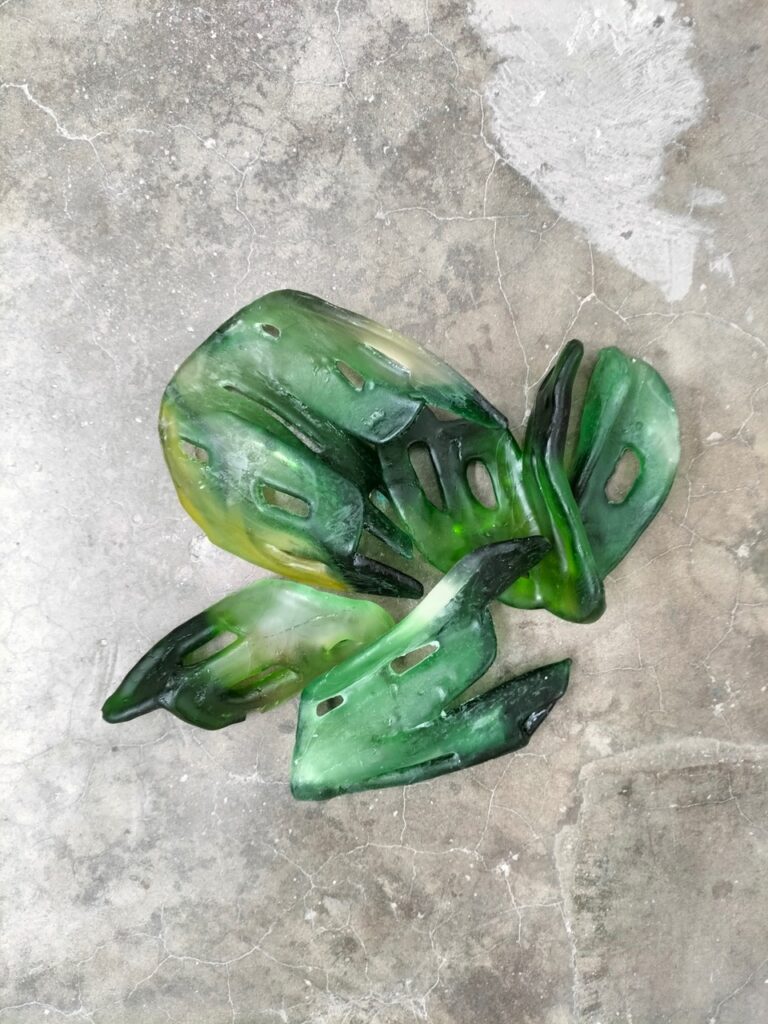
The installation by Belén Uriel, currently on display at MACE in Elvas as part of the exhibition ‘Diante do Tempo,’ organised by Appleton, is singular and deliberately transient. Here, time is not merely a backdrop but an active, plastic force that acts upon the materials and shapes our perception of them. An echo runs through this exhibition, manifesting as an intentional state of transposition, a temporal collage or the cadence of a synchronicity in two tempos.
The piece ‘Ni blanco, ni negro’ was first shown at Appleton over a decade ago, in a homonymous exhibition that questioned the status of the pedestal and the monumentality of sculpture. This was at the beginning of 2011 and marked the artist’s first exhibition in Lisbon. Fragmented, dispersed, and open to activation by the visitor’s body, the work existed in a contingent space, hovering between decomposition and the latent possibility of metamorphosis. As I wrote recently about that past exhibition*, ‘the focus on the pedestal as a symbol of monumentality already anticipated a preoccupation with sculpture as a relational system. The fragmentation of the floor sculptures suggested both the dismantling of hegemonic narratives and the possibility of recomposing other meanings.’
Time has passed, and the work ‘Ni blanco, ni negro’ has borne the marks of its inexorable passage, a slow friction with the outdoors, in a private garden where it has stood ever since. It has accumulated a patina, traces of moisture, organic residues and porous stains, where nature has ruptured the rigidity of its reinforced concrete. The act of reintroducing it into a new context draws attention to its sculptural force, now articulated through clear conceptual concerns that extend a visual lexicon the artist has long been developing – between resistance and the inevitability of impermanence, and an ongoing investigation into the transformation of materials.
‘Ni blanco, ni negro’ (for ‘Diante do Tempo’, 2011/2025) thus emerges in this hiatus, engaged in a dialogue with recent works and objects (from 2024/2025) and revealing a movement of juxtaposition. These cast objects emerge as protective shells – fragments of a hybrid organism that evoke both protective structures (a helmet, a support, a casing) and organic elements (roots, trunks, leaves), with the introduction of blown glass standing out in its singular, intact form. In this exhibition space, concealment and revelation form part of the same choreography: there is an oscillation between what is brought to light and what remains hidden, between transparency and opacity, between the materials themselves and the architecture of the space. In this way, the solid nature of the concrete becomes indistinguishable from the mutability of the objects.
Where ‘Ni blanco, ni negro’ (2011) once harboured the latent possibility of activation within its deconstructed and silent solemnity, that initial function is now rejected. Instead, the blocks become a field of relations between materials, times, and gestures. The concrete, in receiving the glass objects in a serpentine arrangement, evokes the malleability of the forms in which they were cast, absorbing textures, vegetal and mineral traces, scars resembling skin. The artist intervenes in her own work, altering it and returning it to a state of continuous ambiguity. The outside seeps into the exhibition, imprinted onto the pieces or embedded in the memory of the materials themselves. Between permanence and erosion, memory and transformation, it is at this threshold that the gaze collides with meticulous details and their suggestive interrelations, open to further dialogue through a collective dialectic.
In reference to ‘Otoño,’* Belén Uriel’s recent solo exhibition at Appleton, where similar objects appeared incorporated into works such as ‘Shell,’ it was noted that ‘backpack straps blend with filaments; remnants of monobloc industrial chairs take on the form of a skeleton; we encounter pieces where the supports are explicitly revealed; the point of contact signals their prosthetic idiosyncrasy. They are parts of a body with an in-built fragmented memory, whether emotional or industrial, inseparable from an often omnipresent daily existence, bearing the signs of unchecked globalisation, stripped of context. In the realm of the anthropomorphic, we identify a torso or an ear; a helmet that echoes the memory of its utilitarian purpose, sometimes unmade through a rigorous appropriation, sometimes through its transformation by the artist, who resorts to casting, of glass or aluminium.’
In this exhibition, Belén Uriel expands a familiar system and an articulated state of limbo, where fragment and totality coexist. Firmness and vulnerability, cold surfaces and intimate forms – these are dichotomies deeply rooted in the artist’s vocabulary and in a poetic recognition of the properties of the elements she explores, whether as adjacent eventualities or as desired ruptures. As in 2011, also now in 2025, Uriel’s practice remains tied to the potential of intervals, moments of suspension that summon the transitory and mutable nature of each piece.
Within a world of sculptural animism, perspectives on body and materiality are constantly redefined. Here, nature – the garden – seeps through the pores of living pieces, through the interstices of concrete; it moves inwards, breaking through wherever a trace of presence might remain, and always in a burst of surprise and enchantment. The primary ingredient in the recipe is, unquestionably, time. The second is the gaze, attentive, of those who know how to listen to these intervals.
Carolina Trigueiros, April 2025
Appleton, “Get Back” cycle, Belén Uriel “Otoño”, December, 2024”
Bio
Belén Uriel was born in Madrid in 1974. She lives and works in Lisbon.
Her practice focuses on domestic objects and how the way we relate to them can condition our social habits. The artist focuses on the sculptural qualities of materials such as glass and metal in the creation of organic forms originated by the design of objects that accommodate, support or have a relationship with the human body. These elements, reorganized, seem to become anatomical parts, partially reconstructing and returning to the bodies that indirectly inspired their form.
Her most recent solo and duo exhibitions include: Otoño, Appleton Square, Lisbon 2024-25; Outono, Ateliê Fidalga, São Paulo, 2024; Panóplias, Frei Manuel do Cenáculo National Museum, Évora 2023; Jamais o Acaso, UPPERCUT, Lisbon (2022); Rayo Verde, THE RYDER, Madrid (2021); Bonança, CA2M, Madrid (2019); Tandem: Gabriel Abrantes and Belén Uriel, Alexander and Bonin, New York (2019); Estudos do Labirinto, with Ana Santos, Museo da Marinha, Lisbon (2018); segunda-feira, Culturgest, Lisbon (2016); Sand, Paper, Scissors, Projektraum Museum, Wiesbaden (2016); Pedra, Papel e Tesoura, Pavilhão Branco, Lisbon (2013); Ni Blanco, Ni Negro, Appleton Square, Lisbon (2011).
Selected group exhibitions include: 331 Amoreiras em Metamorfose, Museu Arpad Szenes Vieira da Silva, Lisbon, 2024-25; Murmur, Karpuchina Gallery, Prague, 2024; Amor I Love You, P28 Gallery – Pavilhão 31, Lisbon, 2024; Between 58 and 131 infinitely, Galerie Martin Janda, Vienna 2023; Oh So Quiet…Material Meditations on Abstraction, WHATIFTHEWORLD Gallery, Cape Town 2023; Les Péninsules démarrées, Frac Nouvelle-Aquitaine MÉCA, Bordeaux (2022); Spirit of Kindergarten, Hedge House, Kasteel Wijlre, The Netherlands (2021); Anozero’19, The third Bank, Coimbra Biennial, Coimbra (2019-20); No habrá nunca una puerta. You are inside. Teixeira de Freitas Collection. Sala de Arte Santander, Santander Foundation, Madrid (2019); Vacío Perfecto, MUSAC, León (2017); Laboratorio 987.
She was awarded the 6th Audemars Piguet Prize, ARCO Madrid (2018); Calouste Gulbenkian Foundation Visual Arts Support Programme, Lisbon (2021-2015); Motehermoso Arte e Investigação, Montehermoso Contemporary Art Centre, Vitoria (2011); 6th Edition of the MUSAC Artistic Creation Grants, León (2010-11); Matadero Contemporary Art Creation Grants, Matadero Art Centre, Madrid, (2010).
HCI / Colecção Maria e Armando Cabral /  /
/  /
/ 