“Brain-Space”, where nothing is what it seems An exhibition space can be formulated in reverse, like a backstage in which we can enter to discover an intricate universe of objects arranged in space. Catarina Dias explains the scenic device with these words: “the stage is the face, and the backstage is the brain.” The artist sees her fourth exhibition at the Vera Cortês Art Agency (and its extension at Appleton Square) as a virtual space, or, more accurately, as a “brainspace”. In this space, the artworks seem to be in a state of suspension between conception and the irreversibility of their materialization, much like the mummy still breathing in Ingmar Bergman’s Fanny and Alexander (1982), one of her favorite films. In this “brain-space” there are correspondences between materials and associations of ideas, artistic genres, and mental faculties – between the “interior” and the “exterior”. The thing is that, in the work by Catarina Dias, this interiority is revealed not so much as a reflection of what she thinks, but as a mental space in search of a body.
“I was always fascinated by the act of thinking”, she says “the virtual space of thought is fascinating. When connected to this idea, the exhibition space is also a virtual space.” Because of this, this exhibition was designed as a free but guided path – a flux. Somehow, the text is the element that defines this path. Catarina Dias materializes poetry through the gestures of drawing, often superimposing the latter on the surface of a painting that is nothing like a page of a book. (One of her earlier memories is spending a whole afternoon drawing the letter “a”.) It is more accurate to compare her somewhat atmospheric painting to the Baudelairean Parisian “ideal”, with its spleen, clouds, and the dusk hiding and absorbing both the poet’s and the reader’s bodies in the city’s backstreets and narrow passages.
The artist’s poems-drawings either territorialize or deterritorialize the spectator. For example: the text is sometimes inverted on the screen or on the paper, evoking a subjective point of view, as if it was projected on its reader’s retina. Furthermore, the artist writes in English. Bilingualism is a permanent condition of otherness. In her case, it is also the result of the artist’s familiarity with another country (the UK, where she was born, has lived, studied, and worked), which shaped her mental process.
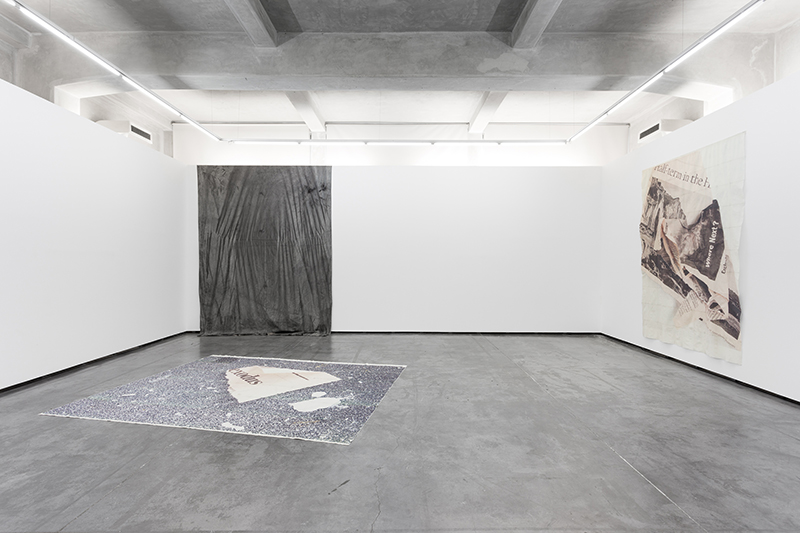
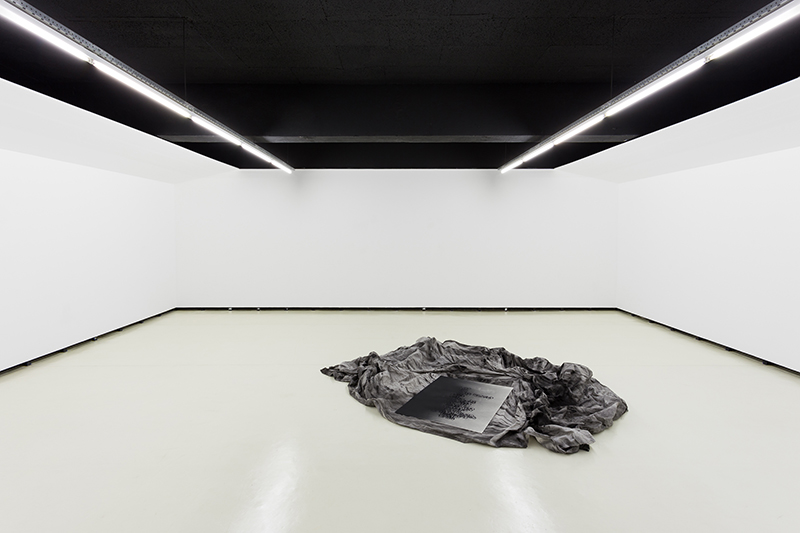
As two languages that communicate without ever perfectly translating, her work associates plastic languages in an idiosyncratic way. No support or material has just one function. Nothing is exactly what it seems. The best example of this free association is the pictorial process applied on fabric, paper, and canvas (with layers of plaster, paint, texturing, etc.). Were it a stage, all these things could be simple décor, expressionist scenarios conferring tonality to whatever happens in front of them. However, in the gallery they assume a prominent and dialectic function as they engage with the text and with the space around them. 1
The graphic poems with the idiomatic oxymora (deafening silence, for example), the superimposition of one of those drawings over painted
1. In fact, the reverse is also true: in 2015, Catarina Dias collaborated with the itinerant show Satélites, by Sofia Dias and Vítor Roriz, for which she created manipulable fabrics that had as much protagonism as the dancers’ bodies.
Solo exhibition in two installments:
Vera Cortês Art Agency: July 4 – September 19, 2015 Appleton Square: September 8 – 19, 2015
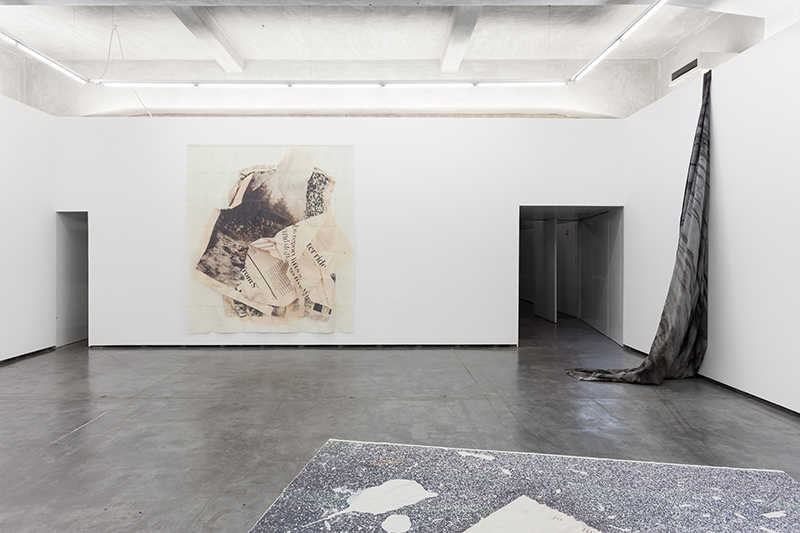
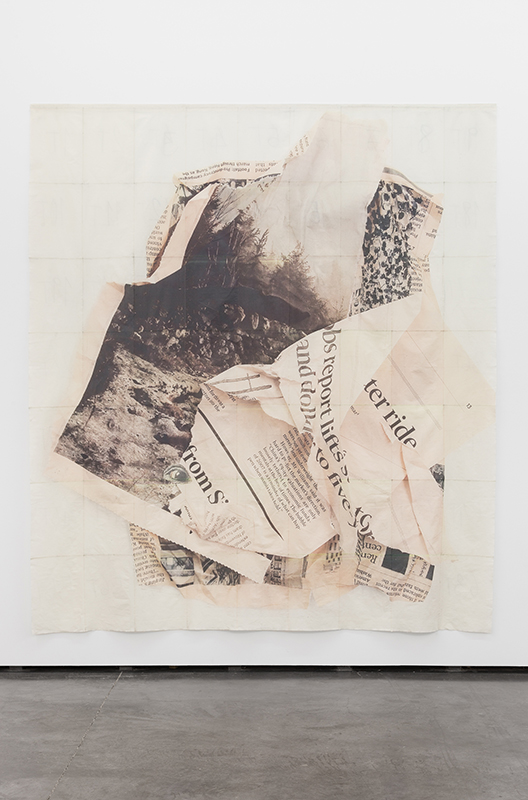
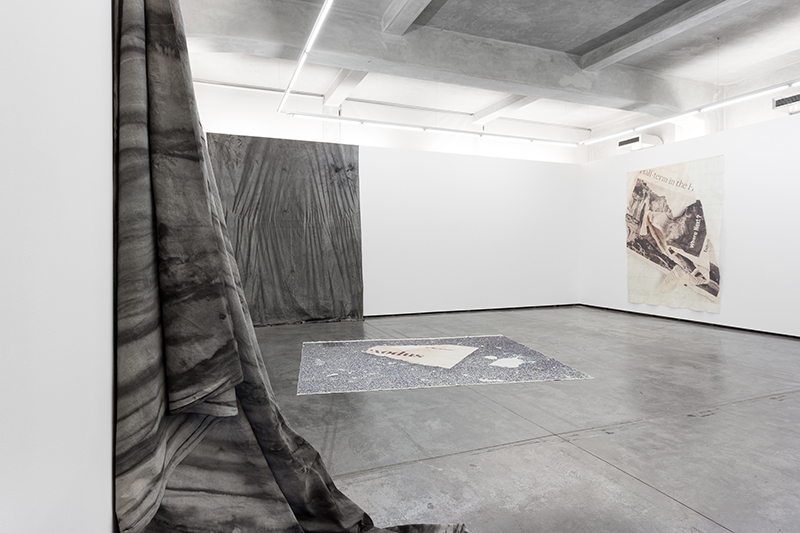
fabric, and the canvases hanging in passageways combine in an unexpected cohabitation of elements that are traditionally foreign to each other. The artist is known to use fragmented newspaper images printed on fabric, often depicting animals – another familiar yet strange body. The newspaper’s ephemerality is translated and transformed as it is transferred to the fabric – scenario – curtain – tent. These supports are also temporary, but not as much as a daily newspaper. The present is extended with these visual poems, using cut-up, a technique in which text is randomly cut up, systematized in 1959 by the writer William Burroughs and the painter Brion Gysin.
The strangeness of these associations can also be explained by the fact that each gesture is subjected to a process of transformation. “In my work, I have no interest on painting in itself”, admits Catarina Dias, even if she allows herself some pictorial-conceptual gestures, like turning the dripping upside down, or using a paint roller to paint a thick white line, creating different screens on the same surface. We truly need a creative lexicon to describe Catarina Dias’ work. I would like to insist on the ultra-contemporary notion of screen, which can also evoke, however, the diagrams by Alberti or Dürer, where the canvas or the paper are the receivers – through the mental process that calculates the proportions and the line that manifests it – not only of the articulation of a creative process but also of the spectator’s projections, which place the work. Following this line of thought, the floor pieces (painted and compressed fabrics) are at rest. If, on the one hand, they lack the blocking 2 of other pieces, on the other hand, they possess a contained energy. The agglutination of foreign bodies, languages, and the sensual images conveyed by the materials and the poems offer the spectator an awareness of “being here”, and reflect a substantial, singular, and continuous mutation of the act of thinking.
“Thinking is living at the highest possible power, both creative and critical, enfleshed, erotical, and pleasure driven. Essentially it is about change and transformations and it is a perversion of sorts, like an unprogrammed mutation”.
Rosi Braidotti, Nomadic Theory, The Portable Rosi Braidotti (2011), New York, Columbia University Press.
Joana Neves






 /
/  /
/ 