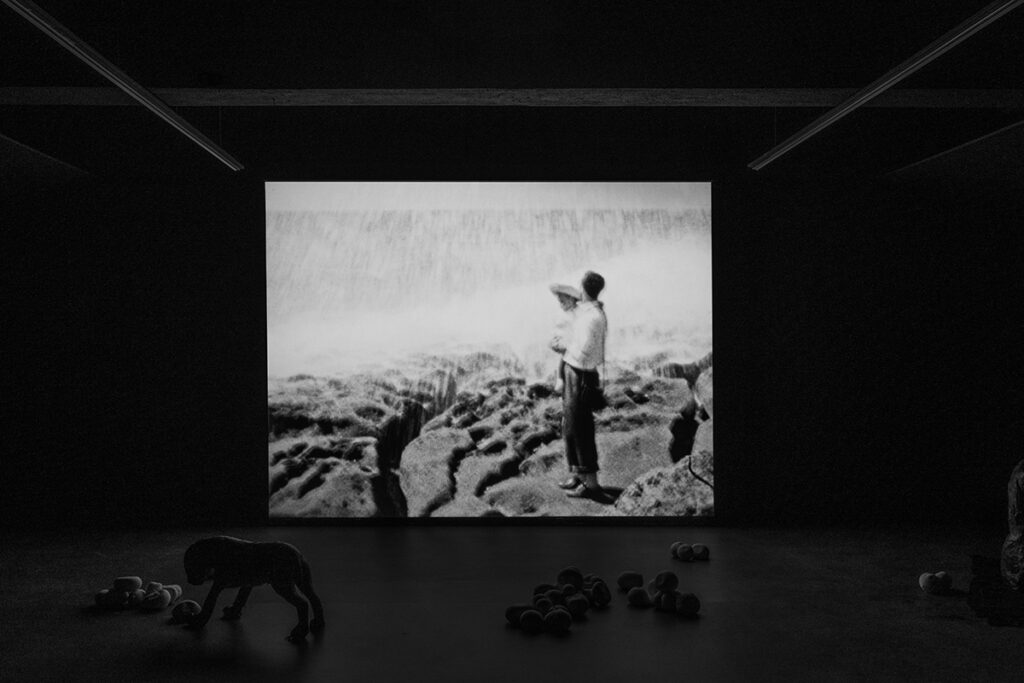
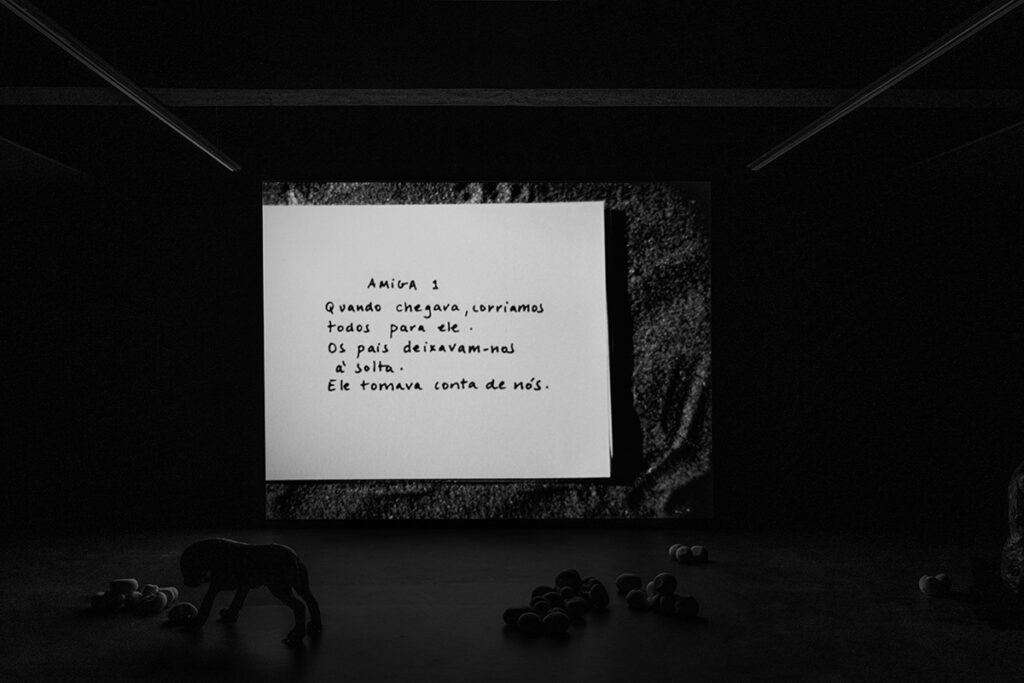
Catarina Mourão’s looped film, which gives its name to the show, is born from a childhood memory of conversations she overheard on the beach between her grandmother and her friends, who in turn recalled events and characters from the beach.
But the film is also born out of an accidental encounter with a shot that she found by chance in a family movie kept in the National Film Archive. It’s a shot of the strange “Whistle Man” who used to hang around Portuguese beaches and haunted her grandmother’s stories: a distressing or familiar figure, who either made children run away or attracted them like the Pied Piper of Hamelin.
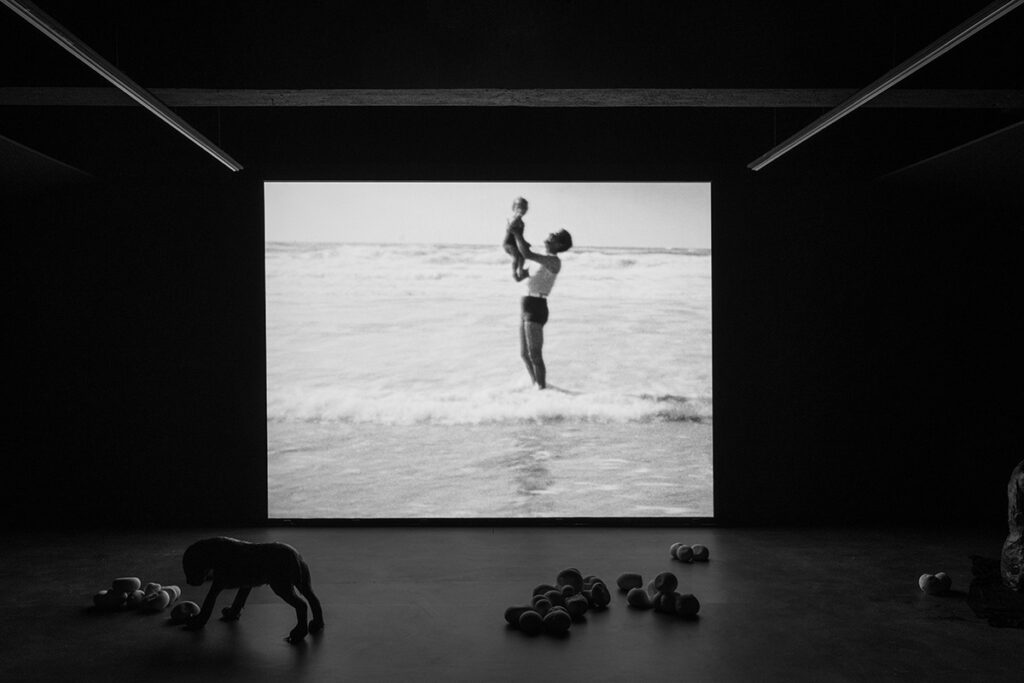
Inspired by the testimonies of women in their 70s and 80s who came across this man on Portuguese beaches in the 1940s and 60s, and by researching many hours of archive footage shot on the beaches in those same decades, Mourão constructs a fictional story revealing different versions of this man and the atmosphere of the beach. Family archive images have been explored in many of her recent films. They are a privileged territory for finding cinematic representations of dreams and blocked memories. Accepting that memory is constructed by being verbalized or represented in the present, these family films become tools of this constructed, fictionalized memory, but which is simultaneously real because of its inherent subjectiveness.
More than documentary or fiction, memory is experimental, a dialogue that is not always synchronized between soundtrack and image, between what we thought it was and what it could be; between what was and what we filmed with our vision; the perception-film-memory whose time wears away the recorded; the grain entering the stories, the sand winding up in the sea.
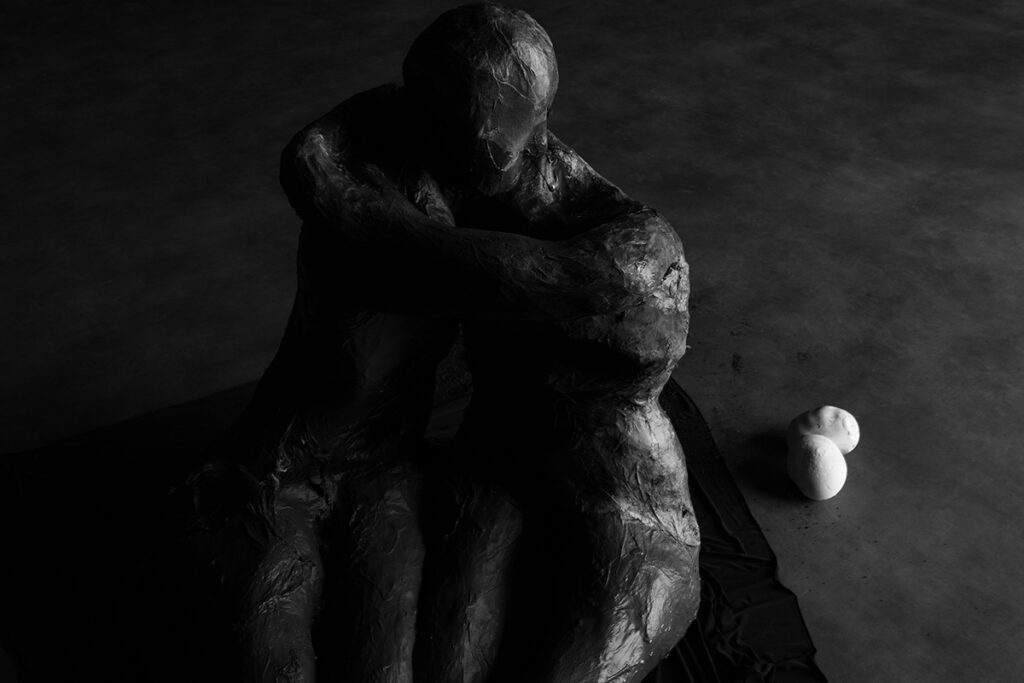
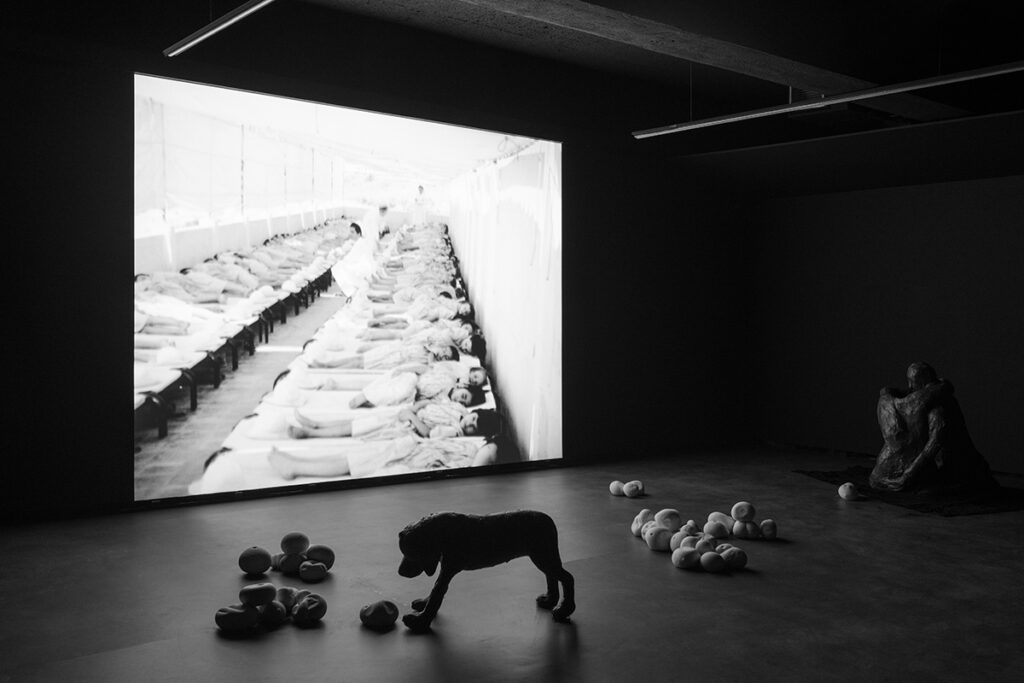
This film was originally intended to be shown in an installation context. The exhibition room becomes an extension of the screened beach, where both viewer and “Vacationers” by Catarina Câmara Pereira contemplate.
“A psychoanalysis of the arts would perhaps consider the practice of embalming as a fundamental fact of their genesis. At the origin of painting and sculpture, it would discover the “complex” of the mummy. (…) Death is nothing but the victory of time. Artificially fixing the fleshly appearances of the being is to save it from the current of duration: to prepare it for life. (…) Thus, from its religious origins, the primordial function of statuary is revealed: to save the being by its appearance. On the other hand, cinema is a language (André Bazin).”
The figures are naturalistic ghosts, equivalent to the petrified bodies of Pompeii. Each one corresponds to a being that no longer exists.
The installation Hissing of Summer Sands unfolds in several layers of memory. Each decision in this piece has been driven by the secret and individual memories of the two authors, their experiences, the stories they have heard told, right down to the chromatic and luminous record of the Super 8 films that captured their childhoods in the 70s. Everything comes together in a subliminal whisper of immemorial reminiscences, prior to a verbalizable consciousness that could organize the world and its concerns. Then there’s the collective memory that alerts us to the uncanny feeling that something is moving menacingly beneath the summer joy. Finally, there is the portrait of a time and a country.
The installation is designed to welcome an observer-participant who, like Arte Povera, can add some meaning to the constructed absence. A stage has been created inhabited by silence where petrified figures, worn down by time, linger in a fossilized indifference to the film’s narrative.





 /
/  /
/ 