The Same and the New
By contrast, we can see that repetition is a necessary and justified conduct only in relation to that which cannot be replaced. Repetition as a conduct and as a point of view concerns non-exchangeable and non-substitutable singularities.
– Gilles Deleuze, Difference and Repetition
Repetition has the power to enhance any language. Repetition is a producer of difference, the gratuitousness of the pointless gesture not falling within its spectrum of activity. The experience of the same will not cease to produce the new, repetition being an outstanding inventive praxis. It is not by chance that repetition (in the Deleuzian sense) is an essential force in the work of Javier Fernandez. Each (non-exchangeable, non-substitutable) gesture repeated by the artist contributes to the building up of a visual rhythmic composition that suspends time, space and the social and cultural layers involved in contemporary experience.
The artist’s practice thus takes shape through a constructive monotony that gives body to form, colour and matter in different media (mainly tapestry, but also video). Since there is no space in which to distinguish between the ontology and axiology of the work of art, this triad insinuates itself as a means and an end in itself. The absence of social, political or ideological pretensions and the hermeneutic impermeability of Javier Fernandez’s work intensify a creative ethics that is conveyed in an aesthetics of serenity and visual commitment.
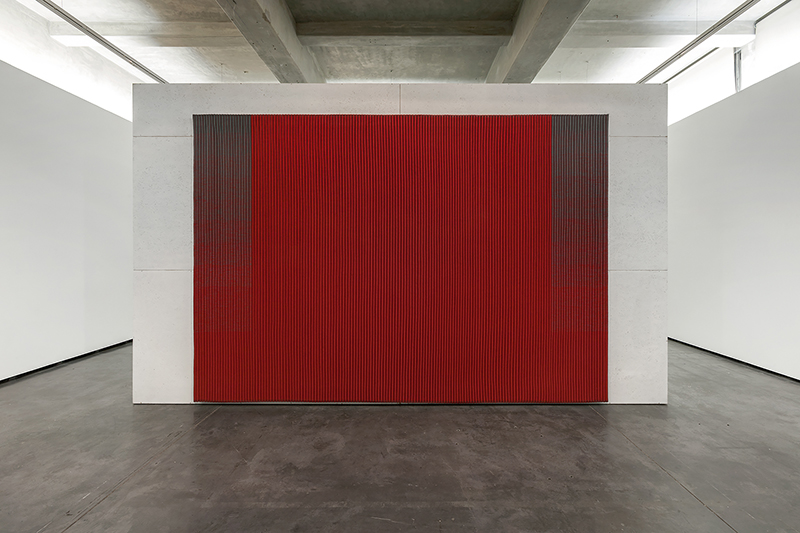
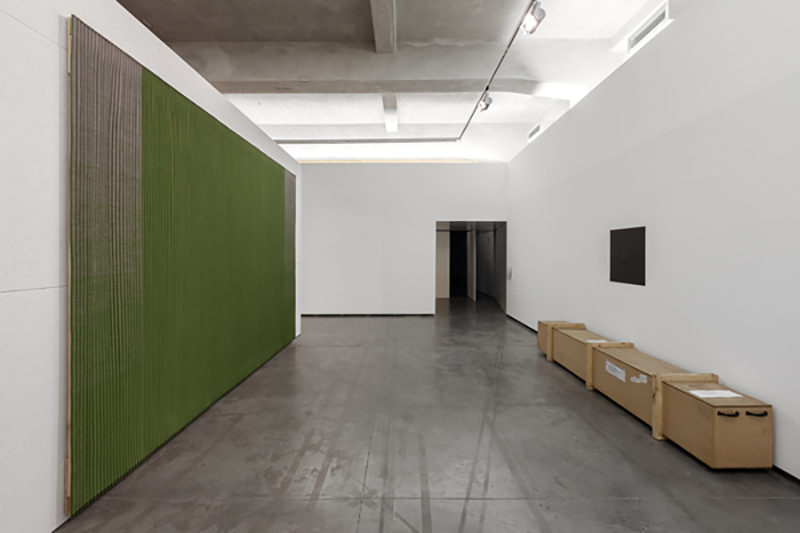
This commitment is revealed, firstly, in the scale of the tapestries that he creates, which allow us to discern the slowness of artistic activity, the performance that accumulates the repetition of the same gesture and creates the new: a new body that inhabits the world while interrupting it. Secondly, it reveals itself in the way in which the textile surface invokes the construction of a unique sense of time in which the chronometric units (seconds, minutes, hours) are replaced by beckoning gestures and gazes that dictate the rhythm of the seeming immobility of the (enormous) rectangular surfaces – Last Green and Last Red – now being shown at Appleton Square.
The architecture of the exhibition space is interrupted by a new wall that divides it and allows each work to be seen separately. This action responds to a specific need that these artistic objects possess. Not being monochrome, they reflect on monochromy and the authenticity that might be found in colour, form and matter. Consequently, they need to be housed in a space in which there is no interference from objectual co-existence.
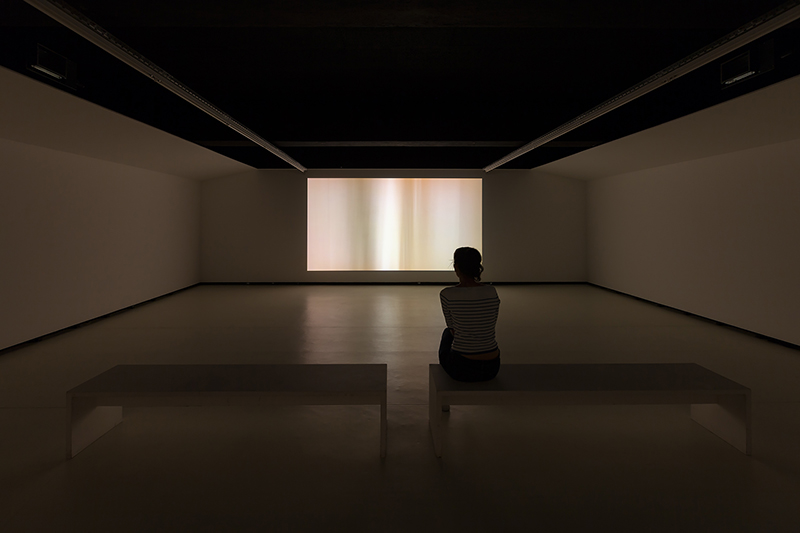
As Javier Fernandez describes them, these works of art are concrete exercises of the hand and the spirit. For this reason, the same matrix that unites the sensitive hypertrophy of the artist and spectator is applied to both the tapestries and the video. Each medium, in its specificity, is placed at the service of an immaterial materiality that overcomes the distinction between form and content, the sensitive and the intelligible, immanence and transcendence.
The demands of his creative process – time, repetition and creation – grant his work a singular status. In turn, it requires a unique spectator who is open to a type of contemplation that synchronises the body and spirit. In this respect, Javier Fernandez’s work celebrates the sameness-novelty dialectic in the elaboration/contemplation of artistic form, not as a system of neutralising opposites but by taking the same and the new as obligatory constituents of a single productive inter-relationship.
The repetition of the same gesture produces new forms just as the repetition of the same gaze produces new images. Stay a while. If you do, you will be busy.
Ana Cristina Cachola
May 2015



 /
/  /
/ 