This is the time.
And this is the record of the time.
Laurie Anderson[1]
It begins with a faint, almost guttural rumbling. The sound gets louder, keeps getting louder. It amplifies progressively, taking on a range of different rhythms, variations and durations. Interruptions, prolongations. The rumbling keeps going, and now it seems to last much longer. The sound is very close: it is low, rasping, deep, hostile when it speeds up. But then it turns into a sharp whistle, weakening as it decelerates. They’re drilling into a wall in the building. They’re opening up a hole. Are they demolishing the wall?
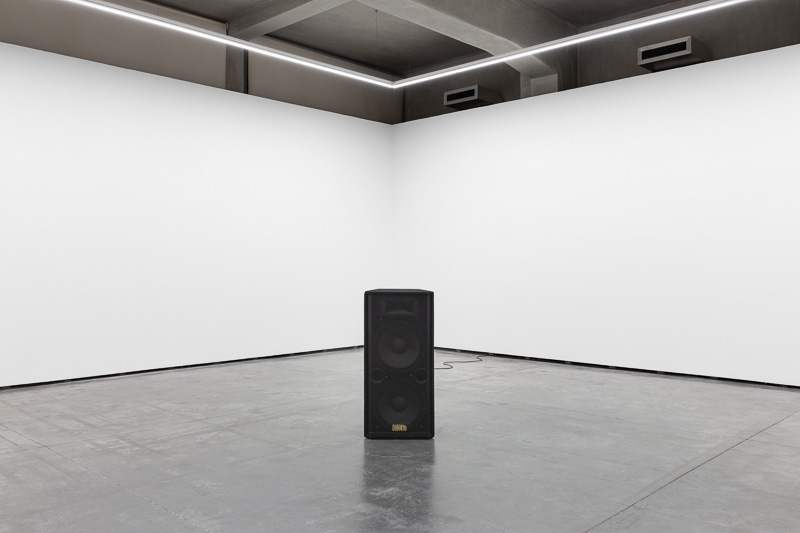
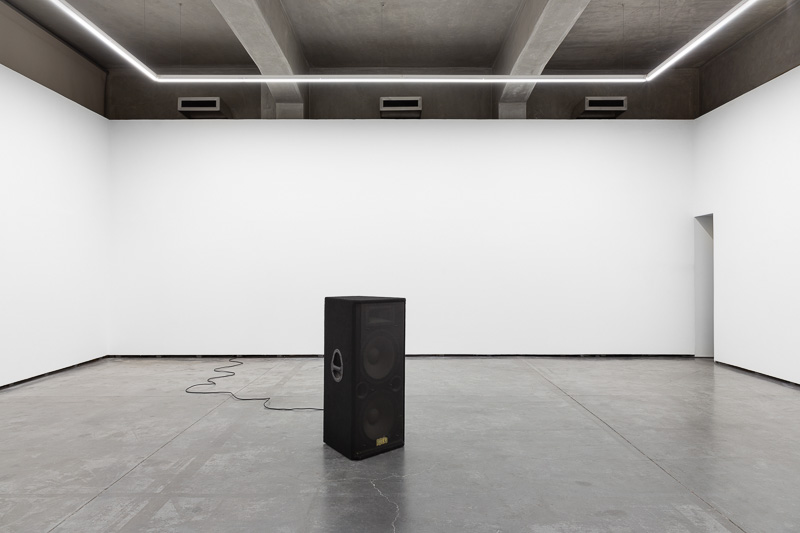
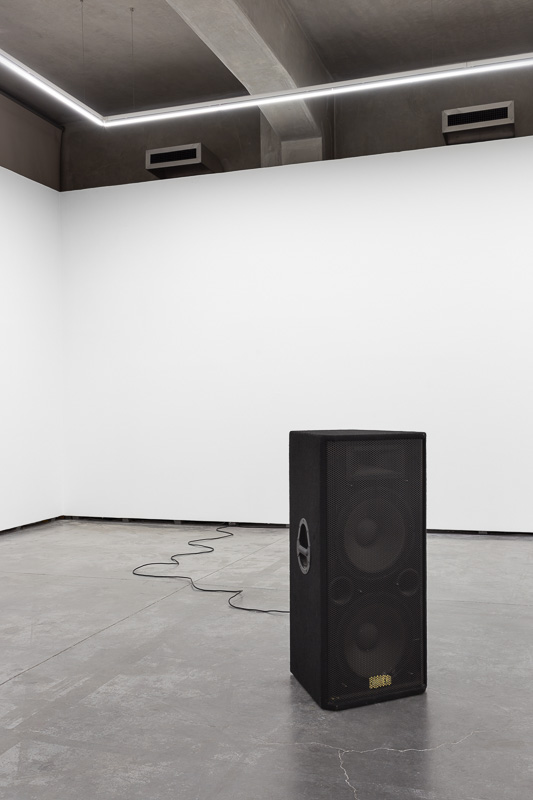
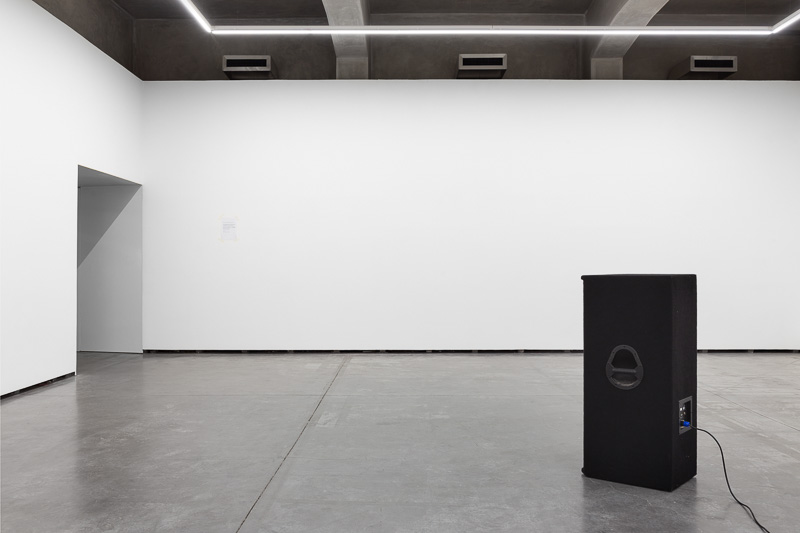
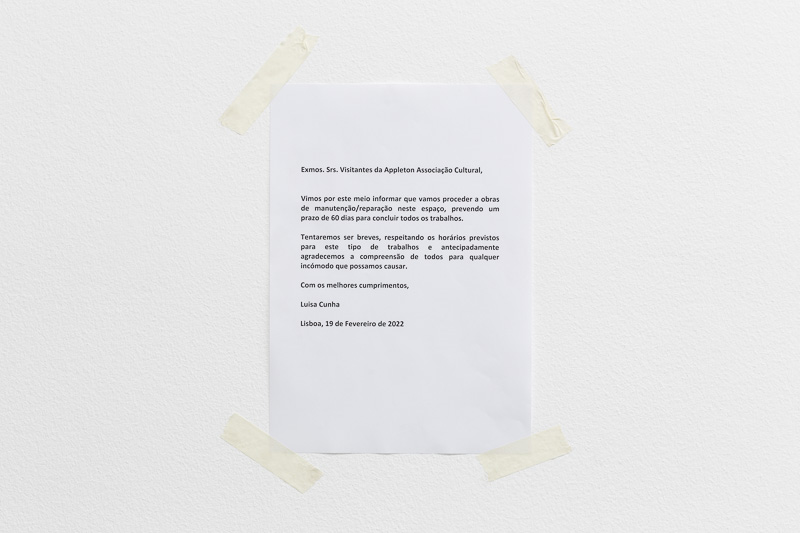
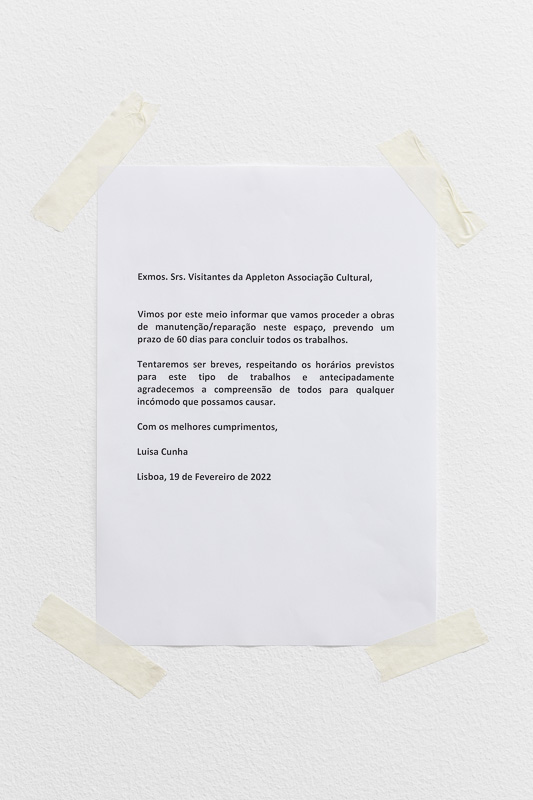
Next to the loudspeaker that stands rigid and sturdy in the centre of the room, a notice is affixed: ‘the gallery will be undergoing works from this date. These will be kept as brief as possible, thank you for your understanding of any inconvenience caused’, and it is signed by Luisa Cunha.
The engine starts at full power, over and over again. Between the pauses in this rhythmic sound, perturbing in its intensity, voices can be heard. Someone is humming a tune, someone else whistles distractedly, we hear music playing on the radio. In the very brief, fleeting moments of quiet, the silence now becomes a strange element, as the noise fills the entire space, consuming it. In the task of concentrating on picking apart and understanding the situation in which we find ourselves, we lose ourselves. We try again to focus our attention, but the noise persists and we lose concentration once more. It is the sound of the roar of machines and hard manual labour. It scratches, strikes, hammers, scrapes, sweeps, spreads, levels, strikes and strikes again. Surrounded by this distorted sound, our heads are completely full, weighed down, and we come to believe that we are unable, within the scope of our abilities and efforts, to even think. We are tacit spectators of this cohesive orchestra that projects something being built very close to us. The most interesting and surprising thing, however, is that all we know of this event that is communicated to us is the sound and, in relation to that, we can only imagine the behaviours and gestures, the practised movements, because we don’t actually see any works under way. It is an intense sound, rhythmic, noise that is sometimes incessant, sometimes intermittent, uncomfortable, taking over the space we occupy.
Bang bang bang…! Bang… Bang! Bang!
‘What was that…?’ asks a languid voice in the distance, half sung and non-committal, after we hear the barking of a dog. It is at this point that friendly voices and genuine laughter can be heard, contrasting with the sound of the works taking place. Bang bang bang…! ‘Is someone knocking at the door?’ we ask ourselves. Who is it? Who whistled? Which door was it that opened and closed? Who is laughing…? And the drilling continues on the wall, slow and resounding…
It is then that we realise that no, we don’t really know what it was that bothered us. Perhaps our experience of extreme agitation and discomfort, influenced by a sound so familiar to us, is due to an inherent primordial condition of our nature, whereby we always seek to demand concrete proof and attribute meanings in a primeval quest to find order in chaos, stability in inconstancy, certainty in expectation, or to find sonorousness in the tremendous noise, to discover a place in the space we momentarily occupy. We recognise, then, that the sound itself is turned into a tangible material here, evoking a presence in a space to which it doesn’t appear to correspond. Sound is an object that is made present, it is texture, it is a substance that vibrates, that stirs, that agitates and provokes us. It is constancy and instability, continuity and suspension, repetition and pause, noise and silence – this sound piece reveals itself as a register of the substance of time that makes up the material that is the sound of any action of construction, of composition.
Luisa Cunha shows us that sound has a genuine weight, that it possesses a profound intensity, revealing a force that truly challenges our perception. Like in a symphony, the coming together of the instruments creates something that resounds under different cadences. The thunder of the machines and contraptions of construction makes itself felt, in crescendo… It is the rhythmic sound of deconstruction, of destruction, of change, of building and of creation, which have a place here and now.
Indeed, this is a Score that was written down and composed in relation to a past moment that is always present here, at the time of the visit and passing by of spectators. And, with the mastery for which she is known, Luisa Cunha creates and recreates this tension between the space occupied, the experience of the visitors who occupy it and the sound that surrounds and immerses them, that consumes and frees them, through an ingenious proposal that is challenging and ironic in tone. But more than the representation of a specific absence that can become tremendously present – the experience of gradual discomfort, latent exasperation and inconvenience influenced by the sound occur by virtue of that very thing – Luisa Cunha’s work sets out for us, more than anything, the recognition that art is related to the emotions aroused by an unexpected and furtive encounter with our own pre-conceived limitations and boundaries in the face of situations we would call ‘unusual.’ In other words, when the experience of evidence is overcome by the experience of illusion. It is, then, Luisa Cunha herself who, with a careful and astutely comical touch, signs the apology and appeal to visitors to be understanding about the potential inconvenience caused.
Filipa Correia de Sousa, February 2022
[1] Final part of the lyrics of the sound composition ‘From the Air’ by Laurie Anderson, featured on the album Big Science, produced by Warner Music, 1982.




 /
/  /
/ 