The Essential Pedro Calapez
Through painting and drawing, Pedro Calapez establishes visual places which offer us spatial and temporal information. Sometimes, such a place may even be a scenographic landscape that we can ‘pass through’. At other times, it is a group of regular or irregular elements that Calapez arranges on the wall like a temporal record of his visual diary, pieces of a game, motifs of a vibrant pattern or markers which demarcate or expand visual territories.
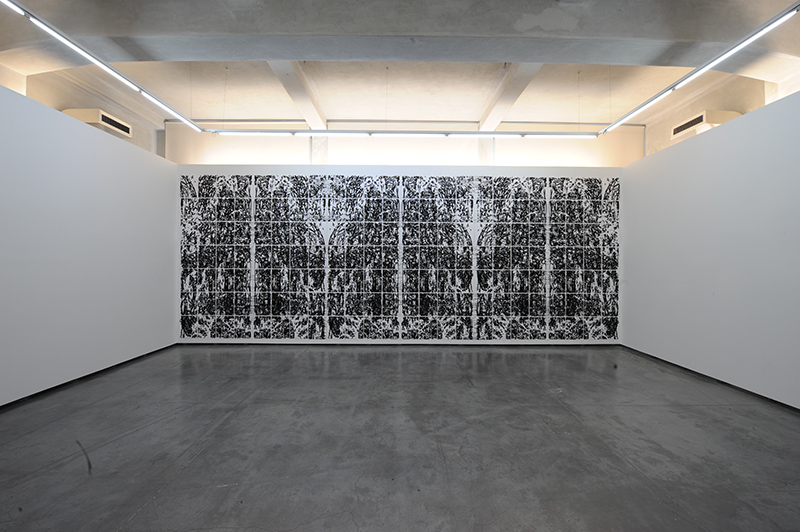
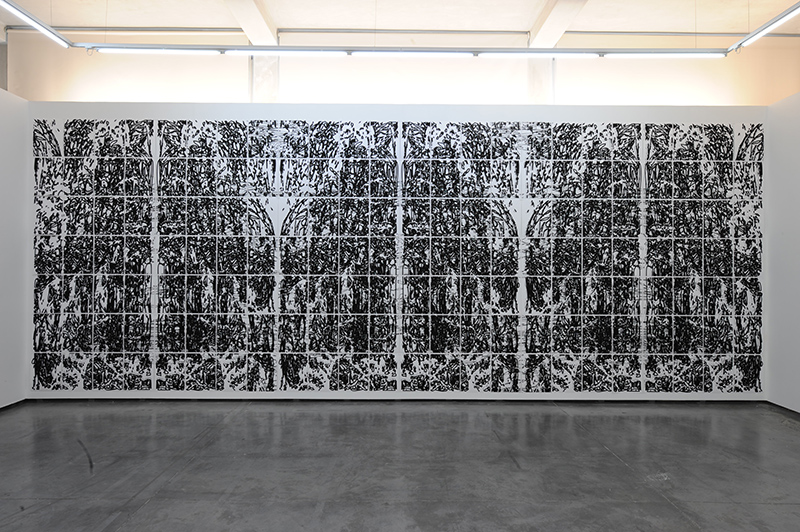
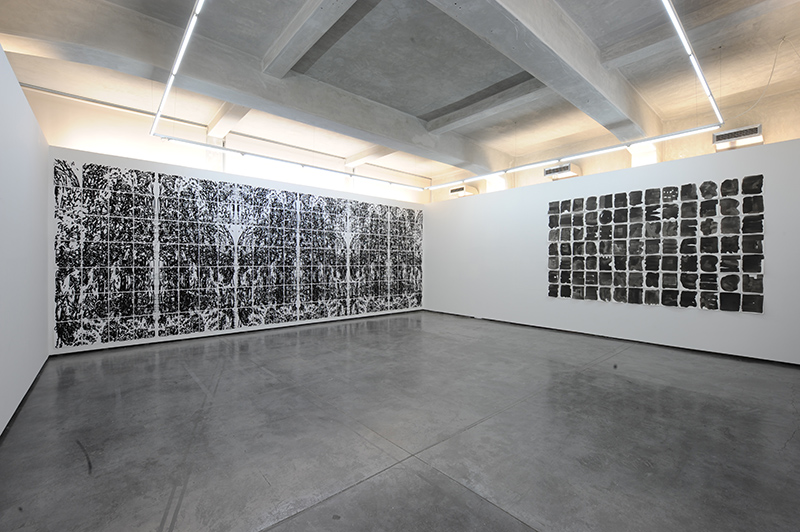
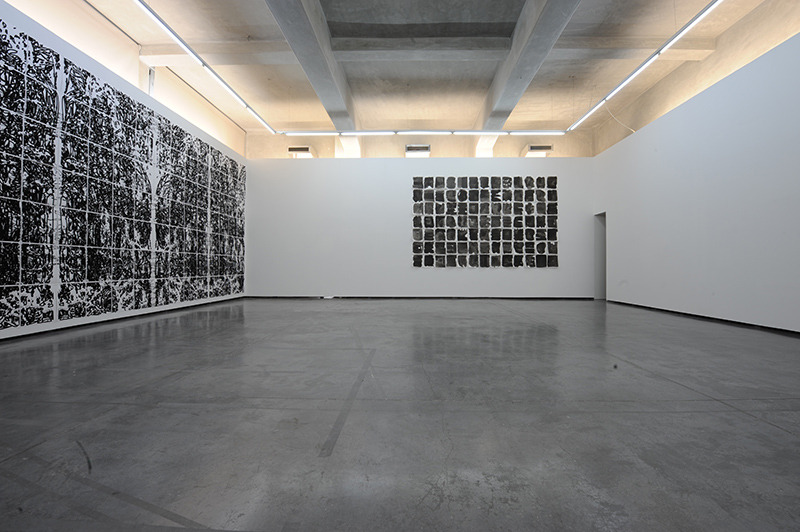
In this exhibition, the first large landscape, intensely filled by the act of drawing lines (which Calapez continues until the surfaces of inscription are exhausted) is expressive of a repeated intent to fill the space/absorb the viewer. However, in this work, one of the exhibition’s defining pieces, the illusion of the scenographic device is undone by various rationalising operations: firstly, we realise that this large drawing has been made on a computer screen and produced using the mechanical solutions of a laser printer (thus dismantling the myth of the visual artist employing purely manual means). We also realise that this print, produced by massive enlargement, divides the image into 168 sheets measuring 45.5 x 34.5 cm, creating a grid which artificialises the image and its optical effects, freeing it from the aleatory gestures of the artist and imposing discipline on the final visual results. This is reinforced by the drawing’s symmetrical repetition (in two sections) – a device through which the artist discovers the solution of a decorative pattern (like those on wallpapers and coverings or tiles) which he places in dialogue with the imaginary architecture we perceive in the image, whether through the rhythm of the vertical ‘columns’ or in the accompanying suggestion of the beginning of two vaults at the top of the drawing, exactly where the imaginary ceiling of the room might be. Through these technical and compositional means, Calapez negates the physical intensity of the obsessive line-making on the computer screen (which he also practised on paper and wood in his early drawings of the 1980s and in some subsequent works) and also negates any mimetic illusionism or optical ease.
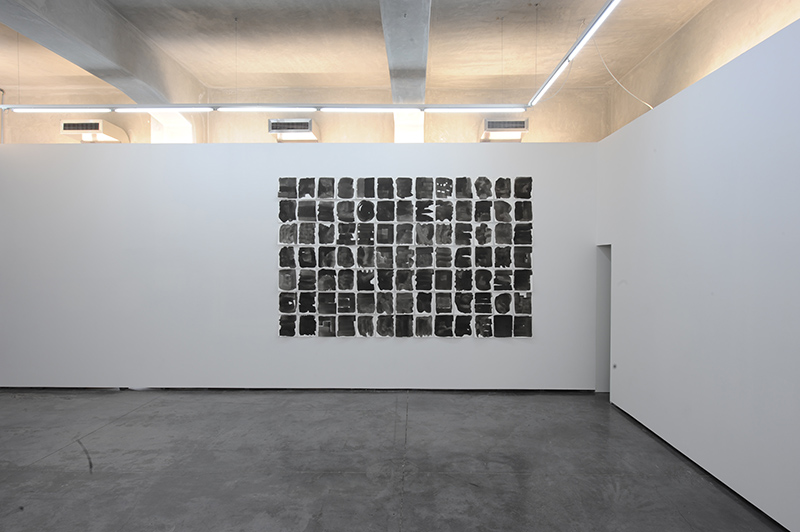
To the side, in the same room, the artist counterposes another and still more evolved presence: a drawing (using a Japanese brush on paper), also arranged in a regular grid, numerically more complex (more numerous), chromatically identical (though the absolute dominance of black and white is here enriched by the many different shades of grey). Here, the gestures are no longer those of scratching, overlaying, obliterating, erasing. Instead, there is a radical poetic movement in the restrained gesture of dipping, removing, positioning and moving the India ink-soaked brush over the paper, where it leaves the undisguised and subtle traces of its passage, the resting of the hand, the weight of the liquid, the different densities… As a whole, this expanse of three hundred small format pieces calms the frenzy of the preceding works.
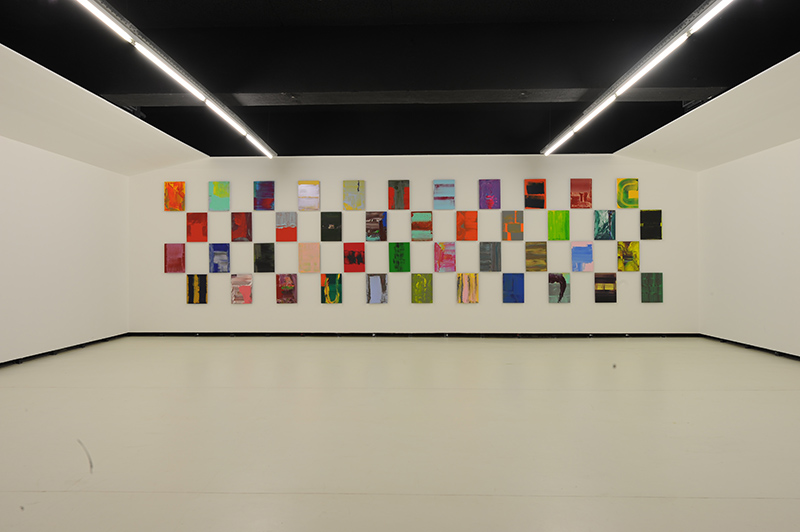
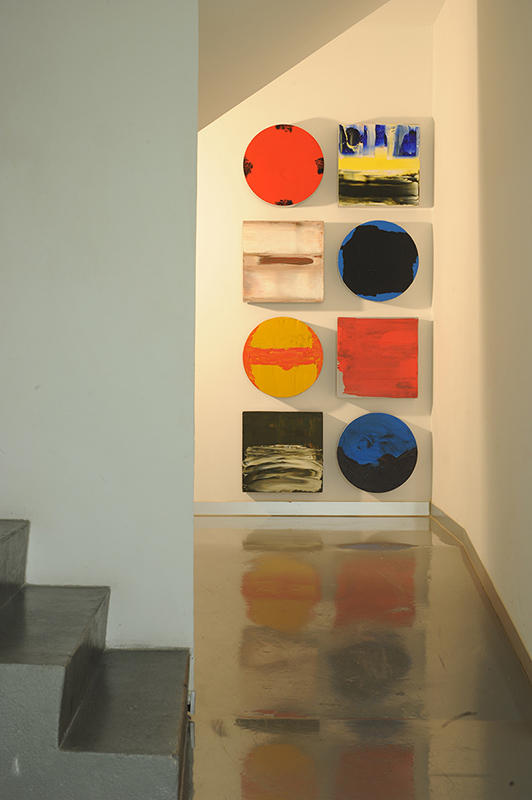
The intensity and expectation (of gesture) and asceticism or radicalism (of colour), the excess (of the constituent elements) and scarcity (of formal differentiation) in the drawings seem to be released into the realm of chance and spontaneity in the paintings. However, the constituent elements remain perfectly controlled. The shapes of the pictorial supports follow a binary logic and each painting is the result of associating two different types of elements: circles and squares or rectangles. Calapez frequently enters into dialogue with the architectural context: one of the works presented in this exhibition (composed of eight ‘pieces’) is arranged in a grid, with alternating circles and squares, but can be installed in various ways. In one of the solutions Calapez achieves a virtual rotation around an empty centre; in the other, with the same alternating elements, he creates a discontinuous verticality. The second painting in this exhibition fills the architectural space defined by the gallery wall with a chequerboard of full and empty rectangles, composing a regular pattern that can be seen as unfolding infinitely into space.
The clearest affirmation of the aleatory as a rule, lack of discipline as a means and freedom as a driving force can be found in the most intriguing facet of Calapez’s work: his insistence on a decorative use of colour which, in a departure from the clear initial subtlety of his painting, is defiantly expressed, in solutions which reject conventions of taste or rules of colour association, which merge with each other on surfaces in such a way that abstraction becomes radical informalism and whose dense and irregular material textures, applied on supports which stand out from the wall, accentuate the sculptural proportions of the pieces and intervene in the architectural redefinition of the spaces.
The limits of drawing and painting are tested in Pedro Calapez’s work: the line-making gesture is, at times, repeated so often that we seem to be presented with a continuum of blacks and, for the last two decades, his painting has created such a striking excess of colour and physical matter – of metaphorical light and real matter – that it acquires sculptural and architectural qualities. Nonetheless, everything is achieved by means of a vocabulary that we can reduce to the essential – divided or balanced, nonetheless, between two poles: the gesture, in an obsessive and overlaid line-making (in the drawings) or in broad brushstrokes, thick swathes and bars (in the painting); texture and volume (in the paintings) or their absence (in the digitally printed drawings); the regular outline of the supports for the pieces (in the case of the polygons shown here) or the most undisciplined irregularity (in the case of the majority of his paintings, not shown here); the material used for these supports, which is robust (metal for the paintings) or fragile (paper for the drawings); and, finally (or, in fact, firstly), the predominance of colour alongside the predominance of black and white.
João Pinharanda – Lisbon, April 2014



 /
/  /
/ 