


DIANTE DO TEMPO
—
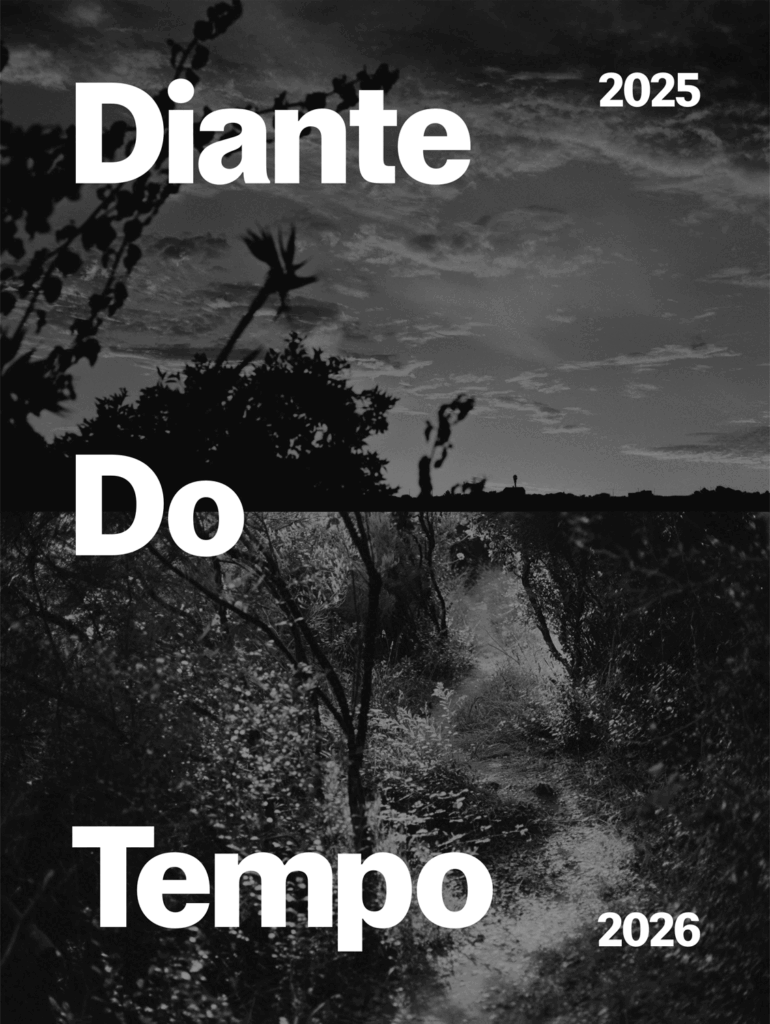
The fact that something has already happened doesn’t just mean it is far away from us in time. It remains distant, true, but that very distancing can bring it closer to us – it is, according to Benjamin, a perfect example of the phenomenon of aura – like a grieving soul, an apparition. The psychic archaeology of things can therefore be the theory of their cryptic memory, of their unconscious and spectral memory.
Georges Didi-Huberman, in “Diante do Tempo – História da Arte e Anacronismo das Imagens”, Orfeu Negro (2017), p. 133
Writing a poem
is like catching a fish
with your hands.
Adília Lopes, ‘Arte Poética’ in Dobra, Assírio & Alvim
(1985), p.12
According to Georges Didi-Huberman, when we observe an image – whether part of our present or a record of a memory – we are inevitably confronted with time. Perhaps for that reason, the philosopher chose a title with poetic resonance for a book exploring the relationship between time and the history of art. In this book, the author sets out a critical and reflexive analysis, combining different perspectives and questioning the foundations of the discipline. He argues that images convey multiple temporalities and that their analysis demands an approach attentive to anachronism, thus challenging the traditional principles of art history and opening up new horizons for studies of visual culture.
His Before Time is a dynamic journey of revisitation and creation, reflecting on the passage of time in art, history and politics and proposing a dialogue between generations of artists, through recovered works and new productions, questioning the linear nature of art history and suggesting a more fluid and simultaneous approach to times and contexts.
Nevertheless, in addition to appropriating the title, the exhibition Diante do Tempo / Before Time does not seek to reflect or to be a case study of Didi-Huberman’s book. The relationship created serves merely as a pretext to look at artistic work with some awareness of that aura that the past can grant it. That process, those works, which over time have occupied other places, physical and symbolic, transform themselves in formal terms without losing their essence.
Here, it is largely the poetry of the title that allows us to expand our thoughts. And it is the sensory, above all, that links us to the artwork. Philosophical reflection can come later, if the spectator so desires – whether they are a scholar, historian or merely curious with an urge to question.
Diante do Tempo / Before Time is an exhibition to be lived, recalled and felt. A space where memories can be revitalised and new associations can emerge. Among the works, we can find political messages, as well as references to history, culture, heritage, and identity. We might be confronted with irony, discomfort, beauty or nostalgia. Or we can just be, feel, without any need for reflexive interpretation.
Each room has its history and the route is simple. The elements, objects and mechanisms on display exist in their own right, to be observed and experienced with no need for understanding or response. The texts accompanying the exhibition can be used as decoding devices or complements, but above all they provide stimulus for thought – and are optional. The spectator has the freedom to be an active participant or simply remain on the margins, inside or outside the exhibition.
Diante do Tempo / Before Time is, therefore, more than anything, a sensory experience, one that favours space and time and rejects excess and noise. Without a linear narrative, each room functions as an autonomous portrait, allowing the viewers to construct their own story from what they see and feel. Perhaps, in the end, they will find a meaning.
Vera Appleton, 2025
Note 1.
Diante do Tempo / Before Time is an exhibition that contains various independent exhibitions within it. Each artist, and each author who writes about their work, lives in isolation from the other. In this second version of the exhibition at CCC CB, we present as in the first at MACE, a wide range of media: sound and video (Osso Exótico, text by Luiza Teixeira de Freitas), photography (Pedro Falcão, text by Nuno Faria), installation (Sara Mealha, text by Filipa Correia de Sousa), film (Albano da Silva Pereira, text by Sérgio Mah), sculpture (Joana Villaverde, Belén Uriel and Sara & André, texts by Marc Lenot, Carolina Trigueiros and Luís Silva and João Mourão, respectively).
Note 2.
With a decentralised programme taking place between the Museu de Arte Contemporânea de Elvas (Exhibition, 2025), the Centro de Cultura Contemporânea de Castelo Branco (Exhibition, 2025), Appleton Associação Cultural (Exhibitions, 2026), the Centro de Artes Visuais Coimbra (Exhibition, 2026) and Córtex Frontal Arraiolos (Residencies, 2025), the exhibitions, residencies and different activities spread into diverse territories, promoting critical reflection and mediation of knowledge through themes such as heritage, ephemerality, performance and the present, creating a narrative that interweaves time, space, art and thought. Through a wide-ranging mediation programme, Diante do Tempo / Before Time is thus a place of sharing, where the artistic object is revealed as an active reading of history. The project is being developed in the context of RPAC – Rede Portuguesa de Arte Contemporânea, and the opening date, in Elvas, it coincided with the celebration of the eighteenth anniversary of Appleton opening its space in Lisbon on 10 April 2007 with an exhibition of books by the North American artist Lawrence Weiner.
To the artists, curators, and authors of the texts:
Albano da Silva Pereira, Ana Hatherly, Belén Uriel, Joana Villaverde, Michael Biberstein and Appleton & Domingos, Osso Exótico (André Maranha, David Maranha, Francisco Tropa, Manuel Mota, and Patrícia Machás), Pedro Diniz Reis, Pedro Falcão, Sara Graça, Sara Mealha, Sara & André, Susana Mendes Silva and Jari Marjamäki, Ana Anacleto and Bruno Marchand, Carolina Trigueiros, Delfim Sardo, Filipa Correia de Sousa, Joana Valsassina, Luís Silva and João Mourão, Luiza Teixeira de Freitas, Marc Lenot, Nuno Faria, Sérgio Mah, Vítor Serrão.
To Appleton’s core team: Teresa Anacleto, Inês Teixeira, and Rita Baleia.
To all the people without whom this exhibition in all its moments, would have been significantly more difficult — or even impossible:
Sónia Abreu, Bruno Esteves, Teresa Antunes, Tiago Salvado, Paulo Martins, Luís Albano, Ricardo Pimentel, Ana Cristina Cachola, António Cachola, Patrícia Machado, Florinda Burrinhas, Ana Nobre de Gusmão, João G. Appleton, Isabel Domingos, Isabel Zarazúa, Chloé Daquet, Nuno Centeno, Norlinda, José and Ricardo Lima, Francisco Soares, Paulo Morais, Pedro Leitão, Caio Guedes e Oliveira, Ícaro dos Santos, Pedro Palma, Tiago Mourão, Pedro Paiva, Melanie Alves, Ana Curto, Paulo Fernandes, Bruno Teixeira, Walter Dias, Nuno Candeias, Paulo Moreiras, Paulo Beicinha, Adriano Carlos, Ana Santa, Patrícia Rondão, António Silva, João Chaves, Laura Gonçalo, Bruno José Silva, André Tasso, António Cunha, Patrick Couto, Mário Valente, Armando Cabral and Maria João Santos, Bruno Marchand, Jorge Simões, João Appleton, Jordi García Pons, Misterpiro, Pedro Falcão, Pedro Tropa and Teresa Santos, Elsa Garcia and António Néu, Filipa Oliveira, Tiago Beirão da Veiga, Galeria Miguel Nabinho, Galeria Madragoa, Galeria Nuno Centeno, MNAC and Culturgest.
To all those who have supported Appleton over the years, especially our current Patrons: HCI, the Maria and Armando Cabral Collection, MyStory Hotels and A2P
In memory of Margarida Appleton, Leonor d’Orey, and Leonor Moutinho.
HCI / Colecção Maria e Armando Cabral /  /
/  /
/ 